We can't wait to hear from you
Connect
Discover how TMI credentials are designed to accelerate your career growth. Explore how TMI incorporates Talent Management into the practice and systems of Human Capital Management. Learn how you can steer your future confidently through TMI's research driven Talent Management standards. Fellow programs equip global HR professionals with the latest in Talent Management in the transformational way.
Explore how the TMP™, STMP™, and GTML™ credentials can take your HR career places, or add to the capabilities of your promising HR staff and leaders.
View CertificationsStrengthen your enterprise HR system by implementing the TMI-ETMS™ international standards.
Learn About TMI-ETMS™If you are interested in consulting, training or education, partner with TMI to join the global league of TMI aligned institutions, companies and industries.
Become a TMI PartnerLearn the latest about how Talent Management is transforming HR into a future oriented business hyperfunction.
Explore the TMI ApproachLearn the steps to earn your TMI certification, from application to successful completion and maintaining your credential.
TMI credentials include globally recognized digital badges, offering a portable and verifiable representation of your achievements.

Kickstart your Talent Management journey with TMI’s globally recognized certifications and resources to excel in your career.
Create myTMI Account TodayTMI Global and Associate Fellow programs turn HR professionals into global Talent Leaders who can drive growth with their superlative strategic ability, business perspective and readiness for change. Since 2024, more than 150 senior HR professionals and HR leaders from 46 global organizations across industries have completed these programs that establish new standards for the practice of talent management as a driver of organizational success and business competitiveness.
You can contact us here for more information.

TMI–ETMS10™ and TMI–ETMS14™ certified organizations are effective for restructuring Talent Management in an organization. With TMI, organizations are better, more agile and better prepared for challenges that are to come.
The TMI-Enterprise Talent Management Standards power enterprise HR with the latest in Talent Management.
To choose a TMI–ETMS™ version most appropriate for your organization!
Write to us via the contact form.

Partnering with TMI means building a powerful structure of Talent Management thought and practice resulting in business profits through standards, certifications and networks.
Get your HR staffers and managers TMI certified on Talent Management by adding TMI into your training regimen. One step toward embedding TMI credentials in your institutions curricula is to become a TMI-ETMS™ consulting partner. Join us to be a part of the groundbreaking work of Talent Management.

If you hold an elite international qualification in HR or a related discipline, possess a recognized HR credential, or studied HRM at a TMI-recognized institution, you may be eligible for an accelerated pathway to a TMI credential through QualiFly™ leading to TMP™, STMP™ or GTML™.
 Institutions
Explore Certification Bodies, Universities, B-Schools & Other Institutions recognized by TMI under the Q1, Q2, and Q3 Lists.
Check if your institution is recognized
TMI’s blogs cover the latest trends, insights, and best practices in HR and talent management.
Comprehensive guides covering talent development, HR metrics, key facts, and more.
Explore TMI's latest updates, announcements, news and press releases in our newsroom.
Strategic insights driving the future of talent, leadership, and global workforce excellence.
Dive into the inspiring journeys of TMI certification holders and learn how the certification has transformed their careers.
An Interview series featuring key advice from global talent leaders for future HR professionals.
TMI’s editorial team is comprised of researchers, writers, editors, proofreaders, and contributors with extensive experience in the HR and Talent Management space. The team scrupulously researches, analyzes and deliberates on each submission before concluding its suitability for our publications.

For much of its history, HR operated within a clearly defined scope: hiring, contracts, payroll, and employee relations. The job had clear edges, and staying within them was expected. That expectation has quietly collapsed over the last decade, and the organizations still hiring for traditional HR roles are beginning to face challenges.
What businesses need now is an HR professional who can lead a performance review conversation in the morning, interpret a workforce analytics dashboard by afternoon, and contribute to a DEI strategy by end of day - without any of it feeling like a stretch. This is what T-shaped HR professionals already do, and it explains why they are becoming the benchmark rather than the exception across industries.
According to Gartner, 70% of CEOs now expect their CHRO to be a key player in enterprise strategy, yet only 55% say their CHRO meets that expectation - a gap that speaks directly to the cost of HR professionals who remain too narrowly specialized to contribute at the level the business requires.
The T-shaped model describes a professional who has both vertical depth and horizontal breadth. The vertical bar represents a specific area of deep expertise - compensation strategy, talent acquisition, employee relations, organizational development. The horizontal bar represents working knowledge across a range of adjacent domains that allows the professional to connect their specialty to the wider business.
For HR professionals, the horizontal bar typically includes business acumen, data-driven decision-making, technology fluency, DEI principles, change management, and cross-functional collaboration. None of these need to be mastered at an expert level. They need to be understood well enough to ask the right questions, recognize when something is wrong, and work productively with the people who do specialize in them.
The distinction matters because breadth without depth produces generalists who cannot drive outcomes in any particular area, while depth without breadth produces specialists who cannot see how their work ripples across the organization. The T-shape is the configuration that allows HR professionals to be genuinely useful at both the strategic and operational level simultaneously.
Consider a talent acquisition specialist working at a mid-sized organization. The role has traditionally been about sourcing candidates, managing interview pipelines, and extending offers. That role remains but now accounts for only a fraction of effective talent acquisition.
A T-shaped HR professional in the same role brings a different set of tools to the problem. They use people analytics to predict the long-term success of hires, rather than relying solely on interview performance. They collaborate with marketing to shape employer branding that attracts candidates who fit the culture. They apply DEI knowledge to identify bias in job descriptions, screening criteria, and panel composition. They evaluate whether the Applicant Tracking System the company uses is producing the outcomes it should - and know enough about HR technology to make a credible case for switching platforms if it is not.
Each of these capabilities requires knowledge that sits outside traditional recruiting expertise. Without that broader foundation, the specialist is limited to optimizing within a narrow lane while missing the larger levers that drive hiring quality. The scale of this gap is documented: only 24% of organizations currently have HRBPs partnering with business leaders on solution design, and just 15% believe their HRBPs can redesign work or organizational structures.
The same logic applies across every HR domain. An employee relations professional who understands behavioral science can design well-being programs rather than just responding to grievances. A compensation specialist who understands financial metrics can make a case to the CFO in the language the CFO respects. An L&D manager who understands organizational behavior can design training programs that build culture, not just skill sets.
Several external factors have accelerated the need for this broadened HR skill set and understanding them makes clear why the T-shaped model has moved from desirable to necessary.
Several converging pressures have made the T-shaped model less of a preference and more of a practical necessity for organizations that want HR to function as a genuine business partner.
There is a gap between describing T-shaped HR professionals in theory and understanding what their work actually looks like. Two examples make the distinction concrete.
When the pandemic forced organizations to rebuild their operating models almost overnight, HR teams that had broad cross-functional knowledge moved faster and with more confidence than those that did not. They understood the technology requirements of remote work. They knew enough about occupational health to translate guidance into workable policies. They could communicate with employees and leadership in terms that acknowledged both the human and operational dimensions of what was happening. Their breadth meant they could improvise without losing their bearings.
Contrast that with HR teams that were deeply skilled in their specialties but had no exposure to change management, digital tools, or crisis communication. These teams often found themselves dependent on other departments to interpret what was happening and advise on what to do - a position that erodes HR’s credibility and its ability to contribute at a strategic level.
The pattern repeats in less dramatic situations as well. An HR business partner who understands financial performance metrics can walk into a conversation with a business unit leader and engage with the actual business problem rather than offering generic people solutions. An HR analyst who understands organizational design can reframe a headcount request as a structural question rather than a simple numbers exercise. These moments of genuine cross-functional contribution are where HR earns its seat at the table and they require the horizontal bar of the T. Without it, HR risks remaining a support function rather than evolving into a true strategic partner.
Find the right certification for your career stage and growth goals.
Take the TMI Certification Fit Assessment
One concern that comes up often is whether developing breadth means sacrificing depth. The answer, in practice, is no - but it does require intentional investment over time rather than hoping breadth develops on its own.
Continuous learning plays a role, though formal certifications are only part of the picture. HR professionals who seek out cross-functional projects, rotational assignments, and opportunities to work alongside colleagues in other departments build genuine contextual knowledge that classroom learning rarely provides. The professional who has sat in a finance planning meeting understands budgeting differently than the one who has only read about it. The one who has worked alongside an IT team on a platform implementation understands systems thinking differently than the one who attended a webinar on HR technology.
Mentorship accelerates this process, particularly when mentors have already navigated the shift from specialist to T-shaped professional. They can identify gaps, suggest specific experiences, and help junior professionals understand which areas of breadth are most relevant to their specialty and their organization.
Strategic HR leadership skills, specifically the ability to connect people’s decisions to business outcomes, develop most reliably through exposure to the decisions themselves. This means HR professionals who want to grow in this direction need to actively pursue inclusion in business conversations, not wait to be invited.
From an organizational perspective, T-shaped HR professionals reduce the friction that comes with siloed expertise. When HR business partners can engage meaningfully with people analytics, organizations do not need to build a separate analytics team and a separate HRBP team (Human Resources Business Partner) and hope they communicate effectively. When talent acquisition professionals understand employer branding, the recruiting function does not depend on marketing to define the candidate’s experience.
Research from The Josh Bersin Company found that only 11% of companies operate HR at the highest level of systemic maturity, but those that do are twice as likely to exceed financial targets, 12 times more likely to achieve high workforce productivity, and seven times more likely to adapt well to change. These outcomes come from HR professionals who can operate across functional boundaries rather than within them.
This integration is particularly valuable in organizations with lean HR teams, where each professional is expected to cover a wide range of situations. A single T-shaped HR professional in a scaling startup contributes to more than two narrowly specialized professionals who cannot work outside their lanes.
Broader HR leadership skills within the team also improve the quality of decisions that get escalated. When HR professionals understand the business well enough to make independent judgments on routine matters, leadership can focus on genuinely complex decisions rather than serving as interpreters between HR and the rest of the organization.
The organizations that are building T-shaped HR teams now are not doing so because it is theoretically appealing. They are doing so because the alternative - HR teams that cannot adapt, collaborate, or contribute strategically - is a liability that shows up in workforce outcomes, compliance gaps, and missed opportunities to retain and develop talent.
If you are an HR professional reading this and wondering where to start, the answer is simpler than it might seem. Begin with the area of breadth most adjacent to your current specialty. If you work in talent acquisition, invest in people analytics. If you work in L&D (Learning and development), spend time understanding organizational design. If you specialize in compensation, build your fluency in financial modeling.
The goal should be to become useful enough in adjacent areas that you can contribute to conversations, ask informed questions, and recognize when something outside your specialty is affecting the outcomes you care about. That level of breadth, combined with genuine depth in your specialty, is what makes a T-shaped HR professional genuinely difficult to replace.
HR leadership skills have always required emotional intelligence and people judgment. What has changed is that digital fluency, data literacy, and business understanding are now essential. Organizations with mature people analytics programs are five times more likely to make fast, data-driven decisions and 3.2 times more likely to outperform their competitors, which means the HR professionals building those programs are not peripheral to business performance. The professionals who develop these skills together are the ones who will define how organizations respond to hybrid work models, workforce automation, and the rising complexity of the talent environment from the inside.
Building T-shaped HR capability is not something that happens by accident. It requires structured exposure to both depth and breadth, along with a clear understanding of how talent decisions connect to business outcomes. For professionals looking to accelerate this transition, globally recognized certifications such as those offered by the Talent Management Institute provide a practical pathway. Programs like TMP™, STMP™, and GTML™ are designed to build strategic talent management capabilities aligned with modern business needs, helping HR professionals move beyond functional expertise into true business partnership.
Q. What is a T-shaped HR professional?
A. A T-shaped HR professional combines deep expertise in one HR domain with a broad understanding of adjacent areas like business strategy, analytics, technology, and organizational design. This allows them to contribute both operationally and strategically across functions.
Q. Why is T-shaped HR becoming important now?
A. Organizations are becoming more cross-functional, data-driven, and technology-enabled. HR professionals are expected to contribute to business outcomes, not just HR processes—making breadth of knowledge essential alongside specialization.
Q. How can HR professionals develop T-shaped skills?
A. They can build breadth through cross-functional projects, learning business and analytics skills, working with other departments, and gaining exposure to strategic decision-making beyond traditional HR responsibilities.
Q. Does becoming T-shaped mean losing specialization?
A. No. The T-shaped model requires maintaining deep expertise while adding working knowledge across related areas. The goal is not to replace depth but to make it more impactful.
Q. What skills are most important for T-shaped HR professionals?
A. Key skills include business acumen, data literacy, HR technology fluency, stakeholder management, and the ability to connect people decisions to business outcomes.

Uncover the trends redefining workforce strategy, the skills shaping next-generation CHROs, and strategies to drive lasting impact. Explore insights and assess your readiness to lead the future of talent.
Download the Guide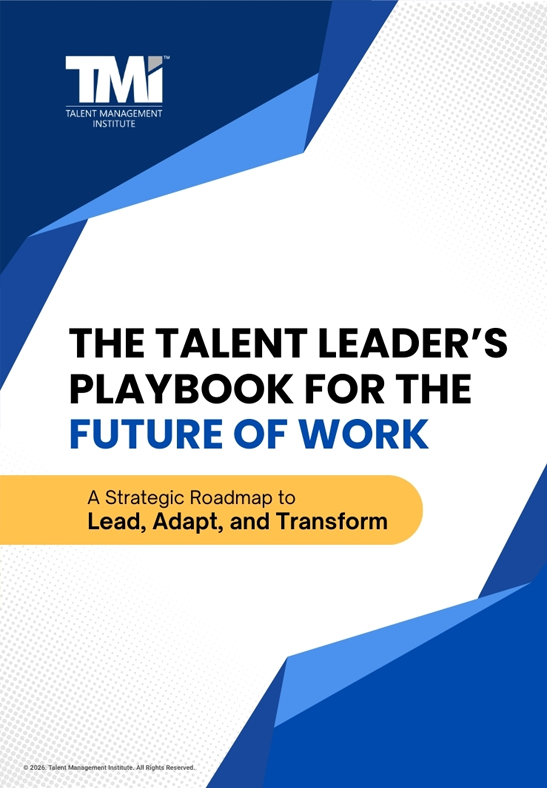

CredBadge™ is a proprietary, secure, digital badging platform that provides for seamless authentication and verification of credentials across digital media worldwide.
CredBadge™ powered credentials ensure that professionals can showcase and verify their qualifications and credentials across all digital platforms, and at any time, across the planet.

Please enter the License Number/Unique Credential Code of the certificant. Results will be displayed if the person holds an active credential from TMI.