We can't wait to hear from you
Connect
Discover how TMI credentials are designed to accelerate your career growth. Explore how TMI incorporates Talent Management into the practice and systems of Human Capital Management. Learn how you can steer your future confidently through TMI's research driven Talent Management standards. Fellow programs equip global HR professionals with the latest in Talent Management in the transformational way.
Explore how the TMP™, STMP™, and GTML™ credentials can take your HR career places, or add to the capabilities of your promising HR staff and leaders.
View CertificationsStrengthen your enterprise HR system by implementing the TMI-ETMS™ international standards.
Learn About TMI-ETMS™If you are interested in consulting, training or education, partner with TMI to join the global league of TMI aligned institutions, companies and industries.
Become a TMI PartnerLearn the latest about how Talent Management is transforming HR into a future oriented business hyperfunction.
Explore the TMI ApproachLearn the steps to earn your TMI certification, from application to successful completion and maintaining your credential.
TMI credentials include globally recognized digital badges, offering a portable and verifiable representation of your achievements.

Kickstart your Talent Management journey with TMI’s globally recognized certifications and resources to excel in your career.
Create myTMI Account TodayTMI Global and Associate Fellow programs turn HR professionals into global Talent Leaders who can drive growth with their superlative strategic ability, business perspective and readiness for change. Since 2024, more than 150 senior HR professionals and HR leaders from 46 global organizations across industries have completed these programs that establish new standards for the practice of talent management as a driver of organizational success and business competitiveness.
You can contact us here for more information.

TMI–ETMS10™ and TMI–ETMS14™ certified organizations are effective for restructuring Talent Management in an organization. With TMI, organizations are better, more agile and better prepared for challenges that are to come.
The TMI-Enterprise Talent Management Standards power enterprise HR with the latest in Talent Management.
To choose a TMI–ETMS™ version most appropriate for your organization!
Write to us via the contact form.

Partnering with TMI means building a powerful structure of Talent Management thought and practice resulting in business profits through standards, certifications and networks.
Get your HR staffers and managers TMI certified on Talent Management by adding TMI into your training regimen. One step toward embedding TMI credentials in your institutions curricula is to become a TMI-ETMS™ consulting partner. Join us to be a part of the groundbreaking work of Talent Management.

If you hold an elite international qualification in HR or a related discipline, possess a recognized HR credential, or studied HRM at a TMI-recognized institution, you may be eligible for an accelerated pathway to a TMI credential through QualiFly™ leading to TMP™, STMP™ or GTML™.
 Institutions
Explore Certification Bodies, Universities, B-Schools & Other Institutions recognized by TMI under the Q1, Q2, and Q3 Lists.
Check if your institution is recognized
TMI’s blogs cover the latest trends, insights, and best practices in HR and talent management.
Comprehensive guides covering talent development, HR metrics, key facts, and more.
Explore TMI's latest updates, announcements, news and press releases in our newsroom.
Strategic insights driving the future of talent, leadership, and global workforce excellence.
Dive into the inspiring journeys of TMI certification holders and learn how the certification has transformed their careers.
An Interview series featuring key advice from global talent leaders for future HR professionals.
TMI’s editorial team is comprised of researchers, writers, editors, proofreaders, and contributors with extensive experience in the HR and Talent Management space. The team scrupulously researches, analyzes and deliberates on each submission before concluding its suitability for our publications.

Your org chart is obsolete the moment you finish drawing it.
While businesses pivot quarterly, HR systems still run on annual cycles. While markets demand new capabilities overnight, companies take months to identify who has what skills. While employees crave growth and mobility, they're trapped in rigid job descriptions that haven't been updated in years.
With two-thirds of organizations redesigning their operating models in the past two years, it's clear that leaders recognize the urgent need for change.
The future of HR demands a new approach, one that treats skills as currency, leverages AI for real-time decision-making, and enables seamless talent mobility. This is the 2026 talent operating model: a framework designed to balance growth, resilience, and employee fulfillment across the entire talent lifecycle.
For decades, workforce planning followed a simple formula: define roles → post jobs → hire talent → occasionally reskill. This worked when business cycles were predictable, and job roles remained stable. That world no longer exists.
Modern organizations face:
Five Critical Breakdowns:
Traditional hierarchies fail to reflect how work actually happens. Employees have multiple roles and contribute to cross-functional projects, but rigid org charts don't capture this fluidity. The result? Misaligned workforce planning and underutilized capability.
Workforce decisions rely on outdated spreadsheets, infrequent surveys, or disconnected HR systems. Organizations lack real-time insight into who has what skills, how those skills evolve, or where gaps exist. This leads to reactive hiring and over-reliance on external consultants.
Workforce planning remains a siloed, annual process disconnected from real-time business demand. There's no intelligent bridge between upcoming project needs and available internal talent, resulting in unfilled critical roles and missed opportunities.
Despite growing awareness around internal mobility, most organizations lack infrastructure to facilitate it at scale. Employees don't know what roles they can move into, and systems don't match people to opportunities based on evolving skill adjacency.
Decisions around upskilling versus hiring are based on gut feeling, not data. Without understanding real-time proficiency levels and market benchmarks, organizations invest in the wrong places.
In 2026, leading organizations will run on a new model where skills are the currency, AI powers real-time decisions, and roles evolve as fast as the market. This five-part framework shows exactly how top companies will attract, deploy, and grow talent to stay ahead.
In 2026, successful organizations will treat skills, not roles or resumes, as the primary unit of workforce value. This fundamental shift enables:
This represents a core element of the modern talent strategy, moving away from static job descriptions toward dynamic skill portfolios.
The modern workforce functions like a live, responsive network rather than a static structure. The new operating model resembles a supply chain where:
AI enables predictive demand modeling, validates fulfillment probability, and orchestrates movement to maximize utilization.
Roles are no longer fixed. The skills required for the same job evolve year-over-year, sometimes month-over-month.
Titles and responsibilities update themselves as the market moves.
AI drives real-time decisions on whether to upskill existing employees or hire externally, helping organizations:
Live skill inventories enable HR and business leaders to act with clarity and speed.
In a 2026-ready workforce, mobility is critical. Talent movement across roles, projects, and functions signals organizational resilience.
Stagnation is now a red flag. Healthy organizations move people constantly.
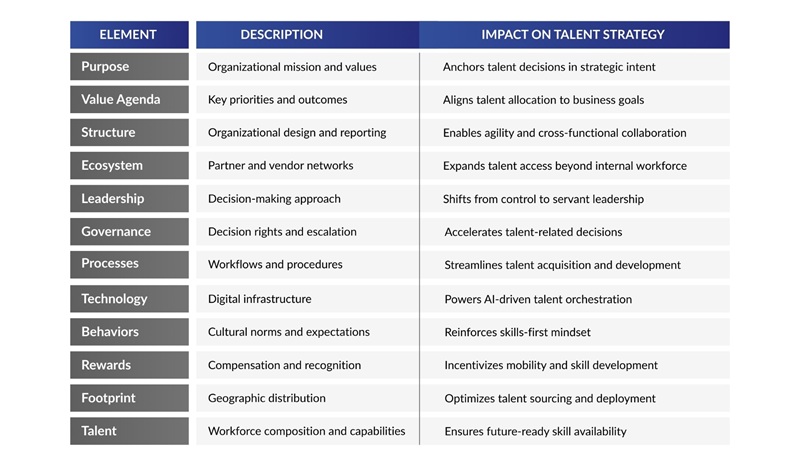
Successful operating models comprise 12 interlocking elements that create a holistic system:
Effective operating models deliver four measurable outcomes:
You don't need to overhaul your entire workforce system overnight. The smartest organizations take a phased approach to workforce transformation.
The foundation of any modern talent operating model is making skills visible across roles, functions, geographies, and business units. This requires moving beyond self-reported skills or resume-based mapping, which quickly becomes outdated and unreliable.
Instead, organizations should leverage AI to continuously update and validate skills based on project contributions, certifications, peer reviews, learning journeys, and external labor market signals.
By classifying employees into granular skill levels defined as expert, advanced, and proficient, organizations gain an accurate, living view of capability across the enterprise.
Once skill visibility is established, the next step is syncing workforce planning with business needs through integrated demand forecasting. This phase addresses critical questions:
AI can handle this autonomously, modeling demand scenarios and offering fulfillment plans based on real-time availability, capacity, and job-fit scores. This moves talent planning from reactive scrambling to predictive capability, allowing organizations to anticipate needs and prepare talent before skill gaps become urgent.
With visibility and forecasting in place, organizations can build a skills-based internal marketplace that fundamentally changes how employees navigate their careers. This means matching employees to roles, projects, and mentorships based on evolving skill graphs rather than traditional career ladders, enabling lateral movement as easily as promotions, and surfacing best-fit opportunities automatically while aligning with strategic workforce priorities.
This phase is critical for the HR operating model evolution, shifting from manual career planning, which is slow, subjective, and often limited by individual managers' networks, to automated, AI-driven opportunity matching that democratizes access to growth and maximizes the utilization of existing talent.
The fourth phase enables talent movement across functions and business units, transforming organizational structure from a rigid pyramid into a flexible mesh. This approach prevents siloed decision-making, reduces time-to-fill for critical roles, and turns idle capacity into productive output.
Cross-unit redeployment requires breaking down traditional barriers between departments and empowering talent to flow where it's needed most. Rather than each function hoarding its people and building redundant capabilities, the organization operates as a dynamic talent network where skills and capacity are shared strategically across the enterprise.
The final phase replaces vanity HR metrics with value-driven KPIs that actually reflect organizational capability and efficiency. Critical metrics include skill fill rate, which measures how often roles are fulfilled with internal talent. These metrics become the heartbeat of your talent strategy, providing concrete indicators of whether the operating model is delivering business value and enabling continuous improvement based on data rather than intuition.
Before embarking on an operating model redesign, assess your readiness:
Review recent strategic plans and identify where goals weren't fully achieved. Determine root causes for these gaps.
Define desired future performance across clarity, speed, skills, and commitment. Create accountability for key initiatives.
Assess all 12 operating model elements. Identify inconsistencies and areas where poor execution limits effectiveness.
Evaluate the degree of change required and determine factors that could prevent effective implementation.
Take stock of how leaders (including middle managers) need to lead in the new model and demonstrate required behavior shifts.
Even the best talent operating models fail without strong execution. These four common mistakes can derail progress fast. Here’s what to watch out for and how to get it right:
Many leaders focus on structural redesigns while ignoring other critical elements. While 89% of organizations still use traditional hierarchical structures, structure alone doesn't determine organizational fitness.
Technology and processes are easier to change than culture and behaviors. However, without addressing leadership style, rewards, and behaviors, even the best structural design will fail.
Organizations frequently redesign their operating models, half plan to embark on a redesign in the next two years, but many leave value on the table due to poor implementation.
Workforce transformation requires buy-in and active participation from business leaders, not just HR. The most successful implementations involve cross-functional teams from the start.
By 2026, organizations that adopt this model will:
The 2026 talent operating model is already taking shape. Organizations that begin today by making skills visible, aligning supply with demand, and enabling smart mobility will not only weather uncertainty but thrive through it.
The future of HR is powered by AI, grounded in skills, and centered on value creation. The operating model you build today determines the business advantage you unlock tomorrow.
Don't wait for the perfect moment or complete clarity. Start with Phase 1, establishing skill visibility, and build momentum from there. The transformation journey may span months or years, but every step forward creates tangible value and positions your organization for long-term success.

Uncover the trends redefining workforce strategy, the skills shaping next-generation CHROs, and strategies to drive lasting impact. Explore insights and assess your readiness to lead the future of talent.
Download the Guide

CredBadge™ is a proprietary, secure, digital badging platform that provides for seamless authentication and verification of credentials across digital media worldwide.
CredBadge™ powered credentials ensure that professionals can showcase and verify their qualifications and credentials across all digital platforms, and at any time, across the planet.

Please enter the License Number/Unique Credential Code of the certificant. Results will be displayed if the person holds an active credential from TMI.