We can't wait to hear from you
Connect
Discover how TMI credentials are designed to accelerate your career growth. Explore how TMI incorporates Talent Management into the practice and systems of Human Capital Management. Learn how you can steer your future confidently through TMI's research driven Talent Management standards. Fellow programs equip global HR professionals with the latest in Talent Management in the transformational way.
Explore how the TMP™, STMP™, and GTML™ credentials can take your HR career places, or add to the capabilities of your promising HR staff and leaders.
View CertificationsStrengthen your enterprise HR system by implementing the TMI-ETMS™ international standards.
Learn About TMI-ETMS™If you are interested in consulting, training or education, partner with TMI to join the global league of TMI aligned institutions, companies and industries.
Become a TMI PartnerLearn the latest about how Talent Management is transforming HR into a future oriented business hyperfunction.
Explore the TMI ApproachLearn the steps to earn your TMI certification, from application to successful completion and maintaining your credential.
TMI credentials include globally recognized digital badges, offering a portable and verifiable representation of your achievements.

Kickstart your Talent Management journey with TMI’s globally recognized certifications and resources to excel in your career.
Create myTMI Account TodayTMI Global and Associate Fellow programs turn HR professionals into global Talent Leaders who can drive growth with their superlative strategic ability, business perspective and readiness for change. Since 2024, more than 150 senior HR professionals and HR leaders from 46 global organizations across industries have completed these programs that establish new standards for the practice of talent management as a driver of organizational success and business competitiveness.
You can contact us here for more information.

TMI–ETMS10™ and TMI–ETMS14™ certified organizations are effective for restructuring Talent Management in an organization. With TMI, organizations are better, more agile and better prepared for challenges that are to come.
The TMI-Enterprise Talent Management Standards power enterprise HR with the latest in Talent Management.
To choose a TMI–ETMS™ version most appropriate for your organization!
Write to us via the contact form.

Partnering with TMI means building a powerful structure of Talent Management thought and practice resulting in business profits through standards, certifications and networks.
Get your HR staffers and managers TMI certified on Talent Management by adding TMI into your training regimen. One step toward embedding TMI credentials in your institutions curricula is to become a TMI-ETMS™ consulting partner. Join us to be a part of the groundbreaking work of Talent Management.

If you hold an elite international qualification in HR or a related discipline, possess a recognized HR credential, or studied HRM at a TMI-recognized institution, you may be eligible for an accelerated pathway to a TMI credential through QualiFly™ leading to TMP™, STMP™ or GTML™.
 Institutions
Explore Certification Bodies, Universities, B-Schools & Other Institutions recognized by TMI under the Q1, Q2, and Q3 Lists.
Check if your institution is recognized
TMI’s blogs cover the latest trends, insights, and best practices in HR and talent management.
Comprehensive guides covering talent development, HR metrics, key facts, and more.
Explore TMI's latest updates, announcements, news and press releases in our newsroom.
Strategic insights driving the future of talent, leadership, and global workforce excellence.
Dive into the inspiring journeys of TMI certification holders and learn how the certification has transformed their careers.
An Interview series featuring key advice from global talent leaders for future HR professionals.
TMI’s editorial team is comprised of researchers, writers, editors, proofreaders, and contributors with extensive experience in the HR and Talent Management space. The team scrupulously researches, analyzes and deliberates on each submission before concluding its suitability for our publications.

Human Resources departments face a choice that defines their organizational relevance. Continue processing paperwork, managing compliance, and reacting to problems, or become strategic partners who shape culture, develop talent, and drive measurable business results.
More than 80% of CHROs now see their number one priority as aligning talent strategy with business goals, according to recent research. The gap between those two approaches determines whether HR adds value or merely incurs costs.
Making this transition requires rebuilding workflows, developing new capabilities, and fundamentally changing how HR professionals think about their work. This article is for HR leaders, CHROs, and business leaders who want HR to drive outcomes, not just manage processes.
Transactional HR focuses on executing administrative tasks efficiently. The core activities center on payroll processing, benefits administration, employee records, and legal compliance. Performance lives in metrics like time to process forms, payroll accuracy, and help desk ticket closure speed.
This operational focus served organizations when business changed slowly and workforce management meant following established procedures. HR professionals operated as policy custodians, interpreting rules and ensuring compliance. The value proposition was simple: keep things running smoothly, avoid legal problems, minimize costs.
The limitations emerge when business conditions shift rapidly. Transactional HR reacts to problems after they surface rather than anticipating them. It lacks visibility into whether the organization has the right capabilities for future needs. When HR spends most of its time on administrative work, strategic questions go unanswered. Which roles are becoming obsolete? What skills are rising in demand? Who is ready to lead or pivot to new responsibilities?
Strategic HR aligns people’s practices with business objectives. HR professionals must understand competitive dynamics, financial drivers, and market trends. They participate in discussions about organizational direction, contribute workforce capability insights, and design programs that directly support business outcomes.
The contrast with transactional HR becomes clear when you compare how each model operates across the same dimensions:
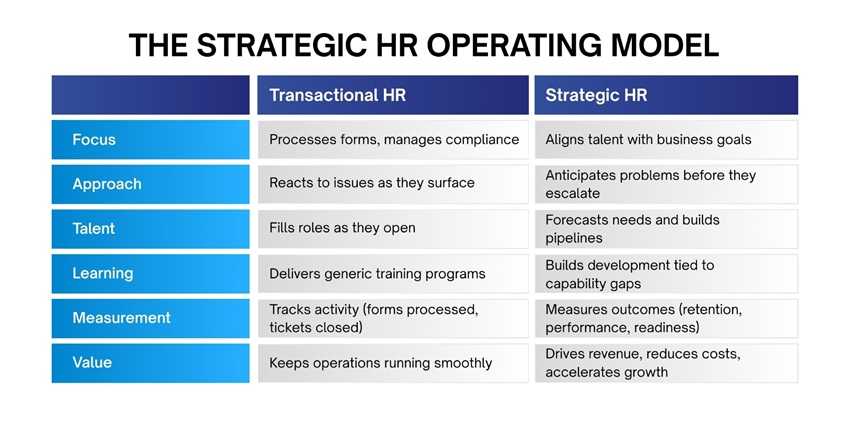
The operating model shifts from reactive to proactive. Instead of waiting for managers to report problems, strategic HR uses data to identify issues before they escalate. Instead of generic training programs, it builds development journeys tied to specific capability gaps. Instead of filling roles as they open, it forecasts talent needs and builds pipelines in advance.
This requires different workflows, skills, and relationships. HR professionals need business acumen for leadership conversations about strategy, analytical capabilities to translate workforce data into insights, and change management skills to guide organizations through transitions.
The value proposition changes fundamentally. Strategic HR demonstrates how people practices drive revenue growth, reduce costs, improve quality, or accelerate innovation through clear connections between HR initiatives and business metrics.
Reorganizing HR isn’t a chart exercise. The real work is structural, cultural, and behavioral. It requires rebuilding how HR operates from the ground up.
Transactional HR focuses on efficiency and compliance. Consultative HR requires different capabilities: translating business strategy into workforce requirements, using data to predict future needs rather than just reporting past results, partnering with leaders on outcomes rather than just delivering services, and measuring impact on business results rather than just activity completion.
HR functions operating as strategic partners contribute more directly to organizational performance and leadership effectiveness than those confined to administrative roles. However, you cannot simply assign this capability through reorganization. You must build it intentionally and consistently.
The transformation demands fundamental changes in how HR professionals spend their time. Less time answering routine questions that self-service systems could handle. More time analyzing workforce trends and advising leaders on talent decisions. Less time administering programs designed elsewhere. More time designing interventions that address specific business challenges.
The shift from transactional to strategic requires redesigning how workflows through HR. Automation handles routine tasks. Self-service portals let employees access information without HR intervention. Chatbots resolve routine employee inquiries without HR intervention.
Over 70% of companies have already adopted AI in at least one HR process, according to Deloitte research. This frees HR professionals for work requiring judgment, relationship building, and strategic thinking.
New workflows emerge around talent intelligence and workforce planning. HR teams use analytics to predict turnover, identify skill gaps, and spot high performers needing development. They build dashboards showing workforce metrics alongside business metrics.
Recruiting shifts from filling requisitions to building talent pipelines. Performance management moves from annual reviews to continuous feedback. Learning programs evolve from generic courses to personalized development journeys aligned with business needs.
These workflow changes require different tools and skills. HR professionals need comfort with data analysis, extracting insights from workforce metrics and translating them into recommendations.
The structure of the HR function signals whether it can operate strategically. Traditional HR organizations group people by specialty: recruiting, benefits, training. Each operates independently, optimizing their own processes.
Strategic HR often reorganizes business units or customer segments. HR business partners align with specific divisions, building a deep understanding of their challenges. They coordinate specialists who provide expertise in recruiting, compensation, or analytics.
The business partner role becomes central. These professionals sit between business leaders and HR specialists, translating business needs into people solutions. They participate in leadership meetings, contribute to strategic planning, and coordinate HR interventions addressing business priorities.
Centers of excellence concentrate deep expertise within specific HR disciplines. They develop best practices, design programs, and provide specialized support to business partners. Shared services handle routine transactions efficiently through standardized processes and technology.
This three-part model - business partners, centers of excellence, and shared services - has become common in strategic HR. However, structure alone doesn’t create strategic capability. Culture, skills, and leadership must support it.
One of the most defining features of strategic HR is how it redefines the relationship between HR professionals and the managers they support. A consultative HR function doesn’t take ownership away from leaders. It strengthens their capacity to lead. That means coaching managers through difficult conversations rather than having those conversations for them, providing frameworks and tools that guide decision making rather than making decisions for managers, and clarifying when issues require HR involvement versus manager ownership.
Too often, HR becomes a dumping ground for management responsibilities. Managers hand off performance problems, conflict resolution, and culture building to HR rather than addressing these as core leadership work. This dependency undermines both management’s effectiveness and HR’s strategic capacity.
Strategic HR helps managers develop capability to handle people challenges themselves. It offers training, coaching, and resources that build management skills. It intervenes when policy, legal, or systemic issues require HR expertise. But it resists taking accountability that belongs with line managers.
Maintaining this boundary requires ongoing effort and clear communication. HR must listen deeply to leaders, understand operational realities, and align people strategies with mission and results. At the same time, partnership does not mean abdication. Leaders remain responsible for culture, conduct, and performance.
Holding that line - supportive yet firm - how HR earns credibility and influence. Effective leaders must know when to lead and when to follow. HR must lead when values, policy, or legal requirements are at stake. HR must follow when operational decisions belong with business leaders who carry accountability for results.
Demonstrating business value requires different metrics than transactional HR uses. Activity measures like time to fill positions or training hours delivered matter less than outcome measures like quality of hire, retention of high performers, time to productivity for new employees, and skill readiness for future roles.
The best metrics connect HR initiatives to business results. Does leadership development correlate with better team performance? Do engagement improvements predict lower turnover and higher productivity? Does workforce planning reduce critical skill shortages that delay projects?
Making these connections requires integrating HR data with business data. Track whether divisions with higher engagement scores show better financial performance. Monitor whether teams with more development hours innovate faster. Measure whether better hiring processes improve customer satisfaction scores.
This evidence-based approach raises HR’s credibility with business leaders who make decisions based on data. It also enables continuous improvement by showing which interventions work and which don’t. Knowing what to measure, however, only matters if the broader transformation is executed with discipline and consistency.
HR transformation is ongoing work requiring discipline, consistency, and leadership presence. It demands uncomfortable conversations and sustained accountability.
Gartner research shows companies that invest in employee experience see up to 25% lower turnover and 20% higher performance. These results emerge from changed workflows, developed capabilities, rebuilt trust, and clear accountability.
Organizations serious about strategic HR must invest in upskilling current staff, selectively hiring new capabilities, deploying technology enabling automation and analytics, redesigning workflows for strategic work, building partnerships with business leaders, and measuring impact on business outcomes.
The outcome includes a credible HR function that leaders seek out, capable managers handling people challenges effectively, engaged employees contributing their best work, and culture grounded in trust and performance.
This represents the critical focus of strategic HR transformation. The shift requires moving beyond forms and reactive problem solving toward talent strategy, data-driven decisions, and proactive business partnership. Organizations that make this shift successfully create HR functions that drive results through superior talent management, faster capability development, and stronger organizational culture.

Uncover the trends redefining workforce strategy, the skills shaping next-generation CHROs, and strategies to drive lasting impact. Explore insights and assess your readiness to lead the future of talent.
Download the Guide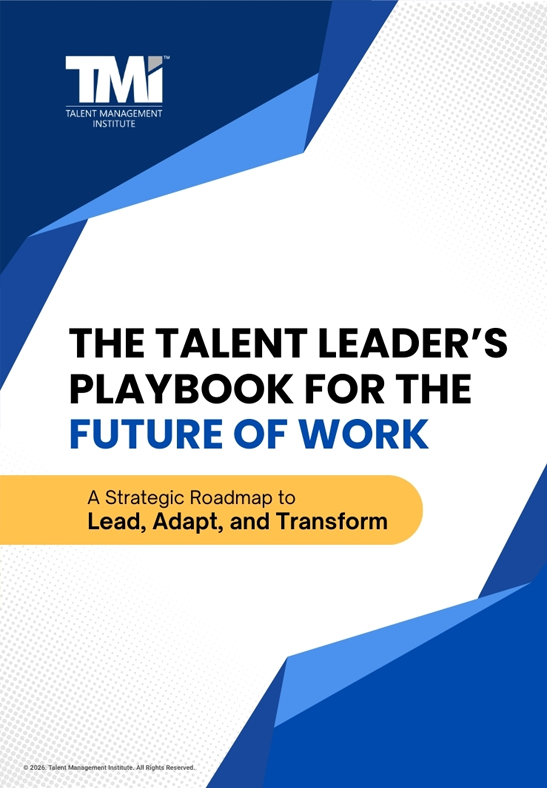

CredBadge™ is a proprietary, secure, digital badging platform that provides for seamless authentication and verification of credentials across digital media worldwide.
CredBadge™ powered credentials ensure that professionals can showcase and verify their qualifications and credentials across all digital platforms, and at any time, across the planet.

Please enter the License Number/Unique Credential Code of the certificant. Results will be displayed if the person holds an active credential from TMI.