We can't wait to hear from you
Connect
Discover how TMI credentials are designed to accelerate your career growth. Explore how TMI incorporates Talent Management into the practice and systems of Human Capital Management. Learn how you can steer your future confidently through TMI's research driven Talent Management standards. Fellow programs equip global HR professionals with the latest in Talent Management in the transformational way.
Explore how the TMP™, STMP™, and GTML™ credentials can take your HR career places, or add to the capabilities of your promising HR staff and leaders.
View CertificationsStrengthen your enterprise HR system by implementing the TMI-ETMS™ international standards.
Learn About TMI-ETMS™If you are interested in consulting, training or education, partner with TMI to join the global league of TMI aligned institutions, companies and industries.
Become a TMI PartnerLearn the latest about how Talent Management is transforming HR into a future oriented business hyperfunction.
Explore the TMI ApproachLearn the steps to earn your TMI certification, from application to successful completion and maintaining your credential.
TMI credentials include globally recognized digital badges, offering a portable and verifiable representation of your achievements.

Kickstart your Talent Management journey with TMI’s globally recognized certifications and resources to excel in your career.
Create myTMI Account TodayTMI Global and Associate Fellow programs turn HR professionals into global Talent Leaders who can drive growth with their superlative strategic ability, business perspective and readiness for change. Since 2024, more than 150 senior HR professionals and HR leaders from 46 global organizations across industries have completed these programs that establish new standards for the practice of talent management as a driver of organizational success and business competitiveness.
You can contact us here for more information.

TMI–ETMS10™ and TMI–ETMS14™ certified organizations are effective for restructuring Talent Management in an organization. With TMI, organizations are better, more agile and better prepared for challenges that are to come.
The TMI-Enterprise Talent Management Standards power enterprise HR with the latest in Talent Management.
To choose a TMI–ETMS™ version most appropriate for your organization!
Write to us via the contact form.

Partnering with TMI means building a powerful structure of Talent Management thought and practice resulting in business profits through standards, certifications and networks.
Get your HR staffers and managers TMI certified on Talent Management by adding TMI into your training regimen. One step toward embedding TMI credentials in your institutions curricula is to become a TMI-ETMS™ consulting partner. Join us to be a part of the groundbreaking work of Talent Management.

If you hold an elite international qualification in HR or a related discipline, possess a recognized HR credential, or studied HRM at a TMI-recognized institution, you may be eligible for an accelerated pathway to a TMI credential through QualiFly™ leading to TMP™, STMP™ or GTML™.
 Institutions
Explore Certification Bodies, Universities, B-Schools & Other Institutions recognized by TMI under the Q1, Q2, and Q3 Lists.
Check if your institution is recognized
TMI’s blogs cover the latest trends, insights, and best practices in HR and talent management.
Comprehensive guides covering talent development, HR metrics, key facts, and more.
Explore TMI's latest updates, announcements, news and press releases in our newsroom.
Strategic insights driving the future of talent, leadership, and global workforce excellence.
Dive into the inspiring journeys of TMI certification holders and learn how the certification has transformed their careers.
An Interview series featuring key advice from global talent leaders for future HR professionals.

TMI’s editorial team is comprised of researchers, writers, editors, proofreaders, and contributors with extensive experience in the HR and Talent Management space. The team scrupulously researches, analyzes and deliberates on each submission before concluding its suitability for our publications.

Picture two workplaces. In the first, employees feel heard, collaboration flows naturally, and innovation thrives. In the second, decisions happen behind closed doors, ideas get dismissed, and leadership feels distant. Research shows the difference often comes down to transformational leadership, a style where women naturally excel.
Women hold 29% of C-suite positions, up from just 17% in 2015, according to McKinsey research. Progress is happening, yet a significant gap remains. While women occupy 40% of C-suite roles in Fortune 500 companies, only 10% serve as CEOs. Women of color represent less than 1% of Fortune 500 CEOs.
The disparity becomes more puzzling when data reveals what women leaders actually deliver. Organizations with gender-diverse executive teams have a 39% greater likelihood of financial outperformance, based on research across 1,265 companies in 23 countries.
Let’s discuss why organizations continue missing out on the measurable benefits women leaders provide.
Transformational leadership focuses on inspiring and empowering rather than commanding and controlling. This approach doesn't rely on positional authority. Instead, it builds on a leader's ability to uplift, engage, and drive lasting change.
Women naturally excel in this style through specific behaviors. They create workplaces where employees feel valued, heard, and motivated. Studies show people perform better when they feel supported, and female leaders cultivate this environment instinctively.
They encourage teamwork, shared problem solving, and inclusive decision making, leading to more innovative solutions. They don't just manage; they coach, develop, and champion others, creating future leaders instead of followers. They bring a mission-driven mindset, ensuring employees feel connected to a bigger vision rather than just a paycheck.
A Pew Research study revealed that women either outperform or match men in nearly every essential leadership trait. Women were rated more honest (50% versus 20%), more intelligent (38% compared to 14% for men), and higher in compassion, creativity, and fairness. The only category where men slightly ranked higher was decisiveness, yet decisiveness alone doesn't make great leaders.
These translate into specific workplace improvements that drive measurable business results.
When a senior executive named Lisa took over a struggling tech company department, she inherited low morale, disengagement, and high turnover. Productivity had stalled. Employees felt undervalued. Rather than enforcing rigid policies or issuing top-down demands, Lisa took a transformational approach.
She mentored employees individually, ensuring they felt heard. She fostered a collaborative culture, encouraging team input in decision making. Most importantly, she helped her team connect to a greater purpose, aligning their work with the company's mission. Employee satisfaction soared, turnover dropped, and productivity skyrocketed.
Lisa's story represents a pattern of research confirms repeatedly. Teams with more women demonstrate higher collective intelligence, meaning they make better decisions, communicate more effectively, and solve problems faster, according to research by Dr. Anita Williams Woolley.
A study revealed that employees expect fairer treatment and greater transparency in women-led organizations. When leadership is equitable and inclusive, workplace culture thrives. Companies with more female leaders experience lower turnover, higher employee satisfaction, and stronger commitment to company goals.
When corporate boards have more than a quarter of women on their executive committees, they realize profit margins of 16%, according to a World Economic Forum analysis. The mechanisms connecting women's leadership to better outcomes are clear and documented. One key area where women leaders influence organizations is in boardroom decision-making.
When women serve as board directors, they change how decisions get made. They ask more questions and seek multiple opinions to fully understand situations before deciding. This thoroughness adds significant value to boardrooms where quick consensus can mask poor thinking.
Traditional leadership often centralizes decision making at the top. Women leaders recognize that the best solutions emerge from diverse perspectives and collective wisdom. They create environments where team members feel empowered to contribute ideas and participate in decisions affecting their work.
This approach builds trust, increases buy-in and leads to better outcomes. When people participate in decisions, they become more invested in success. The shift from directive to collaborative decision-making changes organizational dynamics fundamentally.
Research shows diverse teams make better decisions 87% of the time. Beyond just being diverse, these teams need active HR leadership that nurtures environments where every voice counts. Women leaders excel at creating these conditions.
Effective Leaders navigate polarities. They must be confident, yet humble, decisive, and yet empowering. Women who reach the CEO role have mastered five critical balances.
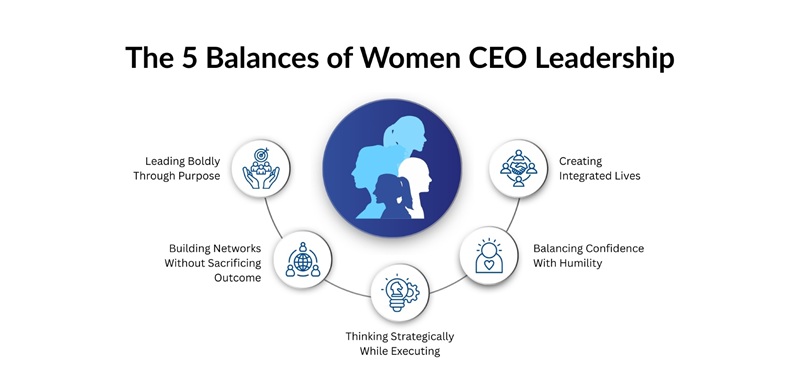
Women CEOs ground vision in purpose rather than ego. They care about long-term impact on employees, customers, and communities. One infrastructure CEO explains she thrives "when I'm working with a team to set a clear vision and relentlessly pursue it."
This purpose-driven approach addresses a challenge women face. Women are 2.1 times more likely than men to be described as overly ambitious, yet equally likely to be seen as lacking ambition, revealing cultural biases women navigate.
Women tend to score higher on people orientation. This relational leadership becomes a superpower when harnessed to serve organizations. The CEO role requires making tough decisions and leveraging relationships strategically.
Women often rise by focusing on execution. The trap? Great executors may become trapped in day-to-day delivery rather than being seen as visionaries. When reaching the top chair, women must leverage strengths as strategic thinkers while being seen as doing so.
Women who prioritize humility can find confidence takes a hit when they're the only woman in the room. One CEO realized questions lingered about whether she was hired because she was a woman. "We have to do so much more to get the same assessment as a male counterpart," she notes.
Women leaders sustain demanding roles by creating integrated lives. "You cannot have it all," says one CEO. "If you are leaning in, you are also leaning away."
If women possess leadership skills, drive business success, and foster stronger teams, why are they still vastly underrepresented at the top? The answer lies in deeply ingrained societal bias that subtly and sometimes overtly resists women stepping into power positions.
Misogyny remains entrenched in workplace culture. It's woven into workplace culture, hiring decisions, and leadership norms. It manifests in unconscious bias, double standards, and outright resistance against female authority.
Women are scrutinized more harshly, labeled "too emotional" if they lead with empathy or "too aggressive" if they assert themselves. The same qualities making men "strong leaders" frequently get used to discredit women.
This bias doesn't just shape individual experiences. It shapes institutional structures favoring men's advancement. Sponsorship opportunities, leadership pipelines, and networking circles remain male-dominated, making it harder for women to gain access to decision-making roles.
Men are more likely to be promoted based on potential, while women must prove themselves repeatedly before being considered for leadership. Barriers exist especially for women of color, LGBTQ+ women, and those with disabilities, who face greater challenges in career advancement.
Breaking these barriers requires systematic change. Organizations must actively implement bias training, mentorship programs, and sponsorship initiatives advocating for women's career progression. HR leadership evaluations should focus on performance over perceptions, ensuring women's contributions get recognized and rewarded.
Identifying and elevating women leaders early creates stronger, more diverse teams. Going beyond mentorship to champion sponsorship matters because women need more than guidance. They need advocates in power ensuring they're seen and promoted.
When male executives champion women's careers, they advance faster. Effective allyship cultivates genuine opportunities. Investing in leadership programs and industry networks gives women tools to thrive and lead boldly.
Having diversity at the top strengthens a company's talent pipeline, particularly for attracting Gen Z workers. More than half of this generation's workers said they wouldn't accept roles in companies lacking diverse leadership.
Organizations with diverse leadership create greater social impact, contributing positively to communities and environments. They tend to have more satisfied workforces. When leadership teams are diverse, they drive innovation and adaptability.
Women bring collaboration, trust, and innovation to leadership, creating workplaces that thrive. Yet barriers remain that must be intentionally dismantled through awareness, action, and commitment.
Organizations, decision makers, and individuals all have roles in challenging bias, advocating for inclusion, and ensuring leadership is built on talent rather than outdated perceptions.
The time to act is now. Creating a future where leaders rise because of ability rather than gender requires investment from everyone. The women who've broken through without losing authenticity of their leadership style provide roadmaps others can follow.
Their success proves that women's natural inclinations toward transformational leadership, relational skills, strategic thinking, and purpose-driven vision aren't limitations. They're exactly what organizations need to navigate complexity, drive innovation, and deliver sustainable results.
The business case for women in leadership has been proven repeatedly across industries and time periods. What remains is translating that evidence into action that creates real opportunities for women to lead at every level.

Uncover the trends redefining workforce strategy, the skills shaping next-generation CHROs, and strategies to drive lasting impact. Explore insights and assess your readiness to lead the future of talent.
Download the Guide

CredBadge™ is a proprietary, secure, digital badging platform that provides for seamless authentication and verification of credentials across digital media worldwide.
CredBadge™ powered credentials ensure that professionals can showcase and verify their qualifications and credentials across all digital platforms, and at any time, across the planet.

Please enter the License Number/Unique Credential Code of the certificant. Results will be displayed if the person holds an active credential from TMI.