We can't wait to hear from you
Connect
Discover how TMI credentials are designed to accelerate your career growth. Explore how TMI incorporates Talent Management into the practice and systems of Human Capital Management. Learn how you can steer your future confidently through TMI's research driven Talent Management standards. Fellow programs equip global HR professionals with the latest in Talent Management in the transformational way.
Explore how the TMP™, STMP™, and GTML™ credentials can take your HR career places, or add to the capabilities of your promising HR staff and leaders.
View CertificationsStrengthen your enterprise HR system by implementing the TMI-ETMS™ international standards.
Learn About TMI-ETMS™If you are interested in consulting, training or education, partner with TMI to join the global league of TMI aligned institutions, companies and industries.
Become a TMI PartnerLearn the latest about how Talent Management is transforming HR into a future oriented business hyperfunction.
Explore the TMI ApproachLearn the steps to earn your TMI certification, from application to successful completion and maintaining your credential.
TMI credentials include globally recognized digital badges, offering a portable and verifiable representation of your achievements.

Kickstart your Talent Management journey with TMI’s globally recognized certifications and resources to excel in your career.
Create myTMI Account TodayTMI Global and Associate Fellow programs turn HR professionals into global Talent Leaders who can drive growth with their superlative strategic ability, business perspective and readiness for change. Since 2024, more than 150 senior HR professionals and HR leaders from 46 global organizations across industries have completed these programs that establish new standards for the practice of talent management as a driver of organizational success and business competitiveness.
You can contact us here for more information.

TMI–ETMS10™ and TMI–ETMS14™ certified organizations are effective for restructuring Talent Management in an organization. With TMI, organizations are better, more agile and better prepared for challenges that are to come.
The TMI-Enterprise Talent Management Standards power enterprise HR with the latest in Talent Management.
To choose a TMI–ETMS™ version most appropriate for your organization!
Write to us via the contact form.

Partnering with TMI means building a powerful structure of Talent Management thought and practice resulting in business profits through standards, certifications and networks.
Get your HR staffers and managers TMI certified on Talent Management by adding TMI into your training regimen. One step toward embedding TMI credentials in your institutions curricula is to become a TMI-ETMS™ consulting partner. Join us to be a part of the groundbreaking work of Talent Management.

If you hold an elite international qualification in HR or a related discipline, possess a recognized HR credential, or studied HRM at a TMI-recognized institution, you may be eligible for an accelerated pathway to a TMI credential through QualiFly™ leading to TMP™, STMP™ or GTML™.
 Institutions
Explore Certification Bodies, Universities, B-Schools & Other Institutions recognized by TMI under the Q1, Q2, and Q3 Lists.
Check if your institution is recognized
TMI’s blogs cover the latest trends, insights, and best practices in HR and talent management.
Comprehensive guides covering talent development, HR metrics, key facts, and more.
Explore TMI's latest updates, announcements, news and press releases in our newsroom.
Strategic insights driving the future of talent, leadership, and global workforce excellence.
Dive into the inspiring journeys of TMI certification holders and learn how the certification has transformed their careers.
An Interview series featuring key advice from global talent leaders for future HR professionals.
TMI’s editorial team is comprised of researchers, writers, editors, proofreaders, and contributors with extensive experience in the HR and Talent Management space. The team scrupulously researches, analyzes and deliberates on each submission before concluding its suitability for our publications.

Most managers have created at least one employee development plan that looked thorough on paper and achieved very little in practice. Goals were too broad to measure, check-ins were rescheduled and eventually dropped, and the plan became a document rather than a process. The employee moved on, and the organization went back to relying on instinct rather than structure to manage growth.
According to Gallup research, companies that invest strategically in employee training report 11% greater profitability and are twice as likely to retain their employees. 48% of American workers say they would switch jobs if offered better skills training opportunities, and 94% of employees say they would stay longer at a company that invested in their learning. These are retention problems with a development solution, and the gap between organizations that address this well and those that treat development as an annual paperwork exercise is widening.
This guide covers how to create an employee development plan that is grounded in data, tied to business goals, and built to survive the competing demands of real working life.
An employee development plan is a structured, living document that aligns an individual’s growth goals with what the business actually needs from that person over the next six to twelve months. It defines where someone is now, where they are headed, what they need to develop to get there, and how both the manager and the employee will stay accountable along the way.
What it is not is a list of training courses to complete or a performance improvement document dressed up as a growth plan. The distinction matters because plans built around completion metrics rather than genuine capability development tend to generate activity without outcomes. Employees finish modules, managers tick boxes, and nothing changes in how the work actually gets done.
The most effective career development plans treat growth as embedded in daily work, through stretch assignments, real-time coaching, peer learning, and targeted formal training used selectively where it fills a specific gap.
The structural reasons behind failed development plans are consistent and largely preventable. Understanding them before building a plan is more useful than troubleshooting after the fact.
Goals are too vague to act on. "Improve leadership skills" gives neither the employee nor the manager a clear picture of what success looks like or how to get there. Goals need to specify what will change, how it will be measured, and when.
Plans contain too many priorities. Overloading a development plan with five or six development areas is a reliable way to ensure none of them receive adequate attention. One to three priorities per quarter is a more productive approach, concentrating effort where it matters most.
Managers are often too stretched to meaningfully support development. In a survey by Wrike, 98% of managers spend 40% to 87% of their work week on communications alone, leaving limited capacity for developmental conversations. Development plans that require separate processes and additional meetings are most likely to be deprioritized as workload increases.
Check-ins stop after the initial planning meeting. Development is a continuous process, and plans that are created in January and reviewed in December have effectively been dormant for eleven months. Monthly micro-check-ins focused on specific skill progress, embedded into existing one-on-one meetings, sustain momentum without adding to anyone’s calendar burden.
Follow these six practical steps to create development plans that actually deliver results.
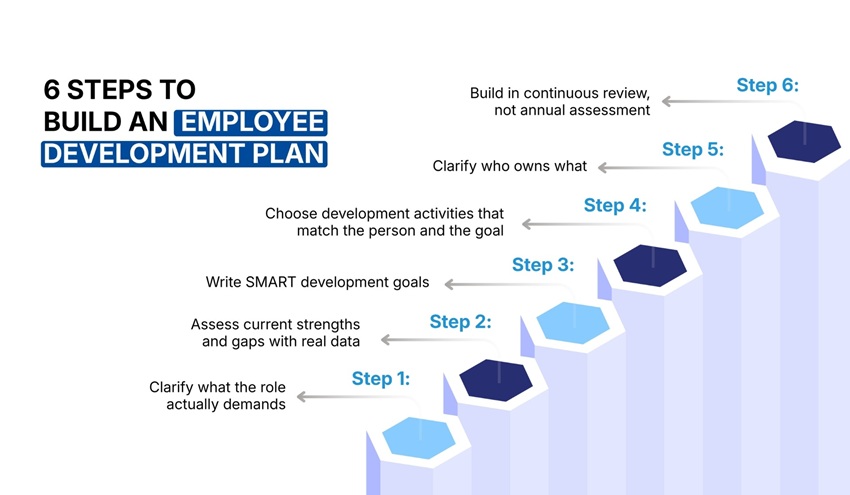
Start by mapping what the role genuinely requires, not just today, but over the next six to twelve months. This means understanding the role’s impact in the wider team, anticipating how responsibilities might shift, and identifying the capabilities that will matter most as the business grows or changes. This context gives the development plan a purpose beyond individual ambition.
Once the role is mapped, the next step is understanding the person in it. Psychometric assessments, skills evaluations, 360-degree feedback, and direct conversations during one-on-ones each contribute to a clearer picture than instinct alone. Platforms like Thomas International, a psychometric assessment provider used by HR teams globally, have surfaced hidden leadership potential and revealed the real reasons someone was struggling in ways that no annual review would have uncovered.
The SMART framework, specific, measurable, achievable, relevant, and time-bound, is useful precisely because it forces specificity. "Lead a strategic planning session for the team by the end of Q3 and gather feedback from the manager and peers" is a SMART goal. "Become more strategic" is not. The level of detail matters because both the employee and the manager need to be able to clearly assess whether the goal has been met.
This is where many plans go off track by defaulting to generic training courses that are easier to schedule than they are to apply. A more deliberate approach involves mixing learning methods based on how that specific employee grows best. The 70-20-10 model offers a useful guide: 70% of development happens through experiential learning such as stretch assignments and new responsibilities, 20% through social learning including coaching and peer feedback, and 10% through formal training targeting specific knowledge gaps. Shadowing a senior leader, owning a cross-functional project, or being given real accountability for a new area of work frequently produces more durable growth than a training module.
A development plan with no clear ownership tends to drift. The manager’s responsibilities, the employee’s responsibilities, the check-in schedule, and the escalation path if development stalls should all be explicitly agreed and documented. Development is a shared effort, but ambiguity about who is responsible for what creates the conditions for it to quietly fall away.
44% of workers’ core skills are expected to change within the next few years, according to a World Economic Forum report. A development plan that is reviewed annually cannot keep pace with that rate of change. Setting structured plans quarterly or biannually, with monthly check-ins embedded in existing one-on-one meetings, creates the feedback loop that allows plans to adapt as the person grows and business priorities shift.
Different employees at different career stages need different kinds of plans. Applying the same structure to a new hire closing technical gaps and a senior employee preparing for a leadership role produces neither useful outcome.
Orsted, the global green energy company, launched a program called "Power Your Career" after HR conducted in-depth interviews and focus group discussions with managers across organizational levels. The initiative addressed gaps in giving constructive feedback and running effective one-on-one meetings. The result was improved leadership quality and a stronger culture of continuous development, driven by data gathered before the program was designed.
Aegon’s "Analytics for Leaders" program built development directly into business execution. Participants were required to identify real applications in their own teams and report on the specific actions that resulted. Turning learning into immediate practical application is what made the development stick.
Both examples share a common thread: the development plan was built around a real business problem, not just an individual ambition, and success was measured by what changed in practice, not what was completed in a system.
Completion rates are the metrics most organizations track, and the metric least connected to actual development outcomes. The more useful indicators are whether employees are progressing through competency levels over time, whether internal promotion rates are improving, whether developed employees stay longer than those without structured plans, and whether the specific business problems the development addressed have improved.
High-intensity job-related training boosts life satisfaction equivalent to a 1% pay rise and significantly reduces intent to leave, according to the UK Government’s review on learning and development. That is a meaningful retention outcome tied to a measurable development input, and it is the kind of connection that makes the business case for continued investment in employee growth programs.
When development planning is treated as an operational discipline rather than an annual document, it produces returns that compound over time: more capable teams, stronger internal pipelines, lower hiring costs, and employees who stay because they can see where they are going. For organizations looking to scale that capability beyond individual managers and embed consistent talent standards across teams, structured enterprise partnerships such as those offered by Talent Management Institute can help formalize internal talent development systems and leadership capability at scale.
Q. How often should an employee development plan be reviewed?
A. Development plans work best when reviewed monthly in brief one-on-one check-ins rather than saved for an annual conversation. A quarterly reset of goals, combined with monthly progress conversations, keeps the plan aligned with both the employee’s growth and any shifts in business direction. Annual reviews alone are too infrequent to catch when a plan has stopped being useful.
Q. What is the difference between upskilling and reskilling in a development plan?
A. Upskilling means building on existing capabilities to help someone perform better or take on greater responsibility in their current area. Reskilling means developing capabilities in an entirely different area, often to prepare someone for a role that did not previously exist in their career path. A good development plan may include both, depending on where the employee is now and where the business needs them to be.
Q. How do you write development goals that are actually measurable?
A. The most measurable goals specify an observable outcome, a timeframe, and a way to verify completion. For example, "lead two client-facing presentations independently by the end of Q3 and gather feedback from the manager afterward" is measurable. "Improve presentation skills" is not, because neither the employee nor the manager can clearly tell whether it has been achieved. The more specific the goal, the easier it is to have an honest conversation about progress.
Q. What should a manager do when an employee is not following through on their development plan?
A. The first step is a direct, low-stakes conversation to understand what is getting in the way. Time pressure, unclear expectations, and a feeling that the plan is not relevant to their actual work are the most common reasons employees disengage from development goals. Revisiting the plan together, adjusting the scope or timeline, and reconnecting the goals to something the employee genuinely cares about professionally tends to be more effective than adding accountability pressure without addressing the underlying issue.
Q. Can development plans help with performance problems?
A. Yes, and this is one of the most underused applications. When a performance issue stems from a skill gap rather than a motivation or conduct problem, a well-designed development plan gives both the manager and the employee a constructive path forward. The plan needs to be collaborative and specific rather than punitive, focused on what the employee needs to build and how they will be supported, with clear milestones so both parties can see progress objectively.

Uncover the trends redefining workforce strategy, the skills shaping next-generation CHROs, and strategies to drive lasting impact. Explore insights and assess your readiness to lead the future of talent.
Download the Guide

CredBadge™ is a proprietary, secure, digital badging platform that provides for seamless authentication and verification of credentials across digital media worldwide.
CredBadge™ powered credentials ensure that professionals can showcase and verify their qualifications and credentials across all digital platforms, and at any time, across the planet.

Please enter the License Number/Unique Credential Code of the certificant. Results will be displayed if the person holds an active credential from TMI.