We can't wait to hear from you
Connect
Discover how TMI credentials are designed to accelerate your career growth. Explore how TMI incorporates Talent Management into the practice and systems of Human Capital Management. Learn how you can steer your future confidently through TMI's research driven Talent Management standards. Fellow programs equip global HR professionals with the latest in Talent Management in the transformational way.
Explore how the TMP™, STMP™, and GTML™ credentials can take your HR career places, or add to the capabilities of your promising HR staff and leaders.
View CertificationsStrengthen your enterprise HR system by implementing the TMI-ETMS™ international standards.
Learn About TMI-ETMS™If you are interested in consulting, training or education, partner with TMI to join the global league of TMI aligned institutions, companies and industries.
Become a TMI PartnerLearn the latest about how Talent Management is transforming HR into a future oriented business hyperfunction.
Explore the TMI ApproachLearn the steps to earn your TMI certification, from application to successful completion and maintaining your credential.
TMI credentials include globally recognized digital badges, offering a portable and verifiable representation of your achievements.

Kickstart your Talent Management journey with TMI’s globally recognized certifications and resources to excel in your career.
Create myTMI Account TodayTMI Global and Associate Fellow programs turn HR professionals into global Talent Leaders who can drive growth with their superlative strategic ability, business perspective and readiness for change. Since 2024, more than 150 senior HR professionals and HR leaders from 46 global organizations across industries have completed these programs that establish new standards for the practice of talent management as a driver of organizational success and business competitiveness.
You can contact us here for more information.

TMI–ETMS10™ and TMI–ETMS14™ certified organizations are effective for restructuring Talent Management in an organization. With TMI, organizations are better, more agile and better prepared for challenges that are to come.
The TMI-Enterprise Talent Management Standards power enterprise HR with the latest in Talent Management.
To choose a TMI–ETMS™ version most appropriate for your organization!
Write to us via the contact form.

Partnering with TMI means building a powerful structure of Talent Management thought and practice resulting in business profits through standards, certifications and networks.
Get your HR staffers and managers TMI certified on Talent Management by adding TMI into your training regimen. One step toward embedding TMI credentials in your institutions curricula is to become a TMI-ETMS™ consulting partner. Join us to be a part of the groundbreaking work of Talent Management.

If you hold an elite international qualification in HR or a related discipline, possess a recognized HR credential, or studied HRM at a TMI-recognized institution, you may be eligible for an accelerated pathway to a TMI credential through QualiFly™ leading to TMP™, STMP™ or GTML™.
 Institutions
Explore Certification Bodies, Universities, B-Schools & Other Institutions recognized by TMI under the Q1, Q2, and Q3 Lists.
Check if your institution is recognized
TMI’s blogs cover the latest trends, insights, and best practices in HR and talent management.
Comprehensive guides covering talent development, HR metrics, key facts, and more.
Explore TMI's latest updates, announcements, news and press releases in our newsroom.
Strategic insights driving the future of talent, leadership, and global workforce excellence.
Dive into the inspiring journeys of TMI certification holders and learn how the certification has transformed their careers.
An Interview series featuring key advice from global talent leaders for future HR professionals.
TMI’s editorial team is comprised of researchers, writers, editors, proofreaders, and contributors with extensive experience in the HR and Talent Management space. The team scrupulously researches, analyzes and deliberates on each submission before concluding its suitability for our publications.

May 20, International HR Day, arrives this year under a theme that asks something specific of the profession: "Empower People to Lead Change." It is a useful challenge, because empowering people requires HR to first examine whether its own systems are built for that purpose.
The evidence suggests many are not. Only 6% of organizations rate their talent management systems as very effective at meeting business needs, according to a global survey by the Center for Creative Leadership. The figures point to a structural problem: organizations are investing heavily in people without managing that investment strategically.
The shift this blog addresses is specific. It moves HR from coordinating isolated processes like hiring, training, and performance reviews toward building a talent ecosystem, a connected system where skills are visible, internal mobility is real, and people strategy is tied directly to business direction. That shift requires a different set of questions, clearer accountability, and the willingness to measure what actually matters.
Every year on May 20, International HR Day invites the profession to reflect on its evolving role. This year’s theme lands at a moment when the gap between what HR systems were designed to do and what organizations actually need has become difficult to ignore. Most HR departments use applicant tracking systems, learning platforms, and performance dashboards; however, these tools typically operate in isolation, limiting the workforce agility organizations need for the decade ahead.
The numbers reflect urgency. According to the World Economic Forum, from 2016 to 2022, productivity growth in advanced economies dropped to just 1%. 77% of employers globally report difficulty filling roles, and in the United States, 71% of manufacturers cite workforce instability as a core operational challenge. These disruptions signal a structural mismatch between how organizations manage talent and what the workforce actually needs.
The solution does not lie in implementing additional processes. It represents a fundamentally different approach to talent management.
A talent ecosystem is best understood as a dynamic, interconnected network of people, processes, technologies, and strategies that govern how talent flows into, within, and out of an organization. The word "ecosystem" is deliberate; it implies interdependence, not just coordination. Every element, from hiring and onboarding to learning, mobility, succession planning, and exit, works within a shared system rather than as a separate function managed by a separate team.
What distinguishes this from a well-staffed HR department with good tools is strategic cohesion and real-time visibility. In most organizations today, full-time employees are managed by HR while contractors and freelancers are handled by procurement or department heads. Managers sometimes bypass formal processes entirely because the systems feel cumbersome and disconnected. The result is that valuable skills go unnoticed, internal career paths stagnate, and external hires fill gaps that internal mobility could have addressed more efficiently and at lower cost.
A talent ecosystem corrects this by treating all talent, permanent, freelance, contract, and gig, as part of a unified workforce model. It provides HR with visibility into who people are, what they can do, where they have potential, and how their capabilities connect to business outcomes. When the World Economic Forum piloted talent innovations across 13 industrial sites using this approach, the results were measurable: a 52% improvement in workforce stability, a 34% improvement in financial performance, and a 28% improvement in productivity and operational safety.
Understanding what a talent ecosystem looks like in practice is one part of the equation. The harder part is recognizing that building one requires HR to operate differently, not just deploy better tools, which is where the real work of repositioning the function begins.
Building a talent ecosystem requires HR to stop seeing itself as a compliance function and start operating as what Michael Shipman, Coach and Consultant at Michael Shipman Coaching and Consulting, describes as "a talent agency," where managers become talent scouts and leaders serve as active mentors.
This shift changes what HR measures, how it communicates with leadership, and what it prioritizes. Instead of tracking time-to-fill or training completion rates as end goals, HR begins asking whether talent initiatives are solving real business problems, whether skill development efforts are closing capability gaps, and whether internal mobility is accelerating project delivery and reducing attrition.
It also changes how talent is sourced and deployed. In 2022, at least 30% of work in half of surveyed organizations came from contractors or freelancers, rising to 40 to 50% in the tech sector, according to MIT Sloan Management Review. Organizations that treat this external talent as a stopgap create a fragmented workforce culture. Those that integrate it into a unified talent model, with consistent governance, shared visibility, and clear expectations, use it as a genuine extension of their internal capability.
The organizations that have made the most progress on workforce transformation share a common characteristic: they distribute accountability for talent across the entire leadership structure rather than concentrating it in HR alone.
This means four distinct roles working in concert. At the board and C-suite level, talent overseers review succession pipelines annually and hold leadership accountable for aligning talent decisions to long-term goals. Senior leaders act as talent orchestrators, modeling cross-functional collaboration, encouraging stretch assignments, and directly mentoring emerging talent. Line managers serve as talent influencers, identifying future leaders early and co-owning development roadmaps with HR rather than delegating them upward. HR and learning and development professionals become the architects of the system, designing the structures, connecting the data, and ensuring that talent conversations happen continuously rather than annually.
The employee sits at the center of this model, encouraged to own their development journey, set career goals, voice aspirations, and access meaningful learning pathways. IBM’s global transformation illustrates what happens when this architecture is built at scale.
After recognizing that its decentralized, region-specific talent practices were creating fragmentation, IBM introduced a globally integrated system built on centralized infrastructure, a common skills taxonomy, and predictive analytics. The outcome was faster deployment of talent across geographies, stronger leadership pipelines for emerging markets, and greater retention of high-potential employees.
IBM’s transformation is instructive precisely because it did not happen through goodwill or initiative alone. It required a common language for skills, centralized systems for visibility, and the organizational commitment to treat talent decisions as a discipline with measurable standards, which is exactly what most organizations are still missing.
Despite growing evidence in favor of ecosystem thinking, talent strategy remains one of the least standardized disciplines in organizational management. A ManpowerGroup study found that 77% of employers report difficulty filling roles, yet many organizations still approach workforce planning as an internally defined process rather than a discipline supported by shared frameworks, measurable outcomes, and recognized professional standards.
When talent management is entirely self-defined, benchmarking becomes difficult, leadership conversations lack a common language, and successful workforce strategies often remain isolated within individual business units instead of scaling across the organization. As HR takes on greater strategic responsibility, the need for consistent methodologies around skills architecture, workforce analytics, succession planning, and organizational development becomes increasingly important.
Professional frameworks, industry certifications, and competency-based learning programs are helping address this gap by giving HR leaders practical tools and shared language to design, measure, and sustain talent ecosystems. Organizations are increasingly investing in HR capability-building through executive education, cross-functional experience, and professional development programs offered by institutions such as the Talent Management Institute and other industry bodies.
The value is not in the credential itself, but in what it represents: HR professionals who can diagnose workforce challenges, design scalable talent systems, and communicate people strategy in terms that leadership can directly connect to business outcomes. In organizations where HR capability is treated as a strategic investment, the returns often extend far beyond a single initiative, creating stronger leadership pipelines, better workforce agility, and more resilient long-term performance.
The path from fragmented HR systems to a functioning talent ecosystem begins with four reorienting actions that can be sequenced over time.
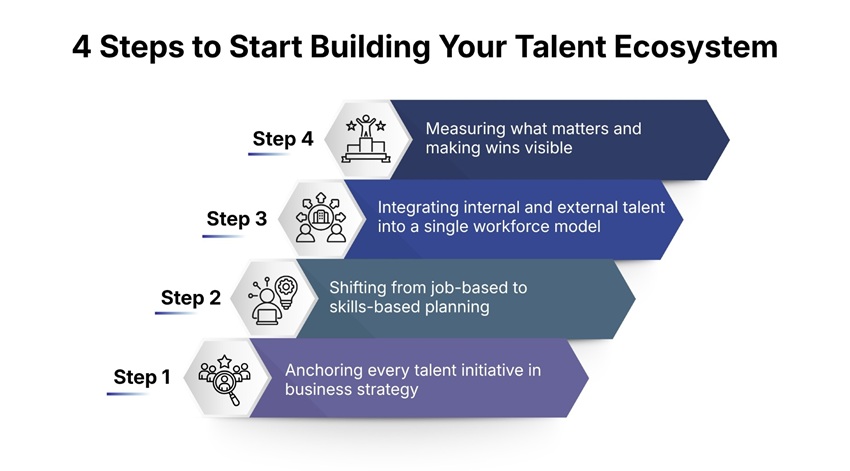
As Michael Shipman noted, "If you’re not connecting it to the strategy, it’s going to be tough to get funded for your talent initiatives." Each program, whether it involves internal mobility, leadership development, or contingent workforce planning, should be traceable back to a specific business goal.
This means moving away from rigid role definitions toward a unified skills database that includes both employees and contractors, with visibility into which skills are available, which are scarce, and which are emerging. It allows managers to search for the exact capabilities a project needs rather than defaulting job descriptions written for a different era.
When contractors appear in the same dashboards and planning systems as employees, managers can make faster, better-informed deployment decisions and organizations can build a more coherent workforce culture.
Beyond standard HR metrics, track how skill development efforts are closing capability gaps, how internal mobility is reducing external hiring costs, and how talent readiness is connected to project outcomes. Reporting these results publicly builds the organizational trust that sustains investment in ecosystem development over time.
International HR Day is not just a moment for recognition. It is an invitation to reexamine what HR is actually for. The workforce management mindset, built around compliance, headcount, and siloed processes, was designed for a different set of conditions. Building a talent ecosystem requires HR to move from managing transactions to architecting the conditions in which people, skills, and business strategy can work in genuine alignment.
The organizations that make this shift do not just become better at HR. They become more resilient, more agile, and more capable of sustaining performance through whatever comes next.
Q. What is a talent ecosystem?
A. A talent ecosystem is a dynamic, interconnected network of people, processes, technologies, and strategies that governs how talent flows into, within, and out of an organization. It unifies internal and external talent, integrates learning with mobility and succession planning, and uses real-time skills data to align people strategy with business outcomes.
Q. How does AI help in HR?
A. AI enables HR teams to pinpoint skill gaps and predict workforce needs, enabling targeted development and retention strategies. It enables HR to shift focus toward anticipatory talent management based on data insights, that would be impossible to generate manually across large, distributed workforces.
Q. What is a skills-based organization?
A. A skills-based organization structures work around capabilities rather than job titles. Projects are matched to people based on what they can do, internal and external talent are deployed based on specific skill requirements, and career progression is tied to demonstrated capabilities rather than tenure or legacy role definitions.
Q. How do you create an employee development plan?
A. An effective employee development plan starts with a skills gap analysis tied to business goals, sets specific and measurable development objectives, mixes experiential learning with coaching and formal training, defines accountability for both the employee and their manager, and includes regular check-ins to track progress and adapt the plan as priorities evolve.
Q. What are the benefits of employee upskilling?
A. Upskilling reduces dependence on external hiring by building capability internally, improves retention by giving employees a visible path for career growth, and increases organizational agility by expanding the range of work that existing talent can take on. It also reduces the risk of capability gaps widening as technology and business requirements change faster than the external talent market can supply.

Uncover the trends redefining workforce strategy, the skills shaping next-generation CHROs, and strategies to drive lasting impact. Explore insights and assess your readiness to lead the future of talent.
Download the Guide

CredBadge™ is a proprietary, secure, digital badging platform that provides for seamless authentication and verification of credentials across digital media worldwide.
CredBadge™ powered credentials ensure that professionals can showcase and verify their qualifications and credentials across all digital platforms, and at any time, across the planet.

Please enter the License Number/Unique Credential Code of the certificant. Results will be displayed if the person holds an active credential from TMI.