We can't wait to hear from you
Connect
Discover how TMI credentials are designed to accelerate your career growth. Explore how TMI incorporates Talent Management into the practice and systems of Human Capital Management. Learn how you can steer your future confidently through TMI's research driven Talent Management standards. Fellow programs equip global HR professionals with the latest in Talent Management in the transformational way.
Explore how the TMP™, STMP™, and GTML™ credentials can take your HR career places, or add to the capabilities of your promising HR staff and leaders.
View CertificationsStrengthen your enterprise HR system by implementing the TMI-ETMS™ international standards.
Learn About TMI-ETMS™If you are interested in consulting, training or education, partner with TMI to join the global league of TMI aligned institutions, companies and industries.
Become a TMI PartnerLearn the latest about how Talent Management is transforming HR into a future oriented business hyperfunction.
Explore the TMI ApproachLearn the steps to earn your TMI certification, from application to successful completion and maintaining your credential.
TMI credentials include globally recognized digital badges, offering a portable and verifiable representation of your achievements.

Kickstart your Talent Management journey with TMI’s globally recognized certifications and resources to excel in your career.
Create myTMI Account TodayTMI Global and Associate Fellow programs turn HR professionals into global Talent Leaders who can drive growth with their superlative strategic ability, business perspective and readiness for change. Since 2024, more than 150 senior HR professionals and HR leaders from 46 global organizations across industries have completed these programs that establish new standards for the practice of talent management as a driver of organizational success and business competitiveness.
You can contact us here for more information.

TMI–ETMS10™ and TMI–ETMS14™ certified organizations are effective for restructuring Talent Management in an organization. With TMI, organizations are better, more agile and better prepared for challenges that are to come.
The TMI-Enterprise Talent Management Standards power enterprise HR with the latest in Talent Management.
To choose a TMI–ETMS™ version most appropriate for your organization!
Write to us via the contact form.

Partnering with TMI means building a powerful structure of Talent Management thought and practice resulting in business profits through standards, certifications and networks.
Get your HR staffers and managers TMI certified on Talent Management by adding TMI into your training regimen. One step toward embedding TMI credentials in your institutions curricula is to become a TMI-ETMS™ consulting partner. Join us to be a part of the groundbreaking work of Talent Management.

If you hold an elite international qualification in HR or a related discipline, possess a recognized HR credential, or studied HRM at a TMI-recognized institution, you may be eligible for an accelerated pathway to a TMI credential through QualiFly™ leading to TMP™, STMP™ or GTML™.
 Institutions
Explore Certification Bodies, Universities, B-Schools & Other Institutions recognized by TMI under the Q1, Q2, and Q3 Lists.
Check if your institution is recognized
TMI’s blogs cover the latest trends, insights, and best practices in HR and talent management.
Comprehensive guides covering talent development, HR metrics, key facts, and more.
Explore TMI's latest updates, announcements, news and press releases in our newsroom.
Strategic insights driving the future of talent, leadership, and global workforce excellence.
Dive into the inspiring journeys of TMI certification holders and learn how the certification has transformed their careers.
An Interview series featuring key advice from global talent leaders for future HR professionals.
TMI’s editorial team is comprised of researchers, writers, editors, proofreaders, and contributors with extensive experience in the HR and Talent Management space. The team scrupulously researches, analyzes and deliberates on each submission before concluding its suitability for our publications.

HR is evolving rapidly, blending traditional people skills with data-driven approaches. The profession that once relied primarily on intuition, experience, and interpersonal skills now demands fluency in data interpretation, analytical reasoning, and evidence-based decision making. This transformation reflects broader shifts in how organizations operate, compete, and create value through their workforce.
Analytical evidence highlights a critical gap and opportunity in HR. A data literacy guide by Workday states, companies using people analytics to support HR functions and business decisions see 82% higher profit over three years compared to organizations with limited analytical maturity. Yet despite this proven advantage, LinkedIn states that only 22% of companies have adopted HR analytics, and as few as 8% can effectively utilize available data. This gap between potential and practice creates both urgency and opportunity for HR professionals willing to develop these critical competencies.
Data literacy represents more than just technical proficiency with spreadsheets or dashboards. It encompasses the ability to understand, interpret, and apply data insights to create meaningful business outcomes. For HR professionals, this means translating numbers into narratives that inform hiring strategies, shape employee development programs, and drive organizational performance.
Data literacy for HR professionals is defined as the ability to interpret insights from data and use them to inform decisions that create value in everyday roles. An HR professional with strong data literacy can examine workforce analytics, identify concerning trends, formulate hypotheses about root causes, and develop targeted interventions.
Consider this contrast. Traditional HR might notice higher turnover through anecdotal observations and exit interviews. Data literate HR professionals examine turnover rates across demographics, departments, tenure levels, and performance ratings. They correlate this information with engagement survey results, compensation data, and manager effectiveness scores. The resulting insights enable precise interventions rather than broad, potentially ineffective programs.
The shift toward analytics-driven HR creates competitive advantage through multiple mechanisms:
Building analytical capability requires developing specific skills that enable HR professionals to extract value from available information. There are five priority skill areas that HR practitioners need to develop as they build data-driven capability:
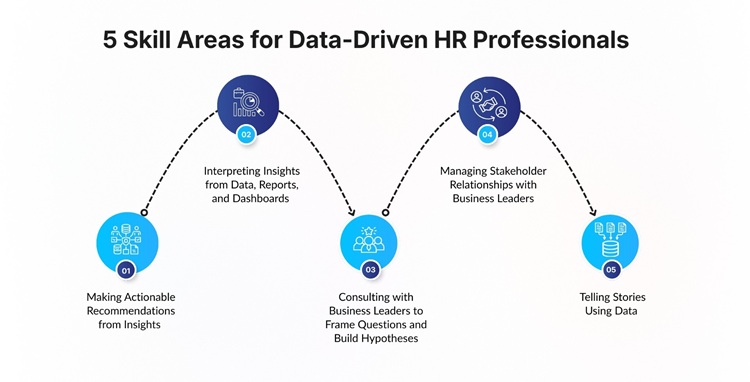
Raw data and basic analysis have limited value until translated into actionable recommendations. This skill involves examining analytical results, understanding their implications, and formulating specific recommendations that address underlying issues. A data literate HR professional moves beyond reporting that turnover increased to proposing targeted retention strategies based on which employee segments are leaving and why.
Analytics capabilities enhance credibility with executives who think and operate in quantitative terms. HR professionals who can present workforce insights using the same data-driven approach that leaders apply to financial and operational metrics gain influence and respect. This relationship management skill involves understanding what information business leaders need, how they prefer to receive it, and what questions they ask when evaluating proposals.
Strategic analytics begins with asking the right questions. Rather than simply producing reports requested by others, skilled HR professionals proactively identify business challenges where workforce data can provide answers. They collaborate with leaders to frame problems, develop testable hypotheses, and design analyses that yield actionable intelligence.
Technical systems can generate countless metrics, charts, and visualizations. The challenge lies in determining what matters, what it means, and what actions it suggests. Interpretation requires understanding statistical concepts, recognizing patterns and outliers, and connecting workforce trends to business outcomes. Research by Tableau found that only 27% of HR professionals received training on reading and interpreting reports directly related to their work, highlighting a critical skills gap.
Numbers alone rarely inspire action. Effective HR professionals weave data into compelling narratives that illustrate problems, demonstrate impact, and motivate change. This storytelling skill involves selecting the right visualizations, providing context that makes numbers meaningful, and crafting messages that resonate with different audiences.
Developing data literacy and HR analytics skills requires deliberate effort and strategic planning. The path forward involves multiple complementary approaches.
Formal learning provides structured introduction to essential concepts and techniques. Courses on people analytics, HR metrics and dashboarding, and data visualization teach fundamental skills that apply across various HR functions. Programs like "People Analytics" and "HR Metrics & Dashboarding" help professionals analyze and present workforce data effectively.
Workshops focused on specific tools such as Excel, Tableau, or Power BI build practical capabilities for working with data systems. These platforms serve as primary interfaces for accessing, manipulating, and visualizing workforce information. Organizations report that only 19% of HR professionals receive training on basic data tools, indicating substantial room for improvement.
Professional certifications validate expertise and demonstrate commitment to analytical excellence. Options like "HR Data Analyst" or "Strategic HR Metrics" focus on building advanced capabilities. Certifications such as "Global HR Data Integrity" emphasize maintaining data accuracy and reliability, which underlies all analytical work.
These credentials enhance marketability in competitive job markets where employers increasingly seek candidates with proven analytical capabilities. They also provide structured learning paths that guide skill development systematically.
Partnering with data specialists accelerates knowledge acquisition. IT teams, data science groups, and analytics centers of expertise possess technical skills that can mentor HR professionals. These partnerships help HR practitioners understand data structures, analytical methods, and interpretation techniques while enabling technical specialists to learn about HR applications and business context.
Internal knowledge exchange creates valuable learning opportunities. Lunch-and-learn sessions focused on specific data literacy skills allow HR teams to develop capabilities together while building shared vocabulary and approaches. Cross-functional collaboration strengthens analytical thinking and expands perspective on how workforce data connects to broader organizational metrics.
Practical application cements learning more effectively than passive consumption of information. Volunteering for data-driven HR projects provides opportunities to apply concepts in real situations. Analyzing employee engagement surveys, tracking recruitment metrics, or examining retention patterns develops both technical skills and business judgment.
Presenting data insights during HR meetings sharpens communication abilities while building confidence. Sharing findings from analysis, supporting recommendations with evidence, and responding to questions about methodology all contribute to growing competence with HR data literacy.
Abstract discussions of data literacy become concrete through examples of how organizations apply these capabilities to solve actual business challenges.
BBVA, a US banking franchise, discovered through benchmarking that they had above-average turnover in certain roles. Rather than implementing generic retention programs, their team explored turnover data by region, branch, and demographic indicators. Analysis revealed that 10% of their 700 branches accounted for 41% of all turnovers for one revenue-producing role.
This insight enabled targeted intervention at problematic locations. Further analysis of survey feedback from current and former employees uncovered concerns with compensation structure, onboarding, and training programs. Branch-level action plans addressing these specific issues reduced turnover for the role by 44%, decreased hiring costs, and improved customer relationship retention.
Gap, the American clothing retailer, wanted to improve customer service through better employee engagement. They tested stable scheduling practices and guaranteed weekly minimum hours for core associates in select stores. Data analysis showed an increase in productivity and growth in sales resulting from improved customer service. The productivity gain was twice the industry average.
Based on this evidence, Gap implemented stable scheduling practices across all locations. The company achieved operational efficiency improvements through evidence-based people practices guided by rigorous data analysis.
Walmart analyzed employee surveys and performance metrics to understand drivers of turnover. Data revealed that employees felt underappreciated and saw limited advancement opportunities. Targeted interventions addressing these specific concerns reduced turnover, delivering substantial cost savings and operational benefits.
Modern HR professionals must navigate an expanding ecosystem of systems and platforms that collect, process, and present workforce information. Familiarity with these technologies represents an essential component of data literacy.
Human Resource Information Systems (HRIS) and Human Resource Management Systems (HRMS) serve as central repositories for employee information, transactions, and historical records. These platforms capture demographics, job classifications, compensation details, performance evaluations, and learning activities. Understanding how information flows into and through these systems helps HR professionals access relevant data for analysis.
Applicant Tracking Systems (ATS) and Learning Management Systems (LMS) provide specialized data related to recruitment and development. Integration between these specialized tools and core HRIS platforms enables comprehensive analysis that spans the employee lifecycle from candidate to alumnus.
Tools like Excel remain foundational for HR professionals working with data. Pivot tables, conditional formatting, and advanced formulas enable sophisticated analysis without requiring programming expertise. Building strong Excel capabilities provides immediate practical value while establishing analytical thinking patterns that transfer to more advanced tools.
Business intelligence platforms such as Microsoft Power BI and Tableau offer powerful visualization and reporting capabilities. These systems transform raw data into interactive dashboards that allow users to explore trends, drill into details, and share insights with stakeholders. Organizations using people analytics platforms see substantially higher returns compared to those relying on manual reporting methods.
Comparative data provides context that makes internal metrics meaningful. External labor market intelligence and benchmarking platforms enable HR professionals to assess whether organizational trends align with broader industry patterns or represent unique situations requiring attention. These resources support strategic workforce planning and help justify resource requests based on competitive positioning.
Despite clear benefits, many organizations struggle to build widespread data literacy across HR functions. Research by HRCI found that HR staff in 60% of companies do not possess basic data literacy skills. Addressing this gap requires acknowledging specific obstacles and developing targeted strategies to overcome them.
HR has traditionally valued interpersonal skills, empathy, and judgment based on experience. Some professionals perceive analytics as cold, impersonal, or contrary to people-focused values. This mindset creates resistance to developing data capabilities.
Reframing analytics as tools that enhance rather than replace human judgment helps overcome this barrier. Data provides evidence that complements intuition, enabling more informed decisions that better serve employees and organizations. Emphasizing how analytics supports rather than threatens core HR values encourages adoption.
Training, tools, and time all require investment that stretched HR budgets may struggle to accommodate. However, the cost of maintaining data illiteracy likely exceeds development expenses. Organizations that fail to build analytical capabilities face competitive disadvantages, reduced influence, and diminished ability to demonstrate value.
Starting small with pilot programs, leveraging free or low-cost learning resources, and demonstrating quick wins through initial projects helps build momentum and justify further investment. Success stories from early adopters create internal advocates who champion continued development.
HR functions include diverse roles with varying analytical requirements. Recruiters, compensation specialists, HR business partners, and compliance officers all need data literacy but at different levels and with different emphases. One-size-fits-all training programs often fail to address these nuanced requirements.
Developing role-specific learning paths acknowledges these differences while ensuring all HR professionals achieve baseline competencies. Recruiters might focus deeply on applicant flow analysis and source effectiveness. Compensation professionals would emphasize pay equity analytics and market positioning studies. This tailored approach maximizes relevance and accelerates skill development.
Data literacy and analytics capabilities have transitioned from nice-to-have skills to fundamental requirements for HR career progression. According to Insight222’s latest People Analytics Trends survey, 85% of organizations report that their CHRO now considers people data and analytics a critical and essential part of the overall HR strategy. This executive-level prioritization ensures that analytical competencies will increasingly influence hiring, promotion, and compensation decisions.
Organizations are incorporating data literacy into job requirements, performance standards, and succession planning criteria. HR business partner roles particularly emphasize these capabilities, as these positions require translating workforce insights for business leaders and consulting on talent strategy. Specialists in compensation, learning, and talent acquisition similarly face growing expectations for analytical sophistication.
Artificial intelligence and machine learning tools are making advanced analytics more accessible. Generative AI platforms can produce basic reports, answer data questions through natural language queries, and suggest analytical approaches. Rather than eliminating the need for human analytical skills, these technologies raise the baseline. HR professionals must understand how to evaluate AI-generated insights, identify their limitations, and determine appropriate applications.
As analytical expectations become universal, professionals who develop advanced capabilities gain significant competitive advantages. Those who can design analytical frameworks, identify novel applications of workforce data, or translate complex findings into compelling narratives stand out in crowded talent markets.
Data literacy is set to be the most in-demand skill by 2030, with 85% of C-suite executives believing that being data literate will be as vital as the ability to use a computer is today. HR professionals who invest in these capabilities now position themselves for long-term career success while those who delay face increasing irrelevance.
The transformation of HR into a data-driven function reflects fundamental changes in how organizations understand, manage, and optimize their workforce. HR professionals who embrace this shift through developing data literacy and analytical capabilities position themselves as strategic partners capable of driving measurable business impact.
The evidence supporting investment in these skills is overwhelming. Organizations with strong people analytics capabilities significantly outperform competitors in profitability, growth, and operational efficiency. Yet most HR functions remain analytically immature, creating substantial opportunity for professionals willing to develop these competencies.
The path forward requires commitment to continuous learning, willingness to move beyond traditional comfort zones, and recognition that data skills complement rather than replace core HR values of empathy, judgment, and people focus. Those who successfully integrate analytical capabilities with human insight will define the future of the profession, leading organizations toward more effective, equitable, and strategic approaches to talent management.
Q. What is data literacy in HR?
A. Data literacy in HR is the ability to understand, interpret, and use workforce data to make informed people decisions. It includes reading reports, analyzing trends, asking the right business questions, and translating insights into actions related to hiring, performance, engagement, and retention.
Q. Why is data literacy important for HR professionals?
A. Data literacy is important because modern HR decisions must be evidence-based rather than intuition-driven. Organizations expect HR to justify strategies using data, improve workforce outcomes, and contribute directly to business performance through measurable insights.
Q. What are the key HR analytics skills?
A. The most important HR analytics skills include:
These skills allow HR professionals to influence strategy, not just execute processes.
Q. How can HR professionals improve data literacy?
A. HR professionals can improve data literacy by:
Hands-on application is the fastest way to build capability.
Q. What tools are used for HR analytics?
A. Common HR analytics tools include:
These tools help collect, analyze, and visualize workforce data.
Q. What is the difference between HR analytics and people analytics?
A. There is no major difference in practice. HR analytics focuses on HR systems and processes. People analytics emphasizes business outcomes and employee experience. Both involve using workforce data to drive better decisions.
Q. Do HR Professionals need coding or data science skills?
A. No, most HR roles do not require coding or advanced statistics. What matters more is:
Tools increasingly handle technical complexity.

Uncover the trends redefining workforce strategy, the skills shaping next-generation CHROs, and strategies to drive lasting impact. Explore insights and assess your readiness to lead the future of talent.
Download the Guide

CredBadge™ is a proprietary, secure, digital badging platform that provides for seamless authentication and verification of credentials across digital media worldwide.
CredBadge™ powered credentials ensure that professionals can showcase and verify their qualifications and credentials across all digital platforms, and at any time, across the planet.

Please enter the License Number/Unique Credential Code of the certificant. Results will be displayed if the person holds an active credential from TMI.