We can't wait to hear from you
Connect
Discover how TMI credentials are designed to accelerate your career growth. Explore how TMI incorporates Talent Management into the practice and systems of Human Capital Management. Learn how you can steer your future confidently through TMI's research driven Talent Management standards. Fellow programs equip global HR professionals with the latest in Talent Management in the transformational way.
Explore how the TMP™, STMP™, and GTML™ credentials can take your HR career places, or add to the capabilities of your promising HR staff and leaders.
View CertificationsStrengthen your enterprise HR system by implementing the TMI-ETMS™ international standards.
Learn About TMI-ETMS™If you are interested in consulting, training or education, partner with TMI to join the global league of TMI aligned institutions, companies and industries.
Become a TMI PartnerLearn the latest about how Talent Management is transforming HR into a future oriented business hyperfunction.
Explore the TMI ApproachLearn the steps to earn your TMI certification, from application to successful completion and maintaining your credential.
TMI credentials include globally recognized digital badges, offering a portable and verifiable representation of your achievements.

Kickstart your Talent Management journey with TMI’s globally recognized certifications and resources to excel in your career.
Create myTMI Account TodayTMI Global and Associate Fellow programs turn HR professionals into global Talent Leaders who can drive growth with their superlative strategic ability, business perspective and readiness for change. Since 2024, more than 150 senior HR professionals and HR leaders from 46 global organizations across industries have completed these programs that establish new standards for the practice of talent management as a driver of organizational success and business competitiveness.
You can contact us here for more information.

TMI–ETMS10™ and TMI–ETMS14™ certified organizations are effective for restructuring Talent Management in an organization. With TMI, organizations are better, more agile and better prepared for challenges that are to come.
The TMI-Enterprise Talent Management Standards power enterprise HR with the latest in Talent Management.
To choose a TMI–ETMS™ version most appropriate for your organization!
Write to us via the contact form.

Partnering with TMI means building a powerful structure of Talent Management thought and practice resulting in business profits through standards, certifications and networks.
Get your HR staffers and managers TMI certified on Talent Management by adding TMI into your training regimen. One step toward embedding TMI credentials in your institutions curricula is to become a TMI-ETMS™ consulting partner. Join us to be a part of the groundbreaking work of Talent Management.

If you hold an elite international qualification in HR or a related discipline, possess a recognized HR credential, or studied HRM at a TMI-recognized institution, you may be eligible for an accelerated pathway to a TMI credential through QualiFly™ leading to TMP™, STMP™ or GTML™.
 Institutions
Explore Certification Bodies, Universities, B-Schools & Other Institutions recognized by TMI under the Q1, Q2, and Q3 Lists.
Check if your institution is recognized
TMI’s blogs cover the latest trends, insights, and best practices in HR and talent management.
Comprehensive guides covering talent development, HR metrics, key facts, and more.
Explore TMI's latest updates, announcements, news and press releases in our newsroom.
Strategic insights driving the future of talent, leadership, and global workforce excellence.
Dive into the inspiring journeys of TMI certification holders and learn how the certification has transformed their careers.
An Interview series featuring key advice from global talent leaders for future HR professionals.
TMI’s editorial team is comprised of researchers, writers, editors, proofreaders, and contributors with extensive experience in the HR and Talent Management space. The team scrupulously researches, analyzes and deliberates on each submission before concluding its suitability for our publications.

Organizations are facing unprecedented difficulty securing qualified professionals. Research indicates that 75% of organizations report challenges filling full-time roles, while 61% of employers struggle to find qualified candidates. This talent shortage impacts business operations, with many companies struggling to maintain productivity and meet market demands.
The hiring environment has transformed dramatically. Baby Boomers are retiring faster than companies can replace them, taking decades of expertise with them. Meanwhile, Gen Z is entering the workforce with completely different expectations about what work should look like. The gap between what organizations need and what’s available has never been wider. According to a LinkedIn report, 75% of recruiters admit they can’t find candidates with the right skills, and 88% say competition for talent has reached new intensity.
Traditional recruitment methods prove insufficient for addressing modern challenges. Posting job advertisements and waiting for applications no longer produces results in competitive markets. Organizations must develop comprehensive approaches that integrate technology, authentic employer branding strategies, and compelling value propositions. The future of recruiting demands proactive, data-driven methodologies that position companies as destinations for exceptional talent.
Talent acquisition has moved far beyond posting jobs and reviewing résumés. Today, smart use of technology lets companies find better candidates faster, cut bias, and create hiring experiences that actually impress top talent.
Here’s how leading organizations are using technology to rethink the entire recruiting process and win the best people in a competitive market.
Technology has significantly reshaped how organizations identify and engage candidates. According to SHRM research, 51% of organizations already utilize AI in recruiting processes. More specifically, 66% of those using AI rely on it for generating job descriptions, 44% for screening resumes, 32% for automating candidate searches, and 29% for communicating with applicants.
AI-powered tools deliver multiple advantages for talent acquisition strategies:
AI-powered recruitment systems have demonstrated the ability to reduce time-to-hire by an average of 40%. However, thoughtful implementation requires human oversight to prevent introducing bias. When applied appropriately, AI gives hiring teams more time for relationship-building and strategic activities rather than manual administrative work.
Making job listings discoverable and appealing significantly influences who sees roles, who applies, and how many complete applications. Clear, searchable postings support recruitment SEO, helping listings appear in relevant searches on job boards and search engines.
Organizations should use clear, searchable job titles rather than internal-only or creative alternatives. Include relevant keywords for skills, responsibilities, and location naturally throughout descriptions so search engines and job-board algorithms identify listings. Structure content with headers like "Role Summary," "Responsibilities," and "What We Offer" to improve both human readability and SEO performance.
Transparency and candidate-friendliness in listings help align expectations and reduce drop-off once candidates click "apply." Simplify application processes and optimize for mobile devices, as many applicants browse and apply via phones. Ensure consistency across platforms so each posting reinforces identical messaging and remains equally discoverable.
When your employer brand reflects the true employee experience, you attract people who fit, stay longer, and become your best advocates.
This section shows how to build an employer brand that feels real, stands out, and drives lasting recruiting success.
Employer branding represents the perception candidates hold about working at your organization. Your employee value proposition (EVP) constitutes the promise you make to employees in return for their commitment, including benefits, rewards, culture, and growth opportunities.
Strong employer branding directly influences recruitment success. Research shows that 83% of job seekers research company reviews and ratings before submitting applications. When employer branding is clear, consistent, and positive, candidates become more inclined to engage and apply. Well-articulated EVPs also strengthen internal advocacy, as employees who feel valued speak positively about their companies, naturally boosting referrals and shaping reputations that attract appropriate talent.
Develop your EVP by defining unique culture and highlighting benefits including salary, bonuses, and perks. Emphasize values and ensure they align with organizational mission and vision. Showcase career development opportunities, including training, mentorship, and advancement paths. This comprehensive approach to employer branding strategies positions organizations as destinations where talented professionals want to build careers.
Sharing real employee experiences brings workplace culture to life and provides candidates with accurate impressions of organizational environments. Multiple approaches prove effective:
Employee spotlights feature short interviews or profiles highlighting backgrounds, roles, and growth since joining. Day-in-the-life content offers realistic views of typical responsibilities, helping candidates understand roles beyond job descriptions. Impact stories showcase challenges solved, projects delivered, or team achievements demonstrating tangible value employees create.
Diverse voices from various levels, teams, and backgrounds should be featured to provide well-rounded cultural views. Share stories across careers pages, job posts, social media, and newsletters to amplify reach. Job postings with videos have 34% higher application rates, and 75% of candidates say posting appearance influences their decision to apply. Employee stories make employer branding more authentic and relatable, helping candidates imagine themselves thriving within your organization.
Engaging passive talent and building strong talent pools is the smart way to stay ahead. Instead of waiting for applications, you proactively identify, nurture, and stay connected with high-potential professionals who could be perfect for future openings.
This section shows how to find them, build genuine relationships, and create a ready pipeline that gives you a real edge when roles open up.
According to LinkedIn, 70% of the global workforce consists of passive candidates, individuals who aren’t actively seeking new roles but are open to considering opportunities that align with their goals or offer something their current positions don’t. These professionals are often highly qualified and already employed, making them important talent segments to cultivate relationships with.
One approach involves encouraging passive candidates to join talent pools. Strong employer branding helps here, since people are more likely to sign up if they already have positive impressions of organizations. Maintaining contact by sending relevant, helpful content builds familiarity and trust over time. Sharing career tips, market insights, or professional development resources keeps organizations top of mind in genuinely valuable ways.
Another tactic is proactive sourcing. Instead of waiting for passive candidates to apply, identify potential fits in advance and build pipelines for future openings. When roles become available, you already have warm, engaged candidates who understand your organization and may be ready for conversations.
Many organizations have seen steady rises in boomerang employees, people who return to former employers after spending time elsewhere. HBR analysis shows that across industries, around 28% of new hires are people who previously left organizations within the last three years. This highlights how valuable alumni can be as long-term talent sources.
Rehiring former employees comes with several advantages. They understand how companies work and already possess valuable organizational knowledge. They ramp up faster and reach full productivity sooner. They bring fresh perspectives gained from experience elsewhere. Their return can positively influence morale by signaling that organizations are desirable places to work.
One relatively simple way to maintain contact with former employees involves creating private LinkedIn or Facebook pages for alumni. Share regular updates about organizations and job openings. British multinational retailer Marks and Spencer has created an M&S Family alumni page where former employees reminisce about their time with M&S, stay informed about business developments, and discover where alumni are today while joining exclusive alumni events.
Strong offboarding processes also ensure smooth transitions when employees leave organizations. People who think fondly of their time as employees speak highly of organizations to others and are more likely to return at some point.
In a tight talent market, relying on the same old job boards and LinkedIn searches just won’t cut it. The best hires are often hiding in places you’re not looking.
This section shows practical ways to broaden your search, build richer pipelines, and bring in people who truly fit your needs.
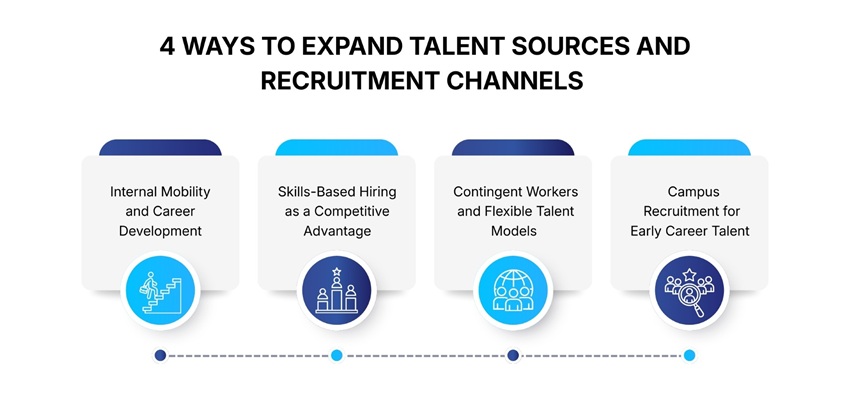
Organizations can’t rely solely on recruiting new people to cover every gap. While external hiring remains important, companies increasingly benefit from identifying and developing talent already inside organizations. Companies with strong internal mobility programs have 30% higher employee engagement and retention rates.
Internal mobility involves more than shifting people from one team to another. It should open access to skills organizations need and make opportunities easier to find. By using workforce data and tools such as internal talent marketplaces, companies connect mobility with workforce planning, anticipate future needs, and match people to roles where their strengths will have the greatest impact.
This approach moves away from classic career ladders and adopts career lattice frameworks to promote horizontal and diagonal career moves. Internal mobility supports succession planning while demonstrating to employees that organizations invest in their growth and development.
Traditional recruitment often screens candidates based on credentials, degrees, and job titles, inadvertently excluding qualified individuals whose experience doesn’t follow conventional paths. Skills-based hiring shifts focus to what candidates can actually do rather than where they’ve worked or what degrees they hold.
This approach expands talent pools significantly by recognizing capabilities gained through alternative pathways including vocational training, self-directed learning, military service, or non-traditional work experiences. Major employers such as Bank of America, Accenture, and IBM have adopted skills-based hiring practices, removing degree requirements for many positions and focusing assessments on demonstrated competencies.
Organizations evaluate candidates through practical assessments, work samples, and skills demonstrations that reveal actual capabilities rather than relying solely on resume credentials.
Implement skills-based hiring by deconstructing roles into required competencies, developing assessments that measure those specific capabilities, and training hiring managers to evaluate skills rather than credentials.
Many organizations are widening talent sources to keep up with shifting expectations and ongoing shortages. One practical approach involves using contingent workers, individuals hired on short-term, project-based, or as-needed bases, giving companies flexibility to adjust workforces without making long-term commitments.
Recent industry data indicate that 65% of companies plan to increase their use of contingent workers, highlighting rapid growth of flexible workforce models. Bringing in contractors or freelancers can be cost-effective options. Hiring expenses tend to be lower, and if matches aren’t perfect, impacts are far smaller than with full-time hires.
Theresa Balsiger, VP of Candidate Relations at Carex Consulting Group, explains: "Fractional roles, consulting, or gig positions are very beneficial when companies are going through large digital transformations, mergers, or some other significant change. Often, consultants are specialists who can provide very specific expertise. The expense is limited to the length of the project, as there’s no long-term commitment."
High-performing freelancers may transition to permanent employment when mutual satisfaction exists, or they can be retained in talent pools for future engagement opportunities.
Recruiting through universities effectively connects organizations with emerging talent, especially Generation Z candidates entering workforces for the first time. Campus recruitment helps companies fill entry-level roles, build early-career pipelines, and introduce themselves to new generations of potential employees.
Structure campus recruitment to include both in-person and virtual activities. Host or join career fairs and project fairs to access soon-to-be graduates and spot students whose interests and skills align with roles. Engage with student organizations by sponsoring or attending events hosted by student associations, putting you in touch with motivated candidates for internships, trainee roles, or graduate programs. Create dedicated graduate landing pages tailored to recent graduates, showcasing entry-level roles, internships, and growth paths.
Jerica Fernes, Head of Human Resources & Vendor Management of Tomedes Translation Company, shares: "Partnering with universities offering translation courses has been invaluable. Hosting events or guest lectures at these venues has consistently drawn in fresh, passionate talent eager to join our ranks."
Effective talent acquisition requires rigorous measurement of key performance indicators that reveal whether recruiting strategies deliver desired outcomes. Organizations should track the following metrics systematically:
Time-to-hire measures the number of days between when a candidate enters the recruitment process and when they accept an offer. This metric indicates recruiting efficiency and helps identify bottlenecks in the hiring process. Shorter time-to-hire often correlates with better candidate experiences and reduced risk of losing top talent to competitors. However, speed should be balanced against quality, as rushing decisions can compromise hire quality.
Quality of hire assesses how well new employees perform and contribute to organizational success. This metric can be evaluated through performance ratings during the first year, retention rates beyond the first 12 months, hiring manager satisfaction scores, and the new hire’s time to productivity. Quality of hire represents the most important recruiting metric, as it directly connects talent acquisition efforts to business outcomes.
Offer acceptance rate tracks the percentage of candidates who accept job offers compared to total offers extended. Low acceptance rates signal potential issues with compensation competitiveness, employer branding effectiveness, or candidate experience throughout the recruitment process. Monitoring this metric helps organizations understand how attractive they are to desired talent and whether their employee value proposition resonates with candidates.
Candidate experience score measures how applicants perceive interactions with your organization throughout the recruitment process. This can be gathered through post-application surveys, post-interview feedback requests, and post-offer surveys regardless of acceptance. Strong candidate experiences improve employer brand reputation, increase offer acceptance rates, and turn even rejected candidates into potential brand ambassadors who speak positively about your organization.
The future of recruiting demands comprehensive, strategic approaches that go far beyond traditional job postings. Organizations must leverage technology thoughtfully, build authentic employer branding strategies, implement skills-based hiring, engage passive candidates, maximize employee referrals, elevate candidate experiences, expand talent sources, measure outcomes rigorously, and integrate recruitment with exceptional onboarding.
With 75% of organizations struggling to fill roles and competition for talent intensifying, companies that adopt these recruiting strategies will gain significant advantages. They’ll build reputations as employers of choice, reduce time-to-hire, improve quality of hire, and create engaged workforces positioned to drive business success.
Implement these talent acquisition strategies systematically, measure results consistently, and remain adaptable as markets continue evolving.
Q. How is AI changing recruitment?
A. AI-powered tools expand sourcing capabilities, enhance screening accuracy, personalize candidate communication at scale, and provide predictive hiring analytics.
Q. What is an employee value proposition (EVP)?
A. An EVP is the promise organizations make to employees in return for their commitment, encompassing benefits, rewards, culture, and growth opportunities. A strong EVP attracts appropriate talent and strengthens internal advocacy.
Q. Why should companies engage passive candidates?
A. Building relationships with passive talent creates ready pipelines for future openings, reducing time-to-hire and improving access to high-quality candidates when roles become available.
Q. How can internal mobility improve recruitment?
A. Internal mobility reduces reliance on external hiring whilst improving engagement and retention. Companies with strong internal mobility programs have higher employee engagement and retention rates, and it demonstrates organizational investment in employee growth and development.
Q. What role do contingent workers play in modern recruiting?
A. Contingent workers provide flexibility to adjust workforces without long-term commitments. They offer cost-effective solutions for specialized expertise during transformations or projects, with high performers potentially transitioning to permanent roles.

Uncover the trends redefining workforce strategy, the skills shaping next-generation CHROs, and strategies to drive lasting impact. Explore insights and assess your readiness to lead the future of talent.
Download the Guide

CredBadge™ is a proprietary, secure, digital badging platform that provides for seamless authentication and verification of credentials across digital media worldwide.
CredBadge™ powered credentials ensure that professionals can showcase and verify their qualifications and credentials across all digital platforms, and at any time, across the planet.

Please enter the License Number/Unique Credential Code of the certificant. Results will be displayed if the person holds an active credential from TMI.