We can't wait to hear from you
Connect
Discover how TMI credentials are designed to accelerate your career growth. Explore how TMI incorporates Talent Management into the practice and systems of Human Capital Management. Learn how you can steer your future confidently through TMI's research driven Talent Management standards. Fellow programs equip global HR professionals with the latest in Talent Management in the transformational way.
Explore how the TMP™, STMP™, and GTML™ credentials can take your HR career places, or add to the capabilities of your promising HR staff and leaders.
View CertificationsStrengthen your enterprise HR system by implementing the TMI-ETMS™ international standards.
Learn About TMI-ETMS™If you are interested in consulting, training or education, partner with TMI to join the global league of TMI aligned institutions, companies and industries.
Become a TMI PartnerLearn the latest about how Talent Management is transforming HR into a future oriented business hyperfunction.
Explore the TMI ApproachLearn the steps to earn your TMI certification, from application to successful completion and maintaining your credential.
TMI credentials include globally recognized digital badges, offering a portable and verifiable representation of your achievements.

Kickstart your Talent Management journey with TMI’s globally recognized certifications and resources to excel in your career.
Create myTMI Account TodayTMI Global and Associate Fellow programs turn HR professionals into global Talent Leaders who can drive growth with their superlative strategic ability, business perspective and readiness for change. Since 2024, more than 150 senior HR professionals and HR leaders from 46 global organizations across industries have completed these programs that establish new standards for the practice of talent management as a driver of organizational success and business competitiveness.
You can contact us here for more information.

TMI–ETMS10™ and TMI–ETMS14™ certified organizations are effective for restructuring Talent Management in an organization. With TMI, organizations are better, more agile and better prepared for challenges that are to come.
The TMI-Enterprise Talent Management Standards power enterprise HR with the latest in Talent Management.
To choose a TMI–ETMS™ version most appropriate for your organization!
Write to us via the contact form.

Partnering with TMI means building a powerful structure of Talent Management thought and practice resulting in business profits through standards, certifications and networks.
Get your HR staffers and managers TMI certified on Talent Management by adding TMI into your training regimen. One step toward embedding TMI credentials in your institutions curricula is to become a TMI-ETMS™ consulting partner. Join us to be a part of the groundbreaking work of Talent Management.

If you hold an elite international qualification in HR or a related discipline, possess a recognized HR credential, or studied HRM at a TMI-recognized institution, you may be eligible for an accelerated pathway to a TMI credential through QualiFly™ leading to TMP™, STMP™ or GTML™.
 Institutions
Explore Certification Bodies, Universities, B-Schools & Other Institutions recognized by TMI under the Q1, Q2, and Q3 Lists.
Check if your institution is recognized
TMI’s blogs cover the latest trends, insights, and best practices in HR and talent management.
Comprehensive guides covering talent development, HR metrics, key facts, and more.
Explore TMI's latest updates, announcements, news and press releases in our newsroom.
Strategic insights driving the future of talent, leadership, and global workforce excellence.
Dive into the inspiring journeys of TMI certification holders and learn how the certification has transformed their careers.
An Interview series featuring key advice from global talent leaders for future HR professionals.
TMI’s editorial team is comprised of researchers, writers, editors, proofreaders, and contributors with extensive experience in the HR and Talent Management space. The team scrupulously researches, analyzes and deliberates on each submission before concluding its suitability for our publications.

Every day, outstanding candidates are being disregarded for positions they are ideally suited for, simply because their professional titles do not correspond with what appears on the job specification. A talented employee is growing restless, unaware that their company desperately needs the exact skills they possess, just three departments over. And across industries, leaders are watching helplessly as 85 million jobs are projected to go unfilled by 2030, not because people lack potential, but because we’re still hiring and organizing work the way we did decades ago.
We’re stuck in an outdated system that values titles over talent and credentials over capabilities.
But there’s a better way forward. A growing number of organizations are moving from "What’s your job title?" to "What can you do?" It’s a complete reimagining of how work gets done, how talent moves through an organization, and how people build meaningful careers.
Deloitte reports that 98% of business executives plan to incorporate more skills-based approaches into their operations. Organizations leading this transition report on measurable improvements in performance, talent retention, and employee engagement. These results stem from treating skills as the foundational currency of work rather than viewing them as secondary attributes attached to predetermined roles.
This comprehensive guide presents eight steps for building a skills-based organization that delivers sustainable advantage through enhanced talent mobility, streamlined skills-based hiring, and competency-based planning.
A skills-based organization reimagines how work gets structured and executed. Rather than defining employment through static job descriptions with fixed responsibilities, this model deconstructs work into discrete tasks and activities that require specific competencies. The organization then matches talent to these requirements based on demonstrated capabilities rather than formal titles or organizational hierarchy.
This approach creates three distinct pathways for implementation.
The first pathway involves relaxing degree requirements during hiring, opening opportunities to broader talent pools with practical experience and knowledge. Major employers including Bank of America, Accenture, and IBM have adopted this method, recognizing that formal education credentials don’t always predict job performance or capability.
The second pathway focuses on deconstructing traditional roles into constituent tasks and required skills. Organizations like Mastercard and Unilever utilize this approach when redeploying talent through internal marketplaces, allowing employees to contribute across departmental boundaries based on capabilities rather than reporting structures.
The third approach emphasizes technology-enabled talent mobility perspectives. Advanced platforms create visibility into workforce skills, enabling internal gig opportunities and talent marketplace functionality. Technology vendors such as Fuel 50, Skyhive, and Gloat provide the infrastructure for managing skills data, proficiency levels, and dynamic work assignments.
The most successful implementations integrate elements from all three approaches, creating comprehensive frameworks that address hiring, development, and deployment simultaneously.
This 8-step guide shows how to make the skills-based transition practical, fair, and effective.
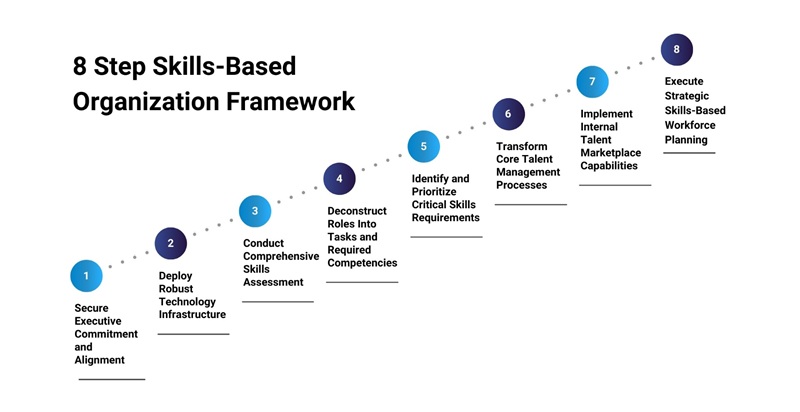
Skills-based transformation represents change to organizational operating models. This magnitude of shift demands unwavering support from executive leadership teams who understand both the strategic imperative and practical implications of this transition.
Begin by articulating a clear value proposition. Connect skills-based practices directly to strategic business objectives. Demonstrate how enhanced talent mobility, more effective skills-based hiring, and sophisticated competency-based planning enable execution of corporate strategy. Present concrete examples of performance improvements, cost savings, and advantages realized by organizations further along this journey.
Leadership commitment must extend beyond initial approval. Executives need to champion this transformation publicly, allocate appropriate resources, and model skills-centric thinking in their own decisions. Regular strategy reviews should assess alignment between skills initiatives and business direction, ensuring continuous relevance as markets shift and priorities change.
Establish clear governance structures that define decision-making authority, accountability mechanisms, and escalation paths for addressing obstacles. These frameworks prevent the initiative from stalling when challenges arise and ensure consistent application of skills-based principles across the organization.
Technology infrastructure forms the backbone of capability-driven organizations. Manual processes cannot scale to meet the demands of capturing, analyzing, and acting upon comprehensive skills data across large workforces. Investment in appropriate HR technology solutions is non-negotiable regardless of organization size.
Modern Human Resource Information Systems (HRIS), Learning Management Systems (LMS), and talent marketplace platforms offer capabilities specifically designed for skills management. These systems track individual competencies, proficiency levels, and development trajectories while providing analytics that inform strategic workforce decisions.
Advanced talent acquisition systems compare candidate qualifications against role requirements using skills-based matching algorithms. This capability streamlines recruitment by surfacing the best-fit candidates based on demonstrated competencies rather than keyword matches in resumes.
Select technology partners carefully. Evaluate solutions based on their ability to integrate with existing systems, accommodate your organization’s complexity, and scale as needs expand. Many organizations discover through trial and error that their initial technology choices don’t fully meet requirements. Conduct thorough due diligence upfront, including pilot testing with representative user groups, to avoid costly migrations later.
The right technology simplifies skills data collection, makes information accessible to stakeholders who need it, and provides actionable insights that drive better talent decisions.
Understanding your current skills inventory provides the essential baseline for competency-based planning. This assessment captures both the competencies present in your existing workforce and gaps between current capabilities and future requirements.
Begin with broad skills taxonomy development that defines categories and specific competencies relevant to your organization. This taxonomy should include technical skills such as programming languages or engineering specialties alongside professional competencies like leadership, communication, and analytical thinking.
Deploy multiple assessment methodologies to build a complete picture. Self-assessments allow employees to report their capabilities and proficiency levels. Manager evaluations provide independent perspectives on demonstrated competencies. Skills-based assessments and certifications offer objective validation of specific technical abilities. Project histories and work samples reveal practical application of various competencies.
Analyze this data to identify patterns. Which skills are abundant within your workforce? Where do critical shortages exist? How does your talent distribution align with strategic priorities? This analysis informs decisions about where to focus development resources, which capabilities to source externally, and how to deploy existing talent more effectively.
Conduct this assessment regularly rather than treating it as a one-time exercise. Skills inventories become outdated quickly as employees develop new capabilities and business requirements shift. Establish ongoing processes for keeping skills data current.
See where you stand and identify the right certification path for your career.
Take the Assessment
Traditional job descriptions bundle responsibilities into fixed packages assigned to specific positions. Skills-based organizations dismantle these bundles, analyzing the actual work that needs to be done and identifying which competencies enable successful execution.
This deconstruction process examines each role systematically. What outcomes must this position deliver? What tasks and activities produce those outcomes? Which specific skills are required to complete each task effectively? This granular analysis reveals opportunities for more flexible talent deployment.
Consider a Business Analyst role as an example. Traditional job descriptions list broad responsibilities such as "gather requirements" and "document processes." Deconstruction identifies discrete tasks: conducting stakeholder interviews, creating process flow diagrams, writing functional specifications, facilitating user acceptance testing. Each task requires distinct competencies that might be distributed across multiple people or sourced from specialists.
This approach creates several advantages. Organizations gain flexibility to assemble teams based on optimal skills combinations rather than predetermined role assignments. Employees contribute to work that matches their capabilities rather than being constrained by job title boundaries. Automation opportunities become visible when tasks are clearly defined and analyzed for technical feasibility.
Document this deconstruction work thoroughly. The resulting task inventories and skills mappings form the foundation for subsequent workforce planning, hiring, and development activities.
Not all skills carry equal strategic importance. Organizations must determine which capabilities are most critical to business success, which are scarce in talent markets, and what volumes are needed to meet operational demands.
A skills segmentation matrix provides a structured framework for this analysis. Evaluate each skill across three dimensions:
Market research informs the scarcity dimension. Platforms like LinkedIn provide data on skills availability and hiring competition. Industry reports and labor market analyses reveal broader supply trends.
Internal subject matter experts assess criticality by evaluating how various skills contribute to business outcomes. Which capabilities directly enable revenue generation, cost reduction, or differentiation? Which skills are prerequisites for other valued competencies?
Workforce planning data and project pipelines indicate volume requirements. Historical patterns show how much capacity was needed for previous initiatives. Strategic plans reveal future demands as new products launch or markets expand.
Visualize this analysis to facilitate strategic discussions. Plot skills on matrices that show scarcity versus criticality, with bubble sizes indicating required volumes. These visuals make priorities obvious and help leaders focus resources on the most impactful capabilities.
Capability-driven organizations require different approaches to essential HR processes. Each major function must be redesigned around skills rather than traditional job-centric models.
Skills-Based Hiring Practices
Recruitment strategies shift from filling predefined positions to building talent pools with required competencies. Job postings describe needed capabilities and expected outcomes rather than listing responsibilities. Skills-based hiring assessments evaluate candidates through practical demonstrations rather than relying solely on credentials and experience.
Hiring managers and recruiters need training to source for skills effectively. They must learn to identify transferable competencies, recognize non-traditional pathways to capability development, and assess potential alongside current proficiency.
Compensation Management Transformation
Traditional compensation structures assign employees to salary bands based on job levels defined by responsibilities, scope, and organizational impact. Skills-based models instead value employees based on the competencies they possess and how effectively those capabilities are deployed.
Redesign compensation frameworks to reward skill acquisition and application. Create incentive structures that encourage employees to develop capabilities aligned with strategic priorities. Ensure pay equity by compensating similar skills comparably regardless of functional assignment.
Performance Management Evolution
Traditional performance management focuses on achieving goals within defined roles. Skills-based approaches emphasize capability development and application toward business objectives.
Evaluate employees on how effectively they deploy their skills, what new competencies they develop, and how they contribute across organizational boundaries. Provide feedback that guides skill-building efforts and recognizes valuable contributions outside traditional role expectations.
Learning and Development Reimagined
Traditional learning programs often focus on role-specific training. Skills-based learning and development instead provides modular, competency-focused offerings that employees can assemble into personalized development pathways aligned with their aspirations and organizational needs.
Move beyond episodic training toward continuous learning cultures where skill development is ongoing and integrated into daily work. Combine formal learning content with experiential opportunities such as stretch assignments, cross-functional projects, and mentorship relationships.
Talent marketplaces represent the practical mechanism through which capability-driven organizations achieve enhanced talent mobility. These platforms create transparency around available opportunities and match employees to assignments based on their capabilities, interests, and capacity.
Modern talent marketplace technology uses artificial intelligence to analyze skills data and recommend opportunities that align with individual profiles. Employees gain visibility into projects, gigs, and stretch assignments across the entire organization rather than being limited to opportunities within their immediate teams.
This visibility drives several valuable outcomes. High-potential employees access development experiences that accelerate their growth. Leaders source talent from broader pools rather than being constrained by organizational boundaries. Critical projects attract the most qualified contributors regardless of their formal roles or reporting relationships.
Implement talent marketplaces progressively. Begin with pilot programs in controlled environments where you can refine processes and build organizational comfort. Share success stories that demonstrate value. Address concerns from managers who may worry about losing team members to other opportunities by emphasizing the mutual benefits of talent mobility.
Establish clear guidelines for participation. Define how much time employees can allocate to marketplace opportunities. Clarify expectations around manager approvals. Create norms for how assignments are selected and evaluated. These structures prevent confusion and ensure fair access.
With technology infrastructure established, skills data captured, and new talent management processes operational, organizations can conduct sophisticated skills-based workforce planning. This strategic activity forecasts future capability requirements and develops comprehensive talent strategies to meet identified needs.
Begin by projecting how business strategy will drive skills demand. Which capabilities become more critical as new products launch or markets expand? What competencies decline in importance as operations mature or technologies automate certain tasks? How do external factors such as regulatory changes or dynamics affect required capabilities?
Compare projected demand against current supply revealed through your skills assessments. This gap analysis reveals where shortages will constrain execution of strategic plans and where surplus capacity might be redeployed.
Develop multifaceted strategies to address identified gaps using the "four Bs" framework:
Determine the optimal mix of these approaches for each capability gap. Critical skills that are scarce in labor markets might require heavy investment in internal development. Commoditized capabilities may be most efficiently sourced through external staffing. Specialized expertise needed only occasionally could be borrowed as needed.
Document these workforce strategies comprehensively. Create implementation roadmaps with clear timelines, resource requirements, and accountability assignments. Establish metrics that track progress and enable course corrections when results don’t meet expectations.
Organizations pursuing skills-based transformation encounter predictable obstacles. Proactive mitigation strategies address these challenges before they derail progress.
Managers often worry that talent mobility threatens team stability and performance. They may resist releasing talented employees to opportunities outside their departments. Address these concerns through transparent communication about mutual benefits. Demonstrate how talent mobility develops capabilities that ultimately strengthen all teams. Create reciprocal access that ensures managers can source talent from across the organization when they need specialized skills.
Skills inventories decay rapidly as employees develop new capabilities and priorities shift. Sustain engagement with skills tracking by integrating data collection into natural workflow points. Prompt employees to update profiles before development conversations. Request certification submissions during workforce planning cycles. Tie performance evaluations partially to skill development and documentation.
Some roles genuinely require specific credentials due to regulatory requirements or professional standards. Doctors, nurses, lawyers, and many specialized positions have external licensing requirements that govern practice. Recognize these realities and build flexibility into your skills-based approach. The goal is optimizing talent deployment within legitimate constraints rather than abandoning all traditional structures.
Skills-based transformation represents cultural change as much as process change. Partner with change management professionals throughout implementation. Develop communication strategies that build awareness, generate understanding, and drive adoption. Engage employees in solution design to increase buy-in and ensure approaches meet their needs. Start with pilot programs that allow learning before broad rollout. Celebrate successes publicly to build momentum.
Building a skills-based organization demands sustained commitment, significant investment, and cultural transformation. The path forward requires patience as employees adapt to new ways of working and leaders develop comfort with fluid talent deployment. However, organizations that successfully make this transition position themselves for sustainable advantage.
Skills-based organizations achieve the agility required to navigate constant disruption. They access broader talent pools through inclusive hiring practices. They develop employees more effectively by creating varied experiences that build diverse capabilities. They deploy talent more efficiently by matching people to work based on optimal skills combinations rather than organizational charts.
The eight steps outlined in this guide provide a comprehensive framework for transformation. Take incremental steps, learn from implementations, and gradually build the skills-centric culture that positions your organization for long-term success in an unpredictable future.
1. What is a skills-based organization?
A. A skills-based organization structures work around specific competencies rather than static job descriptions. It matches talent to tasks based on demonstrated capabilities instead of formal titles or organizational hierarchy, enabling flexible talent deployment across departmental boundaries.
2. What are the benefits of skills-based workforce planning?
A. Organizations gain enhanced talent mobility, access to broader talent pools through inclusive hiring practices, and improved employee development through varied experiences. This approach delivers measurable improvements in performance, talent retention, employee engagement, and workforce agility.
3. How long does it take to implement a skills-based organization?
A. Implementation timelines vary by organization size and complexity. Most organizations adopt progressive implementation, starting with pilot programs in controlled environments before broader rollout, allowing time for employees to adapt and leaders to develop comfort with fluid talent deployment.
4. What technology is needed for skills-based talent management?
A. Essential technology includes modern HRIS, Learning Management Systems, and talent marketplace platforms with AI-powered matching capabilities. Solutions from vendors like Fuel 50, Skyhive, and Gloat provide infrastructure for managing skills data, proficiency levels, and dynamic work assignments.
5. What challenges do organizations face during implementation?
A. Common challenges include resistance from managers concerned about team stability, maintaining current skills data as inventories decay rapidly, and managing cultural change. Organizations must also balance flexibility with regulatory requirements whilst ensuring fair access to talent mobility opportunities.

Uncover the trends redefining workforce strategy, the skills shaping next-generation CHROs, and strategies to drive lasting impact. Explore insights and assess your readiness to lead the future of talent.
Download the Guide

CredBadge™ is a proprietary, secure, digital badging platform that provides for seamless authentication and verification of credentials across digital media worldwide.
CredBadge™ powered credentials ensure that professionals can showcase and verify their qualifications and credentials across all digital platforms, and at any time, across the planet.

Please enter the License Number/Unique Credential Code of the certificant. Results will be displayed if the person holds an active credential from TMI.