We can't wait to hear from you
Connect
Discover how TMI credentials are designed to accelerate your career growth. Explore how TMI incorporates Talent Management into the practice and systems of Human Capital Management. Learn how you can steer your future confidently through TMI's research driven Talent Management standards. Fellow programs equip global HR professionals with the latest in Talent Management in the transformational way.
Explore how the TMP™, STMP™, and GTML™ credentials can take your HR career places, or add to the capabilities of your promising HR staff and leaders.
View CertificationsStrengthen your enterprise HR system by implementing the TMI-ETMS™ international standards.
Learn About TMI-ETMS™If you are interested in consulting, training or education, partner with TMI to join the global league of TMI aligned institutions, companies and industries.
Become a TMI PartnerLearn the latest about how Talent Management is transforming HR into a future oriented business hyperfunction.
Explore the TMI ApproachLearn the steps to earn your TMI certification, from application to successful completion and maintaining your credential.
TMI credentials include globally recognized digital badges, offering a portable and verifiable representation of your achievements.

Kickstart your Talent Management journey with TMI’s globally recognized certifications and resources to excel in your career.
Create myTMI Account TodayTMI Global and Associate Fellow programs turn HR professionals into global Talent Leaders who can drive growth with their superlative strategic ability, business perspective and readiness for change. Since 2024, more than 150 senior HR professionals and HR leaders from 46 global organizations across industries have completed these programs that establish new standards for the practice of talent management as a driver of organizational success and business competitiveness.
You can contact us here for more information.

TMI–ETMS10™ and TMI–ETMS14™ certified organizations are effective for restructuring Talent Management in an organization. With TMI, organizations are better, more agile and better prepared for challenges that are to come.
The TMI-Enterprise Talent Management Standards power enterprise HR with the latest in Talent Management.
To choose a TMI–ETMS™ version most appropriate for your organization!
Write to us via the contact form.

Partnering with TMI means building a powerful structure of Talent Management thought and practice resulting in business profits through standards, certifications and networks.
Get your HR staffers and managers TMI certified on Talent Management by adding TMI into your training regimen. One step toward embedding TMI credentials in your institutions curricula is to become a TMI-ETMS™ consulting partner. Join us to be a part of the groundbreaking work of Talent Management.

If you hold an elite international qualification in HR or a related discipline, possess a recognized HR credential, or studied HRM at a TMI-recognized institution, you may be eligible for an accelerated pathway to a TMI credential through QualiFly™ leading to TMP™, STMP™ or GTML™.
 Institutions
Explore Certification Bodies, Universities, B-Schools & Other Institutions recognized by TMI under the Q1, Q2, and Q3 Lists.
Check if your institution is recognized
TMI’s blogs cover the latest trends, insights, and best practices in HR and talent management.
Comprehensive guides covering talent development, HR metrics, key facts, and more.
Explore TMI's latest updates, announcements, news and press releases in our newsroom.
Strategic insights driving the future of talent, leadership, and global workforce excellence.
Dive into the inspiring journeys of TMI certification holders and learn how the certification has transformed their careers.
An Interview series featuring key advice from global talent leaders for future HR professionals.
TMI’s editorial team is comprised of researchers, writers, editors, proofreaders, and contributors with extensive experience in the HR and Talent Management space. The team scrupulously researches, analyzes and deliberates on each submission before concluding its suitability for our publications.

Somewhere between a promising hire and a high-performing team member, engagement often declines. There is no single moment of failure, just a gradual drift: unclear expectations, limited growth opportunities, a manager too stretched to notice, and eventually, a resignation that surprises no one in hindsight. This pattern repeats itself across industries and company sizes, and the cost of it adds up fast.
Talent management aims to prevent this pattern. It is the set of deliberate practices that shape how an organization finds, develops, and holds onto the people it needs, covering everything from workforce planning and recruitment to learning and development, performance management, and succession. When these practices are connected and consistently applied, they build the kind of workforce that can actually execute on what the business is trying to do.
The evidence for investing here is difficult to argue with. A Gartner survey found that organizations struggling to align talent capabilities with business needs experienced significantly weaker employee and organizational performance, while companies with more agile and strategically managed talent systems were better positioned to respond to changing market conditions.
The term itself was coined by McKinsey following a 1997 study, and it gained wider usage after the 2001 book The War for Talent framed the challenge of building high-performing workforces as a genuine organizational priority. What has changed since then is the complexity of the environment in which talent must operate. Today, CEOs are navigating a period of significant uncertainty, with only 30% expressing high confidence in near-term revenue growth - a notable decline from 56% just two years ago.
Talent management is best understood as a set of deliberate, connected decisions about who to bring into an organization, how to help them perform at their best, how to measure and reward their contribution, and how to retain the people who matter most. It begins before a person is hired and continues through every stage of their journey with the organization.
It is not the responsibility of a single department alone. Effective talent management has to be embedded across line managers, team leads, and senior leadership, because an employee’s daily experience is shaped far more by those relationships than by any HR policy document.
Before building a talent management strategy, it helps to be clear about what the function is actually trying to accomplish. The objectives span several dimensions.
The most immediate is ensuring that the right people are in the right roles at the right time. This requires proactive workforce planning rather than reactive hiring. Organizations need to anticipate skill gaps before they become operational problems, which means mapping current capabilities against where the business is headed over the next two to five years.
Beyond staffing, talent management aims to build the kind of environment where high performers choose to stay. The main reason talented people leave their jobs is that they feel underutilized; they want to do more for the organization than they are given the opportunity to do. Retention of high performers depends more on role design, growth opportunities, and quality management than on compensation alone.
Succession planning is another central objective, ensuring that critical positions can be filled without disruption when the current holder moves on, retires, or is promoted. Organizations that rely on a handful of individuals for disproportionate amounts of institutional knowledge are fragile in ways that only become visible at the worst moment.
Finally, talent management pursues employee engagement as an outcome in its own right, and the stakes attached to it are higher than most organizations acknowledge. According to Gallup's State of the Global Workplace 2026 report, global employee engagement fell to 20% in 2025, its lowest level since 2020, costing the world economy an estimated $10 trillion in lost productivity. That figure puts the cost of disengagement in concrete terms.
The talent management process moves through six connected phases, each of which builds on the last.
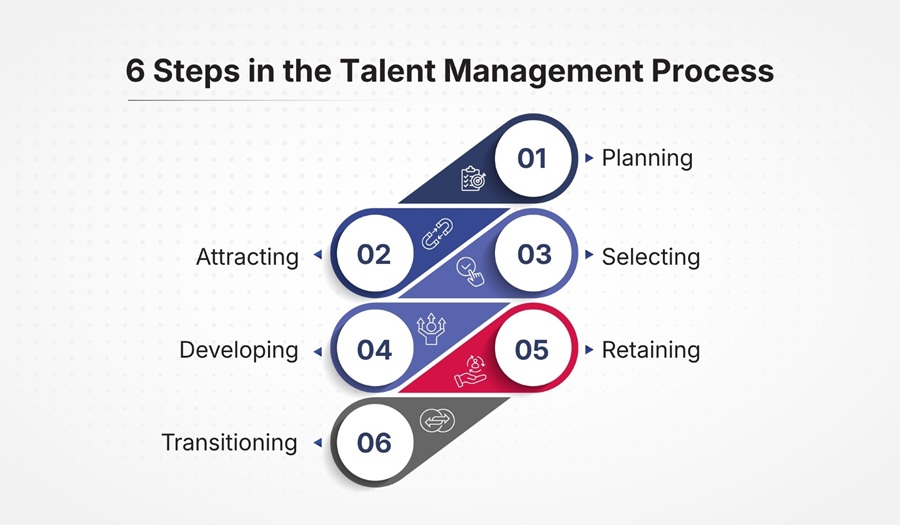
Planning is where the process begins, and where most organizations underinvest. Workforce planning means assessing the skills currently available, projecting what the business will need as priorities shift, and identifying the gap between the two. Done well, it turns hiring from a reactive scramble into a deliberate build. If done poorly, organizations find themselves perpetually filling roles rather than building capability.
Attracting goes beyond job postings. It is shaped entirely by how clearly the organization can articulate its value to prospective employees. Employer branding, the way a company presents its culture, growth opportunities, and working environment, determines the caliber of candidates it draws in. Organizations that treat this as a marketing challenge tend to perform better than those that see it as a logistics issue.
It involves the structured process of evaluating candidates and making hiring decisions. This means assessments, interviews, and reference checks designed to measure both technical fit and cultural alignment. The goal is not to hire the most impressive candidate on paper, but the person most likely to succeed in the specific role and environment.
This covers onboarding, training, mentorship, and the ongoing learning and development opportunities that keep employees growing within the organization. Hiring new workers can cost twice as much as upskilling or reskilling existing employees, which makes internal development both a retention tool and a cost-effective measure. Development should be tied to real business needs rather than generic training calendars.
It is about creating the conditions under which high performers want to stay. This includes fair compensation, but also growth visibility, managerial quality, workload balance, and a sense that the individual's contribution is recognized and valued. One of the most consistent findings in retention research is that employees are more likely to stay when they have open, honest communication with their immediate manager and feel a genuine sense of impact in their work.
It covers movement through roles, whether that is a promotion, a lateral shift to broaden capability, or an eventual departure from the organization. Managing transitions well, including structured exit interviews, ensures that institutional knowledge is preserved and that the organization learns from every departure.
Understanding the components is one thing. Knowing where organizations consistently struggle is what separates a talent management strategy that holds up in practice from one that looks coherent on paper.
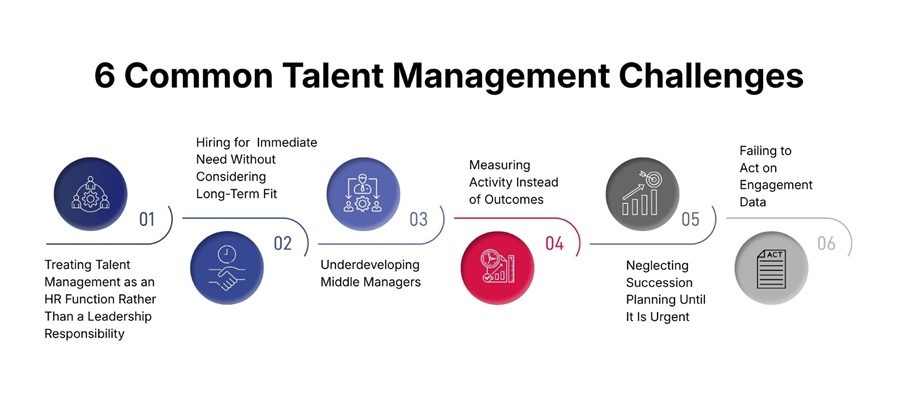
This is the most pervasive challenge. When line managers see performance conversations, development planning, and retention as HR's job rather than their own, the entire system loses its most important delivery mechanism. The daily experience of an employee is shaped almost entirely by their direct manager, which means talent management succeeds or fails at the team level long before any centralized program gets the credit or the blame.
The pressure to fill a role quickly leads organizations to hire the most available candidate rather than the most suitable one. This creates a quiet accumulation of mismatched hires whose skills plateau early or whose values diverge from the organization's direction. The cost of this pattern compounds over time through disengagement, underperformance, and eventual turnover.
Middle managers carry a disproportionate share of talent management responsibility: they conduct performance reviews, identify development needs, handle retention risks, and manage team dynamics. Yet they are frequently the least supported layer of the organization when it comes to their own development. Organizations that invest heavily in senior leadership programs while neglecting frontline and middle management tend to see the gap show up in inconsistent employee experiences across teams.
Many talent management functions track inputs: training hours completed, performance reviews submitted, engagement survey participation rates. These metrics are easy to collect but tell very little about whether the function is actually improving retention, building capability, or developing the leaders the business will need in three years. Outcome-oriented measurement, tracking internal promotion rates, time to productivity for new hires, retention rates among high performers, gives a far more honest picture of whether the investment is working.
Succession planning tends to receive serious attention only when a critical role becomes vacant unexpectedly. At that point, the organization is forced into reactive decisions that carry real risk. Building a pipeline of internal candidates for critical roles is a slow process that requires years of deliberate development, and it cannot be compressed when the need becomes immediate.
Running an annual employee engagement survey and then making no visible changes based on the results is worse than running no survey at all. Employees who take the time to provide feedback and then see no response become more disengaged than those who were never asked. The survey is not the intervention; what happens afterward is.
Most organizations do a reasonable job of recruiting. Where the process breaks down is in the middle: developing people once they are in the door, and retaining them once they have become genuinely valuable.
The issue is structural, as much as intentional. Line managers are often evaluated on team output rather than on how well they develop and retain their people, which causes a misalignment. When retention rates fall, the cost is rarely attributed back to management quality, so the feedback loop that would prompt change is absent.
Talent management also struggles when it operates as a purely HR-owned function rather than a shared organizational responsibility. Only 5% of organizations report having a clear talent management strategy and operational programs in place, which suggests that most are running reactive systems rather than proactive ones. Reactive systems fill open positions; proactive ones prevent positions from becoming open in the first place.
Q. What is the difference between talent management and HR management?
A. HR management is a broader function that covers administrative tasks like payroll, compliance, and employee communications. Talent management sits within HR but is more strategic; it focuses specifically on identifying, developing, and retaining the people who drive organizational performance.
Q. What is a talent management framework?
A. A talent management framework is the blueprint for how an organization executes its talent strategy. It typically defines how recruitment, onboarding, development, performance management, and succession planning connect and reinforce each other.
Q. Why do high performers leave organizations?
A. The most common reason is feeling underutilized. High performers want roles where their contribution is visible and meaningful. When growth opportunities are limited, or when managers do not create space for them to operate with greater autonomy and responsibility, they seek organizations that will.
Q. How does workforce planning fit into talent management?
A. Workforce planning is the foundation of the talent management process. It involves assessing current skills, projecting future needs, and identifying the gap between the two. Without it, organizations hire reactively rather than building toward a defined capability profile.
Q. What role does employee engagement play in retention?
A. Engagement and retention are closely linked. Employees who feel connected to their work, their team, and the organization's purpose are significantly more likely to stay. Engagement is shaped by daily experience, including the quality of management, the meaningfulness of work, and whether employees feel their development is genuinely supported.
Q. Can small organizations implement talent management?
A. Yes. Talent management does not require large HR departments or expensive software. Even a small business benefits from clear job descriptions, structured onboarding, regular performance conversations, and intentional development conversations. The principles scale down as well as up.

Uncover the trends redefining workforce strategy, the skills shaping next-generation CHROs, and strategies to drive lasting impact. Explore insights and assess your readiness to lead the future of talent.
Download the Guide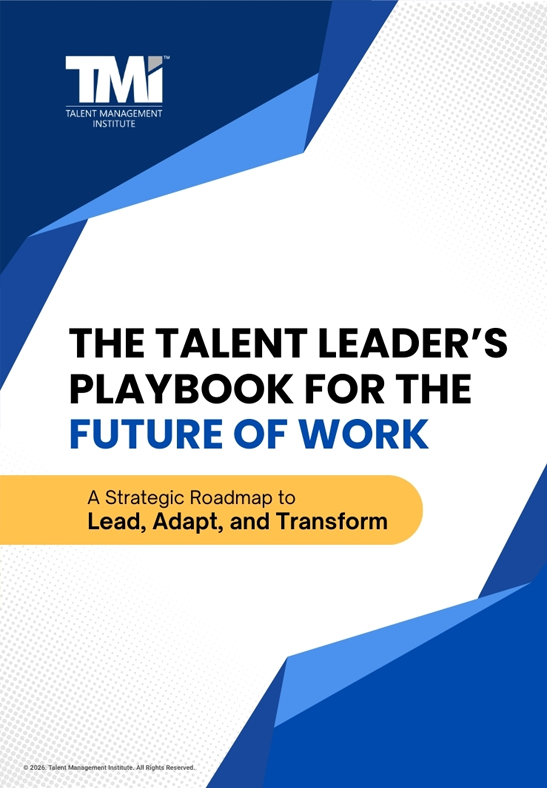

CredBadge™ is a proprietary, secure, digital badging platform that provides for seamless authentication and verification of credentials across digital media worldwide.
CredBadge™ powered credentials ensure that professionals can showcase and verify their qualifications and credentials across all digital platforms, and at any time, across the planet.

Please enter the License Number/Unique Credential Code of the certificant. Results will be displayed if the person holds an active credential from TMI.