We can't wait to hear from you
Connect
Discover how TMI credentials are designed to accelerate your career growth. Explore how TMI incorporates Talent Management into the practice and systems of Human Capital Management. Learn how you can steer your future confidently through TMI's research driven Talent Management standards. Fellow programs equip global HR professionals with the latest in Talent Management in the transformational way.
Explore how the TMP™, STMP™, and GTML™ credentials can take your HR career places, or add to the capabilities of your promising HR staff and leaders.
View CertificationsStrengthen your enterprise HR system by implementing the TMI-ETMS™ international standards.
Learn About TMI-ETMS™If you are interested in consulting, training or education, partner with TMI to join the global league of TMI aligned institutions, companies and industries.
Become a TMI PartnerLearn the latest about how Talent Management is transforming HR into a future oriented business hyperfunction.
Explore the TMI ApproachLearn the steps to earn your TMI certification, from application to successful completion and maintaining your credential.
TMI credentials include globally recognized digital badges, offering a portable and verifiable representation of your achievements.

Kickstart your Talent Management journey with TMI’s globally recognized certifications and resources to excel in your career.
Create myTMI Account TodayTMI Global and Associate Fellow programs turn HR professionals into global Talent Leaders who can drive growth with their superlative strategic ability, business perspective and readiness for change. Since 2024, more than 150 senior HR professionals and HR leaders from 46 global organizations across industries have completed these programs that establish new standards for the practice of talent management as a driver of organizational success and business competitiveness.
You can contact us here for more information.

TMI–ETMS10™ and TMI–ETMS14™ certified organizations are effective for restructuring Talent Management in an organization. With TMI, organizations are better, more agile and better prepared for challenges that are to come.
The TMI-Enterprise Talent Management Standards power enterprise HR with the latest in Talent Management.
To choose a TMI–ETMS™ version most appropriate for your organization!
Write to us via the contact form.

Partnering with TMI means building a powerful structure of Talent Management thought and practice resulting in business profits through standards, certifications and networks.
Get your HR staffers and managers TMI certified on Talent Management by adding TMI into your training regimen. One step toward embedding TMI credentials in your institutions curricula is to become a TMI-ETMS™ consulting partner. Join us to be a part of the groundbreaking work of Talent Management.

If you hold an elite international qualification in HR or a related discipline, possess a recognized HR credential, or studied HRM at a TMI-recognized institution, you may be eligible for an accelerated pathway to a TMI credential through QualiFly™ leading to TMP™, STMP™ or GTML™.
 Institutions
Explore Certification Bodies, Universities, B-Schools & Other Institutions recognized by TMI under the Q1, Q2, and Q3 Lists.
Check if your institution is recognized
TMI’s blogs cover the latest trends, insights, and best practices in HR and talent management.
Comprehensive guides covering talent development, HR metrics, key facts, and more.
Explore TMI's latest updates, announcements, news and press releases in our newsroom.
Strategic insights driving the future of talent, leadership, and global workforce excellence.
Dive into the inspiring journeys of TMI certification holders and learn how the certification has transformed their careers.
An Interview series featuring key advice from global talent leaders for future HR professionals.
TMI’s editorial team is comprised of researchers, writers, editors, proofreaders, and contributors with extensive experience in the HR and Talent Management space. The team scrupulously researches, analyzes and deliberates on each submission before concluding its suitability for our publications.

When a deal closes, the headlines move on to synergies and stock prices. The employees stay behind, navigating a reality that is rarely covered in press releases, including uncertain roles, shifting leadership, rewritten benefit plans, and a workplace culture they may no longer recognize. Understanding what an acquisition actually means for employees and for the companies trying to hold on to them requires looking past the strategic rationale and into the day-to-day experience of the people involved.
The attrition numbers are striking and worth taking seriously. The average employee turnover after a merger reaches 47% within the first year, and climbs to 75% within three years. That is not a people management footnote. It represents a measurable erosion of the very value that many acquisitions are meant to capture.
The reasons employees leave tend to cluster around a few consistent themes. Approximately 30% of M&A retention failures are attributed to differences in company culture between the merging organizations. When a fast-moving, autonomy-driven startup is absorbed by a hierarchical, process-heavy enterprise, the employees who thrived in the original environment often feel stifled within months.
Communication failures accelerate employee departures. 61% of employees who considered leaving their jobs cited poor internal communication as a contributing factor. When leadership stays silent, employees fill the gap with assumptions, and in uncertain environments, those assumptions are rarely optimistic.
There is also the workload problem. Post-merger integration increases demands on existing staff, often without the staffing, training, or role clarity needed to absorb those demands. 40% of employees who receive poor training leave within their first year, and acquisitions frequently drop people into expanded responsibilities before the adequate resources exist.
The first thing most employees want to know after an acquisition is whether their pay and benefits will remain intact. This depends on deal structure and timing.
In a stock purchase, the corporate entity continues and employment terms generally carry over. In an asset purchase, the acquiring company is effectively rehiring the employees it wants to keep, with the freedom to set entirely new terms. Salaries tend to hold steady in the early months, but discretionary pay is more vulnerable. Bonus structures, profit sharing arrangements, and performance incentives are frequently replaced with the buyer’s own programs to ensure parity across the combined workforce.
Health coverage transitions similarly. If the old plan terminates upon close, employees can continue it temporarily under COBRA (Consolidated Omnibus Budget Reconciliation Act), but they absorb the full premium cost, which represents a significant out-of-pocket increase for many. Retirement plans may be merged or terminated. When terminated, employers must fully vest all participants and distribute balances, but employees who miss the rollover window or do not act quickly can face immediate tax liability and penalties.
For employees holding equity, the acquisition can represent a genuine financial event or, in the case of underwater options, nothing at all. Equity vesting structures are often used as retention tools. A double-trigger clause requires two events before unvested shares become accessible: the acquisition closing, and then a qualifying termination such as being laid off or pushed into a significantly different role. This structure keeps employees financially invested in staying through the integration period. Single-trigger acceleration, by contrast, vests everything the moment the deal closes, which means employees have no remaining equity incentive to stay and buyers have less leverage to retain them.
Employee loss after acquisition incurs costs beyond headcount. Experienced employees carry an understanding of internal operations, client relationships, and historical decisions that cannot be transferred through documentation. When those employees go, the integration process slows. Customer relationships that were managed by specific individuals become unstable. Teams that depended on particular colleagues for technical judgment or cultural continuity lose both at once.
The acquisitions that falter most visibly often have sound strategic logic. Failures often arise from mismanaging human factors rather than flawed strategy. When the acquiring company treats culture as a secondary concern or assumes that integration will naturally resolve cultural tension over time, it is usually wrong.
Google’s acquisition of YouTube in 2006 succeeded in part because YouTube was allowed to operate with meaningful autonomy, retaining its brand, leadership, and cultural identity while accessing Google’s infrastructure. DeepMind, acquired in 2014, was granted an operational independence that included its own research agenda, a condition that helped retain a team of researchers who valued academic freedom as much as resources.
Microsoft’s approach under Satya Nadella has become a frequently cited reference for culture-first integration. When Microsoft acquired LinkedIn for USD 26.2 billion, LinkedIn retained its CEO, branding, and operating culture. GitHub, where the open-source community viewed Microsoft’s arrival with skepticism, was managed through restraint. Leadership stayed in place, the hands-off commitment was reaffirmed publicly, and developer trust was rebuilt gradually rather than assumed. Both integrations resulted in continued growth and retention of the engineers and executives who made the assets valuable.
The contrast with failed integrations is instructive. When acquiring companies impose immediate structural conformity, replace leadership with their own appointees, and eliminate the cultural markers that employees identified with, they frequently discover that the talent they paid to acquire has already started looking elsewhere.
Employees at the target company are in a better position when they understand their rights and their options before the ink dries. A few areas deserve particular attention:
Understanding why people leave is the prerequisite to building retention programs that actually work. Several approaches have demonstrated consistent results across different deal types and industries.
Retention bonuses are a direct and widely used mechanism. Nearly 60% of organizations now use retention bonuses during M&A transitions, targeting employees in roles where sudden departure would most disrupt integration. These are typically reserved for senior technical staff, client-facing roles, and leadership positions where knowledge transfer would be slow or incomplete.
Financial incentives, though necessary, rarely hold people on their own. Career clarity matters more to most employees over the medium term. When leadership can articulate a specific growth path within the combined organization, and can show how professional development continues rather than stalls, retention improves substantially. In competitive talent markets, employees whose growth feels stalled by an acquisition will not wait long before exploring what else is available.
Open communication, maintained consistently throughout the transition period, addresses the anxiety that drives premature departures. Regular updates from leadership, short employee surveys that are actually acted upon, and honest answers to the questions employees are asking about their roles reduce the speculation that causes people to reach out to recruiters. The integration period is precisely when leadership credibility is most fragile and most consequential.
The companies that consistently extract long-term value from acquisitions treat talent retention not as a post-deal checklist item but as a central measure of whether the deal succeeded. The innovative capacity, client relationships, and domain expertise that made the acquired company attractive do not automatically transfer with the transaction. They have to be actively preserved, and that requires sustained attention to the people who carry them.
Workforce transitions in mergers and acquisitions are difficult by nature. The uncertainty is real, the structural changes are substantive, and the cultural adjustments take time. Organizations that acknowledge this honestly, communicate with specificity, and demonstrate genuine investment in the careers and wellbeing of employees they have just acquired are the ones whose deals tend to be worth what was paid for them.

Uncover the trends redefining workforce strategy, the skills shaping next-generation CHROs, and strategies to drive lasting impact. Explore insights and assess your readiness to lead the future of talent.
Download the Guide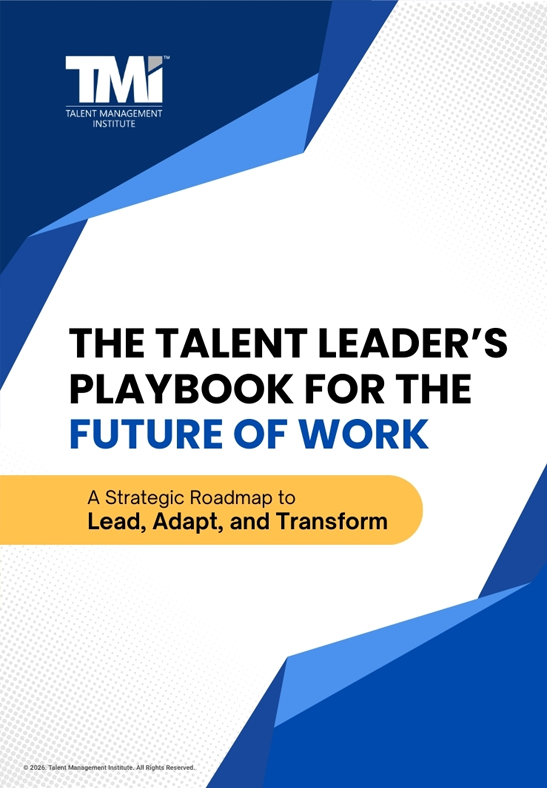

CredBadge™ is a proprietary, secure, digital badging platform that provides for seamless authentication and verification of credentials across digital media worldwide.
CredBadge™ powered credentials ensure that professionals can showcase and verify their qualifications and credentials across all digital platforms, and at any time, across the planet.

Please enter the License Number/Unique Credential Code of the certificant. Results will be displayed if the person holds an active credential from TMI.