We can't wait to hear from you
Connect
Discover how TMI credentials are designed to accelerate your career growth. Explore how TMI incorporates Talent Management into the practice and systems of Human Capital Management. Learn how you can steer your future confidently through TMI's research driven Talent Management standards. Fellow programs equip global HR professionals with the latest in Talent Management in the transformational way.
Explore how the TMP™, STMP™, and GTML™ credentials can take your HR career places, or add to the capabilities of your promising HR staff and leaders.
View CertificationsStrengthen your enterprise HR system by implementing the TMI-ETMS™ international standards.
Learn About TMI-ETMS™If you are interested in consulting, training or education, partner with TMI to join the global league of TMI aligned institutions, companies and industries.
Become a TMI PartnerLearn the latest about how Talent Management is transforming HR into a future oriented business hyperfunction.
Explore the TMI ApproachLearn the steps to earn your TMI certification, from application to successful completion and maintaining your credential.
TMI credentials include globally recognized digital badges, offering a portable and verifiable representation of your achievements.

Kickstart your Talent Management journey with TMI’s globally recognized certifications and resources to excel in your career.
Create myTMI Account TodayTMI Global and Associate Fellow programs turn HR professionals into global Talent Leaders who can drive growth with their superlative strategic ability, business perspective and readiness for change. Since 2024, more than 150 senior HR professionals and HR leaders from 46 global organizations across industries have completed these programs that establish new standards for the practice of talent management as a driver of organizational success and business competitiveness.
You can contact us here for more information.

TMI–ETMS10™ and TMI–ETMS14™ certified organizations are effective for restructuring Talent Management in an organization. With TMI, organizations are better, more agile and better prepared for challenges that are to come.
The TMI-Enterprise Talent Management Standards power enterprise HR with the latest in Talent Management.
To choose a TMI–ETMS™ version most appropriate for your organization!
Write to us via the contact form.

Partnering with TMI means building a powerful structure of Talent Management thought and practice resulting in business profits through standards, certifications and networks.
Get your HR staffers and managers TMI certified on Talent Management by adding TMI into your training regimen. One step toward embedding TMI credentials in your institutions curricula is to become a TMI-ETMS™ consulting partner. Join us to be a part of the groundbreaking work of Talent Management.

If you hold an elite international qualification in HR or a related discipline, possess a recognized HR credential, or studied HRM at a TMI-recognized institution, you may be eligible for an accelerated pathway to a TMI credential through QualiFly™ leading to TMP™, STMP™ or GTML™.
 Institutions
Explore Certification Bodies, Universities, B-Schools & Other Institutions recognized by TMI under the Q1, Q2, and Q3 Lists.
Check if your institution is recognized
TMI’s blogs cover the latest trends, insights, and best practices in HR and talent management.
Comprehensive guides covering talent development, HR metrics, key facts, and more.
Explore TMI's latest updates, announcements, news and press releases in our newsroom.
Strategic insights driving the future of talent, leadership, and global workforce excellence.
Dive into the inspiring journeys of TMI certification holders and learn how the certification has transformed their careers.
An Interview series featuring key advice from global talent leaders for future HR professionals.
TMI’s editorial team is comprised of researchers, writers, editors, proofreaders, and contributors with extensive experience in the HR and Talent Management space. The team scrupulously researches, analyzes and deliberates on each submission before concluding its suitability for our publications.

For decades, career growth followed a single model: climb the ladder. One role led to the next; one title sat above the last, and progress was measured by how far up you went. That model shaped how organizations designed promotion cycles and managed talent at every level.
But the way work moves today has outgrown that structure. Roles are evolving faster than annual review cycles can keep up with. Skills that were relevant two years ago are being replaced by new ones, and employees increasingly want breadth of experience rather than a narrow vertical climb.
The traditional ladder assumes stability, and the modern workplace delivers anything but.
This is where career portfolios and internal mobility programs enter the picture. Instead of a fixed path upward, a career portfolio lets employees build a collection of skills and experiences across roles and functions, creating a career that is adaptable by design.
For HR leaders rethinking their talent management strategy, understanding this shift is essential.
A career portfolio is a professional growth model built around accumulating diverse skills and cross-functional experiences rather than climbing a single vertical track. A marketing professional might move into product strategy, then take on a customer success project before leading a cross-functional initiative.
Each move builds new capabilities without requiring a traditional promotion. Together, these experiences represent a professional’s value in a way that no single job title can.
The career ladder works differently. It follows a linear path where you start in one role, get promoted to the next, and continue moving upward within a defined hierarchy. Success is measured by title and seniority.
This model works well in stable environments where roles stay consistent over long periods, but it struggles when the pace of change outgrows the promotion cycle.
For anyone building a career in talent management, this distinction matters because it directly shapes how you design career paths and succession plans across your organization. It also determines how you build development programs that actually prepare people for what comes next.
The career ladder is not disappearing overnight, but its limitations are becoming harder to ignore. Several converging forces are making the traditional model increasingly difficult to sustain.
Internal mobility programs are the infrastructure that makes career portfolios possible at scale. They give employees visibility into opportunities across the organization and create structured pathways for lateral and vertical movement as well as diagonal transitions between functions.
The business case is strong. Organizations with robust internal mobility programs retain employees 60% longer compared to those without them. Beyond retention, internal hires ramp up faster and already understand the culture and operations, reducing both cost and risk.
Real-world results back this up. Google preferentially fills high-value roles through internal transfers, using performance data to match employee strengths with role demands.
This approach reflects a broader industry shift toward treating internal mobility as a core part of talent strategy rather than a secondary initiative.
Organizations that invest in structured mobility programs are seeing measurable improvements in retention and time-to-fill for critical roles.
Shifting from career ladders to career portfolios requires more than a change in language. It demands new systems and new manager behaviors alongside a fundamentally different approach to how your organization defines growth. Here is how to get started.
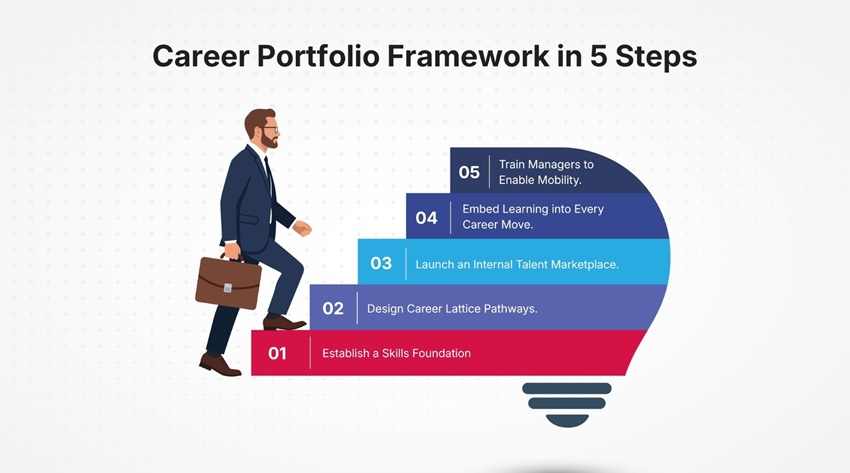
Build a skills taxonomy that captures what your workforce can do today and what capabilities you will need in the next two to three years. This gives you the foundation for every mobility and development decision that follows. Without this layer, career portfolios remain a concept rather than a functioning system.
Replace rigid vertical tracks with lattice models that include lateral moves and cross-functional transitions alongside project-based rotations. Make these pathways visible to employees so they can actively plan their next move. A strong talent management framework should support this kind of multi-directional growth.
Create a transparent platform where employees can explore open roles and short-term projects as well as stretch assignments across the organization. The best marketplaces use skills-based matching rather than title-based filtering.
Connect each transition to a development opportunity. Whether it is a mentorship pairing or a targeted learning module, the move itself should build capability rather than just fill a vacancy.
This is the most overlooked step. Research shows that close to 60% of high-potential employees view their direct manager as the primary barrier to internal mobility. Managers need to be incentivized to develop talent for the organization, not just retain it for their own team.
AI is accelerating the shift toward career portfolios by making skills-based career pathing possible at a scale that manual processes never could.
Modern AI tools can analyze employee profiles and track competency development while recommending personalized career moves based on skills adjacencies rather than job title hierarchies.
AI-powered career coaches can now suggest multi-dimensional career paths by combining factors like desired work and business unit fit with emerging skill requirements. This level of personalization transforms the employee experience from a one-size-fits-all progression track into a genuinely individualized growth journey.
Organizations like IBM have embedded AI deeply into their HR strategy, using workforce intelligence to match high-potential employees with opportunities and predict attrition risk before it becomes a business problem.
EY is similarly using AI to reshape how it evaluates and develops its workforce, signaling that this is not a niche trend but a mainstream shift in how enterprises approach workforce transformation.
The talent management professionals who understand how to govern and implement these AI-driven systems will be the ones leading the next generation of HR. This is not about replacing human judgment with algorithms. It is about equipping talent leaders with tools that make career development more precise and more equitable at the same time.
This shift from ladders to portfolios changes the role of talent management itself. It moves the function from managing hierarchies and promotion cycles to designing ecosystems where skills and mobility are connected to continuous learning.
That requires a broader skill set. Talent managers now need fluency in workforce planning and skills architecture alongside data-driven decision-making and change management. The ability to design and run internal mobility programs is becoming just as critical as traditional competencies like succession planning and performance management.
This is also where the employee experience conversation connects directly to talent strategy. When employees feel they have room to grow in multiple directions, engagement goes up and attrition goes down. Building that kind of environment is not just good for people. It is a measurable business advantage.
For professionals building or advancing a career in talent management, this is an opportunity to lead rather than follow. Showcasing your expertise through recognized talent management certifications signals that you understand these shifts and have the strategic depth to navigate them. The organizations that adapt fastest will be the ones led by talent professionals who saw this coming and prepared for it.
The career ladder model has served organizations effectively for decades ,but the future belongs to professionals and organizations that think in terms of portfolios. Skills-based pathways and internal mobility programs are replacing rigid hierarchies with something far more adaptive. AI is accelerating that transition by making personalized career development possible at scale.
For talent management professionals, this is both a challenge and an opening. The organizations that build portfolio-friendly frameworks will attract, develop, and retain stronger talent. And the HR leaders who understand how to design those systems will define what the next chapter of talent management looks like. The shift is underway; organizations must now focus on how to effectively lead this transformation.
Q. What is a career portfolio?
A. A career portfolio is a collection of skills, experiences, projects, and achievements gained across different roles and functions. Rather than focusing solely on promotions, it emphasizes continuous learning and diverse experiences that increase long-term career adaptability.
Q. How is a career portfolio different from a traditional career ladder?
A. A career ladder follows a linear path of promotions within a specific function or hierarchy. A career portfolio supports growth through lateral moves, cross-functional experiences, project assignments, and skill development, allowing professionals to build broader capabilities.
Q. What are internal mobility programs, and why are they important?
A. Internal mobility programs help employees move into new roles, projects, or departments within the same organization. They support career growth, improve employee retention, and enable organizations to fill critical positions with talent that already understands the business.
Q. How does AI support career development and internal mobility?
A. AI can identify employee skills, recommend learning opportunities, suggest career moves, and match professionals with relevant projects or roles. This helps organizations create more personalized and data-driven career development pathways.

Uncover the trends redefining workforce strategy, the skills shaping next-generation CHROs, and strategies to drive lasting impact. Explore insights and assess your readiness to lead the future of talent.
Download the Guide

CredBadge™ is a proprietary, secure, digital badging platform that provides for seamless authentication and verification of credentials across digital media worldwide.
CredBadge™ powered credentials ensure that professionals can showcase and verify their qualifications and credentials across all digital platforms, and at any time, across the planet.

Please enter the License Number/Unique Credential Code of the certificant. Results will be displayed if the person holds an active credential from TMI.