We can't wait to hear from you
Connect
Discover how TMI credentials are designed to accelerate your career growth. Explore how TMI incorporates Talent Management into the practice and systems of Human Capital Management. Learn how you can steer your future confidently through TMI's research driven Talent Management standards. Fellow programs equip global HR professionals with the latest in Talent Management in the transformational way.
Explore how the TMP™, STMP™, and GTML™ credentials can take your HR career places, or add to the capabilities of your promising HR staff and leaders.
View CertificationsStrengthen your enterprise HR system by implementing the TMI-ETMS™ international standards.
Learn About TMI-ETMS™If you are interested in consulting, training or education, partner with TMI to join the global league of TMI aligned institutions, companies and industries.
Become a TMI PartnerLearn the latest about how Talent Management is transforming HR into a future oriented business hyperfunction.
Explore the TMI ApproachLearn the steps to earn your TMI certification, from application to successful completion and maintaining your credential.
TMI credentials include globally recognized digital badges, offering a portable and verifiable representation of your achievements.

Kickstart your Talent Management journey with TMI’s globally recognized certifications and resources to excel in your career.
Create myTMI Account TodayTMI Global and Associate Fellow programs turn HR professionals into global Talent Leaders who can drive growth with their superlative strategic ability, business perspective and readiness for change. Since 2024, more than 150 senior HR professionals and HR leaders from 46 global organizations across industries have completed these programs that establish new standards for the practice of talent management as a driver of organizational success and business competitiveness.
You can contact us here for more information.

TMI–ETMS10™ and TMI–ETMS14™ certified organizations are effective for restructuring Talent Management in an organization. With TMI, organizations are better, more agile and better prepared for challenges that are to come.
The TMI-Enterprise Talent Management Standards power enterprise HR with the latest in Talent Management.
To choose a TMI–ETMS™ version most appropriate for your organization!
Write to us via the contact form.

Partnering with TMI means building a powerful structure of Talent Management thought and practice resulting in business profits through standards, certifications and networks.
Get your HR staffers and managers TMI certified on Talent Management by adding TMI into your training regimen. One step toward embedding TMI credentials in your institutions curricula is to become a TMI-ETMS™ consulting partner. Join us to be a part of the groundbreaking work of Talent Management.

If you hold an elite international qualification in HR or a related discipline, possess a recognized HR credential, or studied HRM at a TMI-recognized institution, you may be eligible for an accelerated pathway to a TMI credential through QualiFly™ leading to TMP™, STMP™ or GTML™.
 Institutions
Explore Certification Bodies, Universities, B-Schools & Other Institutions recognized by TMI under the Q1, Q2, and Q3 Lists.
Check if your institution is recognized
TMI’s blogs cover the latest trends, insights, and best practices in HR and talent management.
Comprehensive guides covering talent development, HR metrics, key facts, and more.
Explore TMI's latest updates, announcements, news and press releases in our newsroom.
Strategic insights driving the future of talent, leadership, and global workforce excellence.
Dive into the inspiring journeys of TMI certification holders and learn how the certification has transformed their careers.
An Interview series featuring key advice from global talent leaders for future HR professionals.
TMI’s editorial team is comprised of researchers, writers, editors, proofreaders, and contributors with extensive experience in the HR and Talent Management space. The team scrupulously researches, analyzes and deliberates on each submission before concluding its suitability for our publications.

A manager rates one employee a five out of five for solid, dependable work. Down the hall, another manager gives that exact same level of performance a three, simply because their rating scale is more stringent. Neither manager is wrong on their own terms, but put their ratings side by side and the whole review process starts to look arbitrary. Talent calibration meetings address rating disparities by fostering a shared understanding among managers, a practice often underestimated in its impact.
The need for consistent manager decisions has become even more important as organizations adopt
AI-powered HR and performance management tools. According to Gallup’s 2026 State of the Global Workplace Report, only 12% of employees in organizations that have implemented AI strongly agree that AI has transformed how work gets done. The report suggests that technology alone rarely improves organizational performance without effective leadership and manager support. That makes structured processes like talent calibration meetings just as important in the AI era.
Talent calibration is the process where managers and HR come together to compare proposed ratings, discuss the evidence behind them, and align on what each rating actually means across the organization. A talent calibration meeting is not a second review form stapled onto the first one. It is a structured conversation where a rating gets tested against a shared standard rather than one manager's private judgment. The goal remains straightforward even as discussions become complex. Two people performing at the same level, in similar roles, should walk away with the same rating regardless of who happened to manage them that year.
This distinction between performance calibration and talent calibration trips people up often. Performance calibration focuses on aligning ratings for the current review period, while talent calibration looks further ahead, weighing potential alongside performance to inform succession planning. Both processes lean on the same discipline of evidence and discussion, but talent calibration carries the added weight of shaping who gets considered for future roles.
Knowing who belongs in the room matters just as much as knowing what the meeting is for. The core group is usually made up of the direct managers of the employees being discussed, since they carry the supporting data and the proposed ratings into the session. An HR representative or HR business partner typically facilitates, keeping the conversation anchored to the documentation and shared definitions rather than letting it drift into opinion. Peer managers who lead similar roles or adjacent teams often join too, since they can speak to how a given rating compares against people they have worked with directly, even if that employee does not report to them.
A senior HR leader sometimes sits in as well, though usually only when a final approval is required or when a disagreement between managers needs a tiebreaker. Their presence works best as a backstop rather than a regular voice in every discussion, since a senior leader weighing in too often can shift the room toward deferring to seniority instead of evidence. Keeping this group intentionally small also protects the session from the confirmation bias that tends to creep into larger groups.
Teams that treat calibration as optional usually end up paying for that decision later, just in a different currency. Uneven ratings quietly erode trust, and once employees notice the gap, engagement drops fast. This is not a small or rare problem either. According to Gallup’s Report, global employee engagement fell to 20% in 2025, marking the second consecutive annual decline and the lowest level since 2020. Gallup estimates that low engagement cost the global economy approximately USD 10 trillion in lost productivity, or roughly 9% of global GDP. Consistent and transparent performance practices, including calibration meetings, play an important role in maintaining employee trust and engagement.
The cost extends beyond review conversation itself too. Compensation increases, bonus pools, and promotion slates all draw from the same set of ratings, so a generous manager in one team and a stingy one in another quietly reroute budget and opportunity toward whoever happened to work for the easier grader, regardless of actual contribution.
A compensation committee working from uncalibrated ratings has no reliable way to tell whether a proposed raise reflects genuine impact or simply reflects which manager wrote the review that year. Once that pattern repeats across a few cycles, the employees who notice it tend to stop bringing their strongest work forward long before anyone in HR sees an obvious sign of trouble, which makes calibration less a fairness exercise and more a way of protecting the accuracy of every decision that gets built on top of those ratings.
Even teams that follow every step above can still trip on a handful of recurring mistakes. Watching these directly tends to save more time than fixing the fallout afterward.
Most calibration failures trace back to what happened, or did not happen, before anyone sat down in the room. Rating definitions need to exist and be shared well ahead of the review cycle, spelling out what separates "meets expectations" from "exceeds expectations" in terms managers can point to rather than interpret on their own. Documentation needs to be gathered too, drawing on goal completion records, peer feedback, and specific behavioral examples rather than general impressions formed over the year.
A short list captures what a solid evidence packet typically includes:
Skipping this preparation step is the single most common reason calibration sessions run long and result in inconsistent outcomes. When managers arrive without documentation, the conversation drifts toward impressions and personality, which is exactly the terrain where bias operates most freely.
A calibration meeting works best when it has structure, a clear facilitator, and a group small enough that everyone's voice actually gets heard. This point is particularly important, since groups with seven or more participants become more susceptible to confirmation bias, which pushes discussions toward whichever opinion gets voiced first and loudest rather than the strongest supporting data on the table.
A practical flow keeps the conversation moving without letting any single case eat the whole session. The manager presents the proposed rating along with the top few pieces of supporting data. Peer managers who have interacted with that employee add context. The facilitator asks a probing question if the rating seems inconsistent with similar cases discussed earlier. The group then confirms or adjusts the rating, and someone documents the reasoning behind whatever changed. Starting with the highest and lowest performers first tends to help, since those cases usually have the clearest documentation and establish reference points that make the harder, middle tier decisions easier to judge consistently.
Talent calibration has become even more important as organizations adopt AI-assisted performance management and workforce planning tools. AI adoption in the workplace depends on more than simply introducing new technology. Gallup’s Report found that, after the technical integration of AI tools, manager support is the strongest predictor of regular AI use across organizations.
Employees who strongly agree that their manager actively supports AI are:
These findings reinforce that structured manager conversations, including talent calibration meetings, remain essential even as AI becomes part of HR decision-making.
Calibration is often viewed as a way to eliminate bias, but the room itself can introduce new distortions if nobody is watching for them. Recency bias pulls attention toward the last few weeks of a review period instead of the full stretch. Similarity bias quietly favors employees who resemble the manager doing the rating. Central tendency pushes everyone toward a safe middle score to avoid an uncomfortable conversation. None of these patterns announce themselves, which is exactly why a named facilitator with the specific job of watching for them matters as much as the supporting data on the table.
A few concrete techniques do more to interrupt these patterns than a general reminder to stay objective ever will. Picking two benchmark employees before the session, one solid performer and one clear standout, and anchoring every other discussion against those two examples keeps the group comparing performance to a fixed standard rather than to whoever happens to get discussed next.
A short red flag list also helps, since vague phrases like "great attitude" or "not proactive" get flagged on sight, and the manager using one of them has to replace it with a specific example before the rating moves forward. For the most contested cases, some teams strip names and team context from the discussion entirely and review only the outcomes and behaviors on record, an approach that tends to realign a divided room faster than any reminder about bias on its own.
The value of talent review meetings extends well past the current review cycle. A well run calibration produces a talent assessment that leaders can actually trust when making decisions about promotions, development investment, and succession planning. Without that trust, succession conversations tend to lean on whoever is most visible or most recently discussed, rather than a documented, comparable record of performance and potential across the organization.
Calibration, done with real discipline around evidence and bias, turns individual opinions into decisions the organization can defend and act on with confidence. That confidence is what ultimately separates a talent process people trust from one they quietly route around.

Uncover the trends redefining workforce strategy, the skills shaping next-generation CHROs, and strategies to drive lasting impact. Explore insights and assess your readiness to lead the future of talent.
Download the Guide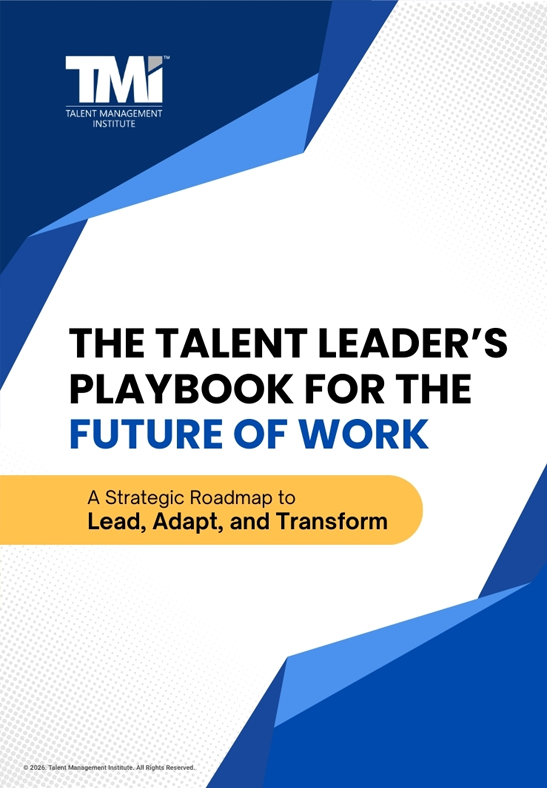

CredBadge™ is a proprietary, secure, digital badging platform that provides for seamless authentication and verification of credentials across digital media worldwide.
CredBadge™ powered credentials ensure that professionals can showcase and verify their qualifications and credentials across all digital platforms, and at any time, across the planet.

Please enter the License Number/Unique Credential Code of the certificant. Results will be displayed if the person holds an active credential from TMI.