We can't wait to hear from you
Connect
Discover how TMI credentials are designed to accelerate your career growth. Explore how TMI incorporates Talent Management into the practice and systems of Human Capital Management. Learn how you can steer your future confidently through TMI's research driven Talent Management standards. Fellow programs equip global HR professionals with the latest in Talent Management in the transformational way.
Explore how the TMP™, STMP™, and GTML™ credentials can take your HR career places, or add to the capabilities of your promising HR staff and leaders.
View CertificationsStrengthen your enterprise HR system by implementing the TMI-ETMS™ international standards.
Learn About TMI-ETMS™If you are interested in consulting, training or education, partner with TMI to join the global league of TMI aligned institutions, companies and industries.
Become a TMI PartnerLearn the latest about how Talent Management is transforming HR into a future oriented business hyperfunction.
Explore the TMI ApproachLearn the steps to earn your TMI certification, from application to successful completion and maintaining your credential.
TMI credentials include globally recognized digital badges, offering a portable and verifiable representation of your achievements.

Kickstart your Talent Management journey with TMI’s globally recognized certifications and resources to excel in your career.
Create myTMI Account TodayTMI Global and Associate Fellow programs turn HR professionals into global Talent Leaders who can drive growth with their superlative strategic ability, business perspective and readiness for change. Since 2024, more than 150 senior HR professionals and HR leaders from 46 global organizations across industries have completed these programs that establish new standards for the practice of talent management as a driver of organizational success and business competitiveness.
You can contact us here for more information.

TMI–ETMS10™ and TMI–ETMS14™ certified organizations are effective for restructuring Talent Management in an organization. With TMI, organizations are better, more agile and better prepared for challenges that are to come.
The TMI-Enterprise Talent Management Standards power enterprise HR with the latest in Talent Management.
To choose a TMI–ETMS™ version most appropriate for your organization!
Write to us via the contact form.

Partnering with TMI means building a powerful structure of Talent Management thought and practice resulting in business profits through standards, certifications and networks.
Get your HR staffers and managers TMI certified on Talent Management by adding TMI into your training regimen. One step toward embedding TMI credentials in your institutions curricula is to become a TMI-ETMS™ consulting partner. Join us to be a part of the groundbreaking work of Talent Management.

If you hold an elite international qualification in HR or a related discipline, possess a recognized HR credential, or studied HRM at a TMI-recognized institution, you may be eligible for an accelerated pathway to a TMI credential through QualiFly™ leading to TMP™, STMP™ or GTML™.
 Institutions
Explore Certification Bodies, Universities, B-Schools & Other Institutions recognized by TMI under the Q1, Q2, and Q3 Lists.
Check if your institution is recognized
TMI’s blogs cover the latest trends, insights, and best practices in HR and talent management.
Comprehensive guides covering talent development, HR metrics, key facts, and more.
Explore TMI's latest updates, announcements, news and press releases in our newsroom.
Strategic insights driving the future of talent, leadership, and global workforce excellence.
Dive into the inspiring journeys of TMI certification holders and learn how the certification has transformed their careers.
An Interview series featuring key advice from global talent leaders for future HR professionals.
TMI’s editorial team is comprised of researchers, writers, editors, proofreaders, and contributors with extensive experience in the HR and Talent Management space. The team scrupulously researches, analyzes and deliberates on each submission before concluding its suitability for our publications.

Most HR dashboards display impressive visualizations filled with metrics that look important but don't actually inform decisions. Leadership glances at the charts during quarterly reviews, nods approvingly, then makes workforce decisions based on gut instinct and anecdotal evidence.
The problem isn't the data. Organizations track plenty of workforce information. The problem is that traditional HR dashboards measure activity rather than outcomes. They show how many training hours were delivered, not whether employees gained skills that improve performance. They track time to fill positions, not whether new hires succeed in their roles.
McKinsey research indicates that companies putting talent at the center of business strategy realize higher total shareholder returns than competitors. But achieving that requires measuring what actually matters: whether your talent investments deliver returns.
A strategic talent dashboard shifts focus from tracking HR activities to measuring business impact. It answers questions executives actually care about:
These questions require different metrics than most dashboards provide.
Most HR dashboards report what happened. Strategic dashboards explain what to do next.
Traditional HR dashboards evolved to prove HR's operational efficiency. They demonstrate that the function processes paperwork quickly, runs programs smoothly, and maintains compliance. These metrics mattered when HR's primary role was administrative.
But when strategy depends on having the right talent in critical roles, operational efficiency metrics become inadequate. A recruiting team might fill positions quickly while consistently hiring people who underperform. Training programs might achieve high completion rates while failing to build needed capabilities. Performance reviews might happen on schedule while failing to identify or develop high performers.
The disconnect appears when dashboards show positive trends while business leaders complain about talent problems. Recruiting metrics look great, yet critical positions remain understaffed with qualified people. Training participation is high, yet skills gaps persist. Retention rates are stable, yet the best performers keep leaving.
These measurement gaps translate directly into business performance problems that traditional HR metrics miss entirely. Sales teams now take an average of 5.7 months to reach full productivity, 32% longer than five years ago. Traditional dashboards tracking time to hire or onboarding completion rates wouldn't surface this productivity problem. A strategic dashboard measuring time to productivity would.
This disconnects between what HR measures and what actually drives performance plays out repeatedly across organizations. Consider what happens when a company optimizes the wrong recruiting metric:
A mid-sized technology company tracked time-to-hire religiously and celebrated when they reduced it from 45 to 30 days. Their recruiting dashboard showed green across the board. Yet six months later, department heads complained that new engineers weren't contributing as expected.
When HR added time-to-productivity tracking, the real problem emerged. While hiring happened faster, new employees took an average of 8 months to deliver work at expected quality levels - two months longer than the previous year.
The company adjusted its approach, adding technical assessments that extended time-to-hire back to 38 days but reduced time-to-productivity to 5.5 months. The total time from job posting to full contribution dropped by nearly three months, and manager satisfaction with new hires increased significantly. The lesson: measuring what actually matters reveals problems that activity metrics hide.
Strategic talent dashboards organize around business outcomes rather than HR activities. They measure talent's contribution to organizational performance through metrics executives that can connect directly to results.
Productivity and value creation metrics show whether talent investments generate returns. Revenue per employee provides a blunt but useful baseline. More sophisticated measures examine output per employee in comparable roles, comparing high performers against average performers. McKinsey analysis shows that top performers in highly critical roles deliver 800% more productivity than average performers in the same role.
Quality of hire metrics assess whether recruiting delivers people who succeed. Track new hire performance ratings, retention rates after 90 days or one year, and hiring manager satisfaction. When quality of hire drops, investigate whether job requirements are unclear; interview processes are ineffective, or offers aren't attracting top candidates.
Time to productivity metrics reveals how quickly new hires contribute value. Define what "fully productive" means for each role, then measure how long it takes new employees to reach that level. Extended ramp-up periods suggest problems with recruiting, onboarding, or both.
Skills gap metrics identify capability mismatches between what strategy requires and what the workforce can deliver. Map critical skills needed for business objectives, assess current workforce capabilities, then track gaps by function, level, and time horizon. This forward-looking view enables proactive development rather than reactive hiring.
High performer retention metrics focus on keeping the people who matter most. Overall retention rates can look healthy while your best talent leaves. Track separately the turnover rates of high performers, high potentials, and people in critical roles. When these specialized retention metrics deteriorate, investigate causes before the problem compounds.
Workforce planning requires predicting future talent needs, identifying gaps, and taking action to close them before they limit business performance. Traditional approaches focus on headcount forecasts. Strategic planning examines capabilities.
Capability gap analysis starts with strategy. What must the organization accomplish? What capabilities does that require? How many people with each critical capability are needed? Compare that to current workforce capabilities to identify gaps by skill, role, and timeline.
Internal mobility metrics show whether people move across roles, teams, and projects. Track promotions, lateral transfers, and cross-functional assignments. High internal mobility suggests that the organization develops talent and provides growth opportunities. Low mobility may indicate rigid structures or insufficient development of investment.
Succession planning effectiveness measures whether critical roles can be filled internally. Track the percentage of critical roles with identified successors, bench strength for each role, and time to readiness for candidates. When succession coverage is weak, development programs and retention efforts need strengthening.
Learning and development ROI connects training investment to business outcomes. Measure training completion rates to ensure employees finish programs. Track whether training improves performance through before-and-after assessments. Calculate cost per employee trained and compare against performance improvements gained.
Building strategic talent dashboards requires overcoming several common obstacles. Most organizations don't fail because they lack data. They fail because they can't connect it.
Data quality problems undermine even well-designed dashboards. Incomplete performance data, inconsistent skill assessments, and unreliable productivity measures produce misleading insights. Address data quality systematically before investing heavily in dashboard design.
System integration challenges emerge when talent data lives in multiple disconnected systems. Recruiting data sits in an applicant tracking system, performance information resides in a separate platform, compensation details exist in payroll systems. Pulling these together for unified analysis requires integration work many organizations underestimate.
Metric definition disputes slow progress when stakeholders disagree about what to measure or how. What constitutes a "high performer"? How do you define "productivity" for roles where output isn't easily quantified? Resolve these definitional questions early through stakeholder alignment sessions.
User adoption failures occur when dashboards get built but not used. Even excellent dashboards fail if leaders don't incorporate them into regular decision processes. Drive adoption by showing leaders how specific metrics answer questions they already face.
Start by identifying the three most important talent decisions your organization makes regularly. Hiring for critical roles? Developing future leaders? Retaining specialists in high demand? Design dashboard metrics specifically to inform those decisions.
Define what "good" looks like for each metric. Set targets based on industry benchmarks, historical performance, or business requirements. Without targets, numbers lack context. Is 15% annual turnover acceptable or alarming? It depends on industry norms, role criticality, and historical trends.
Establish data collection processes that don't burden managers. Automated data pulls from existing systems work better than asking managers to input information manually. The more friction involved in updating dashboards, the less reliable data becomes.
Create role-specific views showing each leader only metrics relevant to their responsibilities. Chief people officers need organization-wide visibility. Division leaders need their division's metrics plus competitive context. This targeted approach prevents information overload.
Build feedback loops for continuous improvement. Which metrics actually inform decisions? Which ones never get referenced? What questions can't be answered with current data? Use these insights to refine the dashboard iteratively.
The shift from traditional to strategic talent dashboards requires changing what gets measured and why. Traditional dashboards measure whether HR completed planned activities. Strategic dashboards measure whether those activities produced desired business outcomes.
This transition demands discipline. Some beloved metrics will disappear because they don't connect to outcomes. Training hours delivered might be replaced by skills gained and applied. Recruiting pipeline size might give way to quality of hire and time to productivity.
The payoff comes when executives stop viewing HR metrics as activity reports and start using them to make better talent decisions. When a dashboard shows that certain recruiting sources consistently produce higher quality hires, shift spending toward those sources. When data reveals that specific development programs correlate with better performance, expand those programs.
McKinsey analysis shows that three measurable factors cause productivity loss: skill gaps, engagement gaps, and time waste. A strategic dashboard surfaces these factors so organizations can address root causes rather than reacting to symptoms.
Strategic talent dashboards succeed when they change decision-making. Leaders stop relying primarily on intuition and start asking "what does the data show?" before making major talent investments.
Recruiting strategies shift based on quality of hire trends by source. Development budgets get allocated to programs showing measurable impact on performance. Retention efforts focus on segments where turnover creates the most risk. Workforce planning drives proactive capability building rather than reactive hiring.
The transformation takes time. Building infrastructure, establishing processes, and changing behaviors requires sustained commitment. But organizations that make the investment gain visibility into whether their largest expense, their workforce, delivers corresponding value.
Success doesn't mean eliminating all traditional HR metrics. Operational measures still matter for managing day-to-day HR functions. The distinction is whether these operational metrics support strategic metrics that executives use to make business decisions.
Designing strategic talent dashboards requires shifting from measuring what HR does to measuring what talent delivers. It demands identifying metrics that actually inform critical decisions and building infrastructure to track those metrics reliably.
The work involves technical challenges around data integration and quality. It requires stakeholder alignment on definitions and targets. Most fundamentally, it demands discipline to focus on metrics that matter while resisting the temptation to track everything available.
Organizations that get this right gain a significant advantage. They make better talent decisions, allocate development resources more effectively, and address retention risks before they escalate. Their talent investments produce measurable returns rather than operating as acts of faith.
The alternative, continuing to track activities while hoping they produce desired outcomes, becomes increasingly untenable as competition for talent intensifies and economic pressures demand demonstrable ROI from all investments. The advantage doesn't come from having more data. It comes from measuring what actually drives performance and acting on it.

Uncover the trends redefining workforce strategy, the skills shaping next-generation CHROs, and strategies to drive lasting impact. Explore insights and assess your readiness to lead the future of talent.
Download the Guide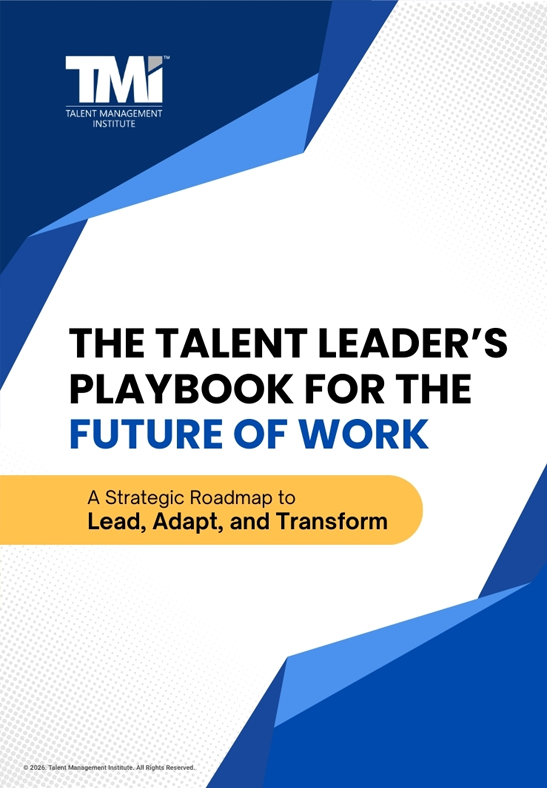

CredBadge™ is a proprietary, secure, digital badging platform that provides for seamless authentication and verification of credentials across digital media worldwide.
CredBadge™ powered credentials ensure that professionals can showcase and verify their qualifications and credentials across all digital platforms, and at any time, across the planet.

Please enter the License Number/Unique Credential Code of the certificant. Results will be displayed if the person holds an active credential from TMI.