We can't wait to hear from you
Connect
Discover how TMI credentials are designed to accelerate your career growth. Explore how TMI incorporates Talent Management into the practice and systems of Human Capital Management. Learn how you can steer your future confidently through TMI's research driven Talent Management standards. Fellow programs equip global HR professionals with the latest in Talent Management in the transformational way.
Explore how the TMP™, STMP™, and GTML™ credentials can take your HR career places, or add to the capabilities of your promising HR staff and leaders.
View CertificationsStrengthen your enterprise HR system by implementing the TMI-ETMS™ international standards.
Learn About TMI-ETMS™If you are interested in consulting, training or education, partner with TMI to join the global league of TMI aligned institutions, companies and industries.
Become a TMI PartnerLearn the latest about how Talent Management is transforming HR into a future oriented business hyperfunction.
Explore the TMI ApproachLearn the steps to earn your TMI certification, from application to successful completion and maintaining your credential.
TMI credentials include globally recognized digital badges, offering a portable and verifiable representation of your achievements.

Kickstart your Talent Management journey with TMI’s globally recognized certifications and resources to excel in your career.
Create myTMI Account TodayTMI Global and Associate Fellow programs turn HR professionals into global Talent Leaders who can drive growth with their superlative strategic ability, business perspective and readiness for change. Since 2024, more than 150 senior HR professionals and HR leaders from 46 global organizations across industries have completed these programs that establish new standards for the practice of talent management as a driver of organizational success and business competitiveness.
You can contact us here for more information.

TMI–ETMS10™ and TMI–ETMS14™ certified organizations are effective for restructuring Talent Management in an organization. With TMI, organizations are better, more agile and better prepared for challenges that are to come.
The TMI-Enterprise Talent Management Standards power enterprise HR with the latest in Talent Management.
To choose a TMI–ETMS™ version most appropriate for your organization!
Write to us via the contact form.

Partnering with TMI means building a powerful structure of Talent Management thought and practice resulting in business profits through standards, certifications and networks.
Get your HR staffers and managers TMI certified on Talent Management by adding TMI into your training regimen. One step toward embedding TMI credentials in your institutions curricula is to become a TMI-ETMS™ consulting partner. Join us to be a part of the groundbreaking work of Talent Management.

If you hold an elite international qualification in HR or a related discipline, possess a recognized HR credential, or studied HRM at a TMI-recognized institution, you may be eligible for an accelerated pathway to a TMI credential through QualiFly™ leading to TMP™, STMP™ or GTML™.
 Institutions
Explore Certification Bodies, Universities, B-Schools & Other Institutions recognized by TMI under the Q1, Q2, and Q3 Lists.
Check if your institution is recognized
TMI’s blogs cover the latest trends, insights, and best practices in HR and talent management.
Comprehensive guides covering talent development, HR metrics, key facts, and more.
Explore TMI's latest updates, announcements, news and press releases in our newsroom.
Strategic insights driving the future of talent, leadership, and global workforce excellence.
Dive into the inspiring journeys of TMI certification holders and learn how the certification has transformed their careers.
An Interview series featuring key advice from global talent leaders for future HR professionals.

Gabriel Nam is a talent management specialist at Mercuri Urval with more than twenty years of experience in executive search and leadership advisory. He is a Certified ESG Analyst and holds the GTML™ qualification. He lectures part‑time on sustainability, talent management, and leadership.

Over the past decade, attention to sustainability and corporate responsibility has intensified, even as some large organizations have scaled back public ESG commitments. As environmental, social, and governance considerations evolve, human resources leaders play a central role in shaping practice, aligning incentives, and sustaining culture across the enterprise.
While environmental topics often receive the most visibility, HR’s remit touches several material areas of ESG.
According to EFFAS, talent management forms a core component of ESG reporting. Turnover, internal mobility, training, and leadership development are measurable indicators that sit squarely with HR and influence long‑term organizational resilience.
Employee interest in sustainability is high across many sectors. Organizations that treat ESG as a strategic management discipline, rather than only a compliance obligation, tend to see stronger engagement and clearer line‑of‑sight between work and purpose.
HR often stewards programs that protect physical and psychological health. The growing focus on mental well‑being requires coordinated policy, access to services, and clear measurement.
Many organizations position community initiatives within HR or talent functions rather than marketing. HR can help design participation models, recognition approaches, and workload norms that make participation feasible and equitable.
DEI is a defined element of the social dimension of ESG. Given heightened scrutiny of DEI programs, HR must ensure fairness, transparency, and proportionality in design and execution while monitoring employee sentiment and outcomes.
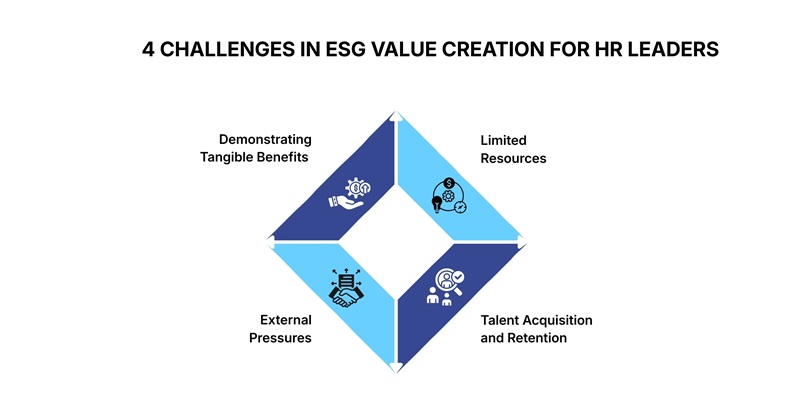
ESG impact varies by industry and time horizon, and the function is still maturing in many organizations. HR should frame outcomes in terms of risk management, human capital quality, and long‑term value, supported by relevant metrics.
After initial program setup, budgets may shift toward nearer‑term priorities. HR can prioritize a small number of high‑leverage initiatives and sequence the rest over realistic timelines.
Public discourse, regulatory changes, and concerns about greenwashing can make leaders cautious about labels. Clarity of intent and careful language reduces the risk of overstatement.
Demand for ESG capability has been cyclical. HR should define role profiles precisely, assess for applied experience, and invest in targeted development for internal candidates.
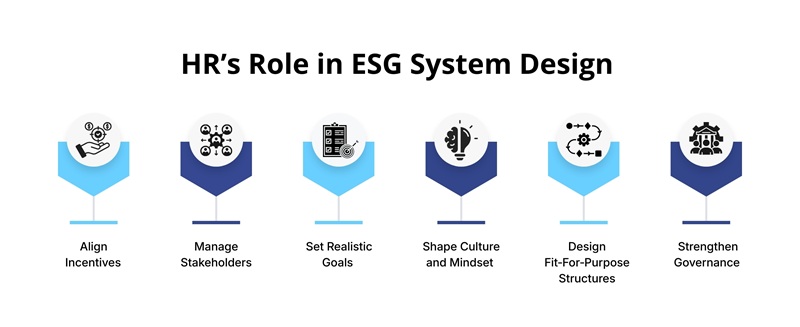
Communicate the practical relevance of ESG to each function and role. Share specific cases where teams improved outcomes or reduced risk. Where appropriate, connect elements of variable compensation to defined ESG indicators that leaders can influence.
Set expectations on scope and time horizons. Be explicit that not all ESG objectives yield immediate returns and that trade‑offs require staged delivery.
Avoid targets that encourage box‑checking. Combine a small number of hard metrics with qualitative milestones that indicate meaningful progress. Use HR’s proximity to employee sentiment to surface equity and fairness concerns early.
Model steady, evidence‑led decision‑making. Encourage experimentation within clear boundaries. Recognize teams that design pragmatic solutions to complex issues such as climate adaptation, supply chain labor standards, or accessibility.
Select structures that match the organization’s context, whether centralized teams, distributed networks, or hybrid models. Document the rationale and revisit it periodically to address skepticism and changing needs.
Coordinate with compliance, risk, and internal audit on policy clarity and control design. Support boards and remuneration committees in aligning executive incentives with a focused set of ESG priorities.
Effective ESG integration is a cross‑functional effort. HR’s contribution is to build the systems, incentives, and culture that sustain progress while avoiding overstatement. In periods when short‑term pressures dominate, disciplined attention to talent, equity, and organizational health helps preserve the capacity to meet regulatory expectations and maintain the social license to operate over the long term.
Gabriel Nam is a talent management specialist at Mercuri Urval with more than twenty years of experience in executive search and leadership advisory. He is a Certified ESG Analyst and holds the GTML™ qualification. He lectures part‑time on sustainability, talent management, and leadership.

Uncover the trends redefining workforce strategy, the skills shaping next-generation CHROs, and strategies to drive lasting impact. Explore insights and assess your readiness to lead the future of talent.
Download the Guide

CredBadge™ is a proprietary, secure, digital badging platform that provides for seamless authentication and verification of credentials across digital media worldwide.
CredBadge™ powered credentials ensure that professionals can showcase and verify their qualifications and credentials across all digital platforms, and at any time, across the planet.

Please enter the License Number/Unique Credential Code of the certificant. Results will be displayed if the person holds an active credential from TMI.