We can't wait to hear from you
Connect
Discover how TMI credentials are designed to accelerate your career growth. Explore how TMI incorporates Talent Management into the practice and systems of Human Capital Management. Learn how you can steer your future confidently through TMI's research driven Talent Management standards. Fellow programs equip global HR professionals with the latest in Talent Management in the transformational way.
Explore how the TMP™, STMP™, and GTML™ credentials can take your HR career places, or add to the capabilities of your promising HR staff and leaders.
View CertificationsStrengthen your enterprise HR system by implementing the TMI-ETMS™ international standards.
Learn About TMI-ETMS™If you are interested in consulting, training or education, partner with TMI to join the global league of TMI aligned institutions, companies and industries.
Become a TMI PartnerLearn the latest about how Talent Management is transforming HR into a future oriented business hyperfunction.
Explore the TMI ApproachLearn the steps to earn your TMI certification, from application to successful completion and maintaining your credential.
TMI credentials include globally recognized digital badges, offering a portable and verifiable representation of your achievements.

Kickstart your Talent Management journey with TMI’s globally recognized certifications and resources to excel in your career.
Create myTMI Account TodayTMI Global and Associate Fellow programs turn HR professionals into global Talent Leaders who can drive growth with their superlative strategic ability, business perspective and readiness for change. Since 2024, more than 150 senior HR professionals and HR leaders from 46 global organizations across industries have completed these programs that establish new standards for the practice of talent management as a driver of organizational success and business competitiveness.
You can contact us here for more information.

TMI–ETMS10™ and TMI–ETMS14™ certified organizations are effective for restructuring Talent Management in an organization. With TMI, organizations are better, more agile and better prepared for challenges that are to come.
The TMI-Enterprise Talent Management Standards power enterprise HR with the latest in Talent Management.
To choose a TMI–ETMS™ version most appropriate for your organization!
Write to us via the contact form.

Partnering with TMI means building a powerful structure of Talent Management thought and practice resulting in business profits through standards, certifications and networks.
Get your HR staffers and managers TMI certified on Talent Management by adding TMI into your training regimen. One step toward embedding TMI credentials in your institutions curricula is to become a TMI-ETMS™ consulting partner. Join us to be a part of the groundbreaking work of Talent Management.

If you hold an elite international qualification in HR or a related discipline, possess a recognized HR credential, or studied HRM at a TMI-recognized institution, you may be eligible for an accelerated pathway to a TMI credential through QualiFly™ leading to TMP™, STMP™ or GTML™.
 Institutions
Explore Certification Bodies, Universities, B-Schools & Other Institutions recognized by TMI under the Q1, Q2, and Q3 Lists.
Check if your institution is recognized
TMI’s blogs cover the latest trends, insights, and best practices in HR and talent management.
Comprehensive guides covering talent development, HR metrics, key facts, and more.
Explore TMI's latest updates, announcements, news and press releases in our newsroom.
Strategic insights driving the future of talent, leadership, and global workforce excellence.
Dive into the inspiring journeys of TMI certification holders and learn how the certification has transformed their careers.
An Interview series featuring key advice from global talent leaders for future HR professionals.
TMI’s editorial team is comprised of researchers, writers, editors, proofreaders, and contributors with extensive experience in the HR and Talent Management space. The team scrupulously researches, analyzes and deliberates on each submission before concluding its suitability for our publications.

For decades, the path to leadership followed a predictable rhythm. Junior employees analyzed data, prepared presentations, sat through meetings, and slowly earned bigger responsibilities by proving themselves through the sheer volume of work they could handle. As artificial intelligence takes over much of the routine analysis and documentation that once served as a proving ground, organizations are being forced to ask a harder question than whether Gen Z wants to lead. They are asking whether the signals they have always used to spot leadership potential still mean anything in a workplace where a 24-year-old can generate a market analysis or a first draft strategy in minutes.
The change is already evident. According to Deloitte Global 2026 Gen Z and Millennial Survey, 74% of Gen Zs and millennials now report using AI to some extent in their day-to-day work, up sharply from 57% of Gen Zs and 56% of millennials in the previous year. AI tools are now common in tasks like data analysis and content creation for Gen Z employees.
This is not a minor adjustment to hiring criteria. It touches on how companies identify talent, how young employees learn the unwritten rules of decision-making, and how leadership itself gets defined when AI can outproduce a junior employee on almost every routine task. Understanding what is changing, and what organizations are doing about it, matters for anyone thinking seriously about the future leadership pipeline.
For years, output was a reasonably reliable stand-in for potential. An employee who could produce more analysis, write more reports, or juggle more projects was assumed to be building the judgement needed for leadership. AI has undermined that assumption. When a tool can compress hours of documentation into a few minutes, the sheer quantity of work someone produces stops telling a manager much about their readiness to lead.
The shift is particularly significant because Gen Z is already using AI for tasks that once formed part of junior-level development. According to Deloitte’ 2026 Survey, 50% of Gen Zs use AI for data analysis, while 42% use it for content creation and 42% for design and creativity. Another 37% use AI for project management, while 38% use it for strategy-related activities. Among millennials, the corresponding figures are 53% for data analysis, 46% for content creation, 43% for design and creativity, 39% for project management and 38% for strategy.
This means that organizations cannot assume that performing these tasks manually demonstrates leadership potential in the way it once might have. The more valuable question is what an employee does with the time and capability AI creates.
A common assumption is that Gen Z is passively opting out of leadership altogether. The numbers tell a more layered story.
Deloitte’s 2026 survey found that only 6% of Gen Zs and millennials identify achieving a leadership position as their primary career goal. That does not necessarily mean they reject leadership. Instead, leadership appears to be competing with other priorities, particularly wellbeing, financial independence, flexibility, and stability.
AI may also be changing what younger employees expect from leadership. Rather than viewing leadership solely as a promotion into people management, Gen Z may place greater value on meaningful work, flexibility, skill development, and opportunities to build expertise. This makes specialist and expert career paths more relevant alongside traditional management tracks.
Career progression itself is also being redefined. 44% of Gen Zs say they prefer steady progress, compared with 25% who favor fast-paced growth involving promotions, titles, or salary increases. Among millennials, 46% prefer steady progress, while 21% favor fast-paced growth. This suggests that younger employees may be more willing to build expertise gradually rather than treating management as the only measure of career advancement.
AI can also make some traditional management roles less attractive if employees associate them primarily with administrative work, reporting, coordination, and information management—areas where AI can provide support. The more attractive leadership proposition may therefore be the opportunity to exercise judgment, influence decisions, solve complex problems, and develop people.
The barriers to leadership are revealing. For Gen Z employees who are not prioritizing leadership roles, stress or burnout and excessive responsibility each account for 50%, while 41% cite a lack of work/life balance. Millennials report similar concerns at 49%, 48%, and 46%, respectively.
Ambition has not disappeared, but it has become secondary to other priorities in the near term, which suggests organizations need patience rather than pressure when nudging younger employees toward management tracks.
If AI has removed some of the informal ways young employees once learned how organizations actually work, companies now have to recreate those experiences on purpose. At Writer Corporation, CPO Girish Naik pointed out that Gen Z employees often turn to AI for research and early decision-making before ever approaching a manager, which can quietly reduce the back and forth that used to create natural mentoring moments.
Several organizations are responding with deliberate, structured interventions rather than hoping mentorship happens organically. Common approaches include:
Sonia Kutty, Senior Vice President of People and Culture at Quest Global, summarized the balance well when she said the organizations that get this right will not choose between AI and mentorship, they will commit to both. These programs do not aim to replicate tasks automated by AI. It is to preserve the exposure a young employee gets to why a business decision was made, how a difficult stakeholder was persuaded, and what happens when the data does not offer a clean answer.
Traditional succession planning asked a simple question: who is next in line for this role? That approach can become less effective when roles themselves are changing because of AI, automation, and shifting business needs. A succession plan built around a fixed job description may identify someone for a position that looks very different by the time that person is ready to take it.
Capability-based succession planning takes a different approach. Instead of asking only who can fill a specific role, organizations ask which people are developing the capabilities the business will need in future leadership roles. The focus moves from replacing positions to building a flexible pipeline of talent.
This means organizations should assess capabilities such as enterprise thinking, strategic judgment, influence, adaptability, resilience, stakeholder management, collaboration, communication, and the ability to make decisions when information is incomplete. AI fluency can be part of that assessment, but it should not become a substitute for these broader leadership capabilities.
This reframing has practical consequences for how HR teams operate. Rather than mapping employees against static job descriptions, teams can assess these capabilities through stretch assignments, cross-functional projects, coaching, and real business challenges. AI can support this process by helping identify skill gaps, personalize learning recommendations, track development progress, and surface patterns across talent data. However, it should support—not replace—human assessment. Managers and talent teams still need to observe how employees behave, make decisions, influence others, respond to setbacks, and take accountability.
In this model, leadership readiness becomes less about tenure or proximity to a particular role and more about whether an employee is developing the capabilities required to lead through changing conditions.
It would be easy to assume that Gen Z’s comfort with AI tools automatically makes them the natural leaders of an AI-first workplace. But technological confidence is only part of the equation. EY’s 2025 US Generation Survey found that 43% of Gen Z are building emotional intelligence and 42% are building relationship skills, highlighting the continued importance of human capabilities alongside emerging technologies.
That distinction reframes what leadership development actually needs to focus on. Comfort with a tool can help a young employee get a seat at the table sooner, but it does not by itself teach someone when to question an AI recommendation, when to override it, or how to take ownership of a decision that turns out to be wrong. The EY survey also found that 36% of professionals are actively developing emerging-technology or durable skills to help them succeed as leaders and work alongside AI.
The leadership test has shifted away from proficiency with technology and toward judgement, influence, and a willingness to be accountable when there is no clear right answer available.
Talent management teams should be careful not to confuse AI proficiency with leadership readiness. Gen Z employees may be highly comfortable using AI, but readiness for leadership requires a broader set of behaviors and capabilities.
A more effective assessment should look at how employees:
Talent teams should also create opportunities to observe these capabilities rather than relying entirely on performance reviews or AI-generated talent scores. Stretch assignments, cross-functional projects, mentoring, simulations, and real-world problem-solving exercises can provide stronger evidence of leadership readiness.
The future leadership pipeline will likely look quite different from the one most organizations built over the last several decades. While AI shifts workplace dynamics, strong leadership remains essential—though organizations must now recognize it in new ways. It is asking HR teams to build new, intentional ways of observing judgement, influence, and accountability rather than relying on workload as a proxy. The organizations that adapt their talent processes to reflect this reality, while still investing in genuine human mentorship, will be the ones best positioned to develop next generation leaders who are ready for problems that do not come with an obvious answer.

Uncover the trends redefining workforce strategy, the skills shaping next-generation CHROs, and strategies to drive lasting impact. Explore insights and assess your readiness to lead the future of talent.
Download the Guide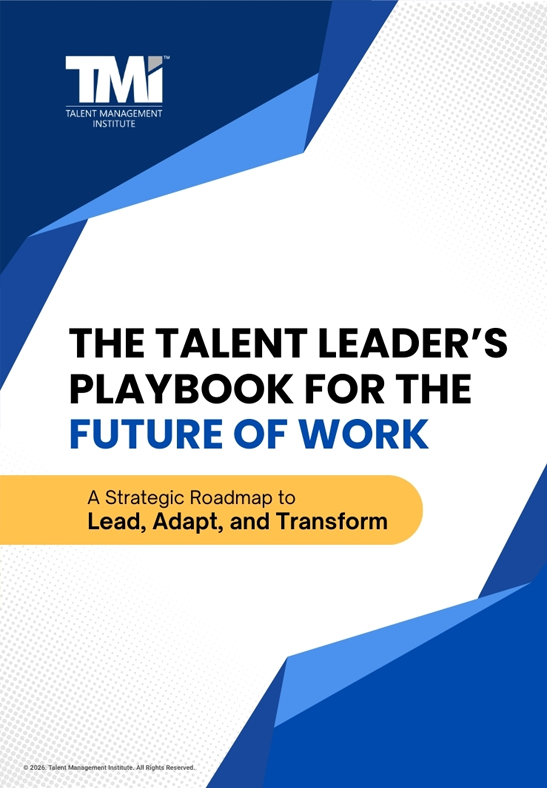

CredBadge™ is a proprietary, secure, digital badging platform that provides for seamless authentication and verification of credentials across digital media worldwide.
CredBadge™ powered credentials ensure that professionals can showcase and verify their qualifications and credentials across all digital platforms, and at any time, across the planet.

Please enter the License Number/Unique Credential Code of the certificant. Results will be displayed if the person holds an active credential from TMI.