We can't wait to hear from you
Connect
Discover how TMI credentials are designed to accelerate your career growth. Explore how TMI incorporates Talent Management into the practice and systems of Human Capital Management. Learn how you can steer your future confidently through TMI's research driven Talent Management standards. Fellow programs equip global HR professionals with the latest in Talent Management in the transformational way.
Explore how the TMP™, STMP™, and GTML™ credentials can take your HR career places, or add to the capabilities of your promising HR staff and leaders.
View CertificationsStrengthen your enterprise HR system by implementing the TMI-ETMS™ international standards.
Learn About TMI-ETMS™If you are interested in consulting, training or education, partner with TMI to join the global league of TMI aligned institutions, companies and industries.
Become a TMI PartnerLearn the latest about how Talent Management is transforming HR into a future oriented business hyperfunction.
Explore the TMI ApproachLearn the steps to earn your TMI certification, from application to successful completion and maintaining your credential.
TMI credentials include globally recognized digital badges, offering a portable and verifiable representation of your achievements.

Kickstart your Talent Management journey with TMI’s globally recognized certifications and resources to excel in your career.
Create myTMI Account TodayTMI Global and Associate Fellow programs turn HR professionals into global Talent Leaders who can drive growth with their superlative strategic ability, business perspective and readiness for change. Since 2024, more than 150 senior HR professionals and HR leaders from 46 global organizations across industries have completed these programs that establish new standards for the practice of talent management as a driver of organizational success and business competitiveness.
You can contact us here for more information.

TMI–ETMS10™ and TMI–ETMS14™ certified organizations are effective for restructuring Talent Management in an organization. With TMI, organizations are better, more agile and better prepared for challenges that are to come.
The TMI-Enterprise Talent Management Standards power enterprise HR with the latest in Talent Management.
To choose a TMI–ETMS™ version most appropriate for your organization!
Write to us via the contact form.

Partnering with TMI means building a powerful structure of Talent Management thought and practice resulting in business profits through standards, certifications and networks.
Get your HR staffers and managers TMI certified on Talent Management by adding TMI into your training regimen. One step toward embedding TMI credentials in your institutions curricula is to become a TMI-ETMS™ consulting partner. Join us to be a part of the groundbreaking work of Talent Management.

If you hold an elite international qualification in HR or a related discipline, possess a recognized HR credential, or studied HRM at a TMI-recognized institution, you may be eligible for an accelerated pathway to a TMI credential through QualiFly™ leading to TMP™, STMP™ or GTML™.
 Institutions
Explore Certification Bodies, Universities, B-Schools & Other Institutions recognized by TMI under the Q1, Q2, and Q3 Lists.
Check if your institution is recognized
TMI’s blogs cover the latest trends, insights, and best practices in HR and talent management.
Comprehensive guides covering talent development, HR metrics, key facts, and more.
Explore TMI's latest updates, announcements, news and press releases in our newsroom.
Strategic insights driving the future of talent, leadership, and global workforce excellence.
Dive into the inspiring journeys of TMI certification holders and learn how the certification has transformed their careers.
An Interview series featuring key advice from global talent leaders for future HR professionals.
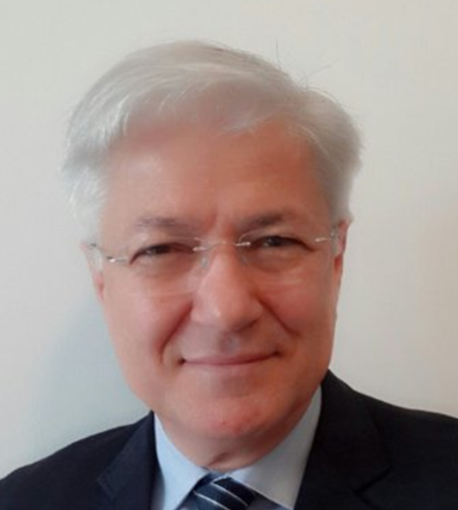
Dr. Sharif Bajo is a talent management practitioner, researcher, and executive coach. He holds a PhD in Talent Management, a master's degree in Assessment and Evaluation from the University of Melbourne, and the ICF Professional Certified Coach (PCC) credential. His work focuses on how organizations distinguish performance, potential, readiness and role fit and translate evidence into accountable decisions about succession, mobility and development. He is Founder and Managing Director of TIPCONS. Professional profile: www.tipcons.com

Effective succession planning involves four separate judgments: current performance, future potential, readiness for greater responsibility, and fit for a specific role. Each requires relevant evidence and a clear decision process.
Most organizations know that the best performer today is not automatically the best leader tomorrow.
To look beyond performance, organizations use psychometric assessments, competency frameworks, assessment centers, leadership simulations, 360-degree feedback, nine-box grids, succession plans, and analytics.
Yet one of the most consequential organizational questions remains difficult to answer with confidence: Who should lead us next?
Deloitte highlighted the contradiction: 86 per cent of leaders regarded leadership succession planning as urgent or important, yet only 14 per cent believed they did it well. That gap helped prompt a year-long mixed-methods study into why succession planning so often breaks down (Routch, Monahan and Doherty, 2018).
The paradox lies in the gap between what the evidence shows and what decision-makers conclude. Even useful assessment results can be misapplied when their purpose and limits are not clear.
When it comes to talent and leadership, common sense is not always common practice.
Marshall Goldsmith and Mark Reiter captured an important dimension of this problem in What Got You Here Won’t Get You There: behaviors that create success at one level may become limitations at the next. In succession, however, the principle applies not only to the leader but also to the organization making the decision. Evidence of success in one role cannot simply be carried forward as proof of potential, readiness or fit for another (Goldsmith and Reiter, 2007).
Consider Sarah, a composite of a pattern familiar across many organizations.
Sarah is the star performer. She exceeds targets, solves difficult problems, and earns the confidence of clients and senior leaders. When an important leadership position becomes vacant, her promotion appears obvious. She has delivered more than anyone else. She has earned the opportunity.
After the promotion, the situation changes. Sarah must now create results through other people, make decisions across competing priorities, manage conflict, and operate at a different level of complexity. Her previous strengths do not disappear, but they no longer guarantee success. Decisions slow, the team becomes uncertain, and Sarah begins to lose confidence.
The organization concludes that Sarah was not good enough. That conclusion misses the more difficult truth. The organization answered one question accurately - who was performing best in the previous role - and then treated that answer as evidence for a different question: who was most likely to succeed in the new one.
Research supports the concern. Benson, Li and Shue examined promotion decisions involving sales workers across 131 US-based firms. They found evidence that organizations placed substantial weight on current sales performance, even when other observable characteristics were more predictive of managerial performance. The best worker was not always the best managerial candidate (Benson, Li and Shue, 2019).
Sarah’s performance made her a strong candidate, but it was not proof that she was ready to lead.
An experienced HR leader could reasonably object: We do not rely on performance alone. We assess potential. We use psychometrics. We run simulations and assessment centers. We calibrate talent and review succession plans.
That objection is correct. Psychometrics, assessment centers, simulations, and managerial evidence can all contribute valuable information. International assessment-center guidelines emphasize job-related behavioral evidence, structured observation, and appropriate interpretation (Rupp et al., 2015). The deeper problem is that multiple sources of evidence do not automatically produce an integrated decision.
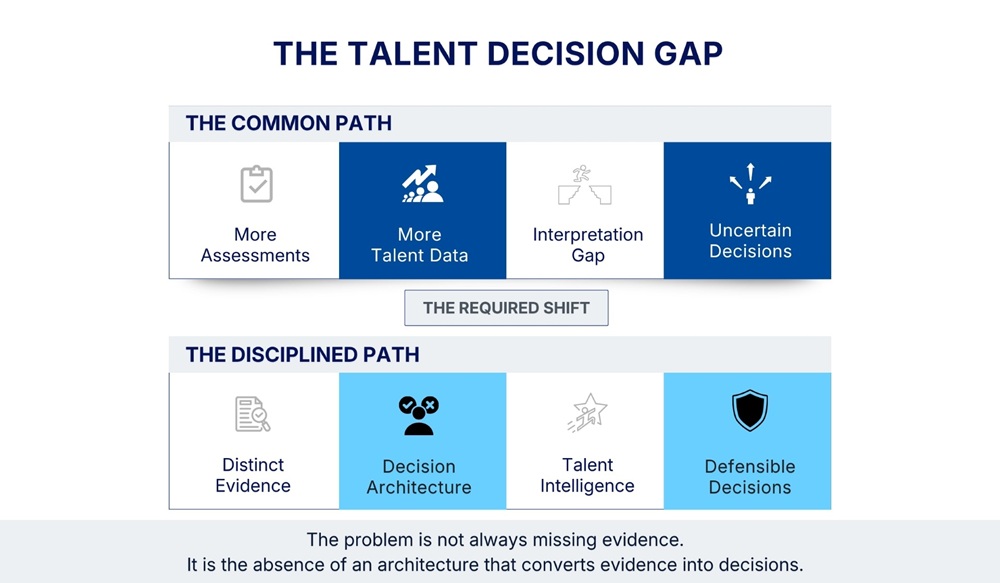
Each method answers a narrower question under particular conditions. A psychometric instrument can indicate relatively stable preferences, tendencies or capabilities, depending on what it was designed to measure. An assessment center samples behavior through defined exercises. A 360-degree process records how others experience the person in a current context. Performance evidence reflects contribution within the opportunities, constraints, and expectations of the present role.
None of these limitations makes the method weak. They make disciplined interpretation necessary. Trouble begins when outputs created for different purposes, and time horizons are treated as equivalent signals, or when they are compressed into a single conclusion without showing how that conclusion was reached.
Assessment reports may sit in separate systems. Performance data may relate to the current role, while psychometric evidence describes broad tendencies. A simulation may capture behavior under a specific set of conditions. Managers may use the same word - potential - while holding different assumptions about what it means. A nine-box position may then compress these differences into a single label.
Deloitte’s research includes a striking example. One executive observed that even an extensive leadership assessment using multiple psychometrics could be derailed by politics. This is the point at which the sophistication of assessment becomes confused with the quality of decision.
The problem is therefore not necessarily that organizations assess too little. It is that they may collect evidence without a disciplined architecture that determines which question each source can answer, how conflicting evidence should be handled, and who remains accountable for the conclusion.
Organizations are not necessarily assessment poor. They are often decision architecture poor.
I describe this distance as the talent decision gap: the space between the evidence an organization possesses and the decisions that evidence can properly support.
Succession discussions often appear to concern one decision about one person. In practice, they contain at least four different questions.
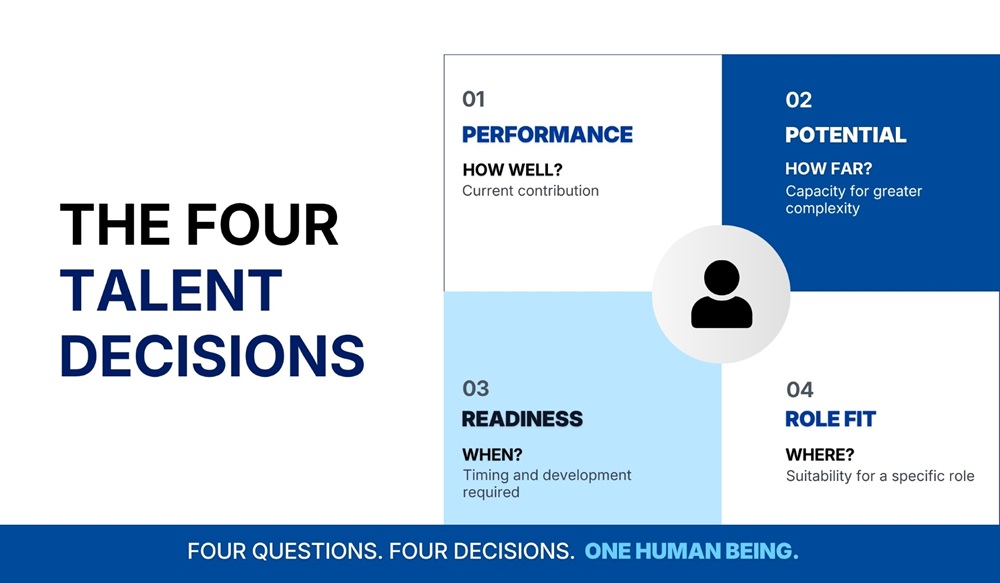
Performance: How well does someone meet expectations in their current role? Current results do not establish readiness for greater responsibility.
Potential: How far could someone grow? This concerns their capacity to handle more complex responsibilities over time.
Readiness: When could someone take on the target role? It depends on the experience and development still needed.
Role fit: Where would someone be most effective? It depends on how well their abilities and experience match a specific role’s demands.
These judgments are related, but they are not interchangeable. Research on potential asks "potential for what?", while research on person–job fit examines the match between individual attributes and job demands (Silzer and Church, 2009; Kristof-Brown, Zimmerman and Johnson, 2005).
Different judgments about one employee can all be valid. They answer different questions.
The practical discipline is simple to state and difficult to maintain. Never use the answer to one question as the answer to another.
Talent evidence is rarely lost because nobody collected it. It is more often lost during interpretation.
A familiar manager advocates strongly for one candidate. A senior sponsor prefers another. An urgent vacancy compresses the timetable. A sophisticated assessment is reduced to a sentence. A nine-box grid becomes a conclusion rather than the beginning of a conversation. The decision then reflects the force of the discussion as much as the quality of the evidence.
This does not make managerial judgement illegitimate. Context matters, and no responsible system should remove leaders from decisions about people. The challenge is to make judgement visible, disciplined and answerable to evidence.
A sound talent decision architecture should therefore do six things:
For example, a candidate may have strong performance reviews but mixed leadership simulation results and little experience managing larger teams. Instead of promoting them immediately, the succession panel could recommend coaching and a stretch assignment, then reassess readiness. This separates current results from the evidence needed for the next role.
This is the difference between collecting information about people and constructing evidence for a decision.
Talent data records facts and observations. Assessment evaluates selected characteristics. Analytics organizes patterns and comparisons. Talent intelligence connects relevant evidence to a defined organizational decision and makes the reasoning available for review.
A disciplined talent intelligence approach does not treat performance, potential, readiness and role fit as interchangeable scores. It brings relevant evidence into one governed decision view while preserving the meaning, limits and time horizon of each construct.
This approach does not eliminate uncertainty. Its value lies in making the chain of reasoning visible: what question is being answered, which evidence is relevant, where sources agree or conflict, and what remains unknown.
The resulting view can inform succession planning, talent pools, internal mobility and targeted development without turning an assessment score or algorithmic recommendation into an automatic verdict.
Talent data tells us something about a person. Talent intelligence helps us decide what to do about it.
Artificial intelligence can increase the speed at which organizations process records, identify patterns and compare large groups of employees. It can also create an impression of certainty that the underlying evidence does not deserve.
If an organization has not defined potential, an algorithm cannot resolve the ambiguity. If readiness is not tied to a target role and a time horizon, a prediction may combine unlike questions. If historical decisions contain bias, greater processing power may reproduce that bias at scale.
This is why AI governance matters in talent decisions. The US National Institute of Standards and Technology developed its AI Risk Management Framework to help organizations incorporate trustworthiness into the design, use and evaluation of AI systems. That logic is especially relevant when recommendations may affect careers, opportunity and leadership pipelines (NIST, 2023).
AI can accelerate analysis. It cannot repair a confused decision architecture.
Before accepting an AI-supported talent recommendation, leaders should be able to answer five questions:
AI should strengthen disciplined judgement, not provide technological cover for an unclear decision.
The next time leaders meet to decide someone’s future, the first question should not be about the person. It should be about the decision.
Are we deciding how well, how far, when or where?
Only then should the organization determine what evidence is relevant, what that evidence can legitimately establish, how it should be interpreted, and where human judgement must enter. The objective is not perfect for certainty. Decisions about people will always contain uncertainty. The objective is to reach a conclusion that is clearer, more consistent and more defensible than one based primarily on reputation, instinct or a single score.
Think again about Sarah. The easy conclusion is that she was not good enough. The more responsible conclusion is that the organization may have used strong evidence of performance to answer questions about potential, readiness and role fit that required different evidence.
Sarah may not have failed leadership. The organization may have failed Sarah.
The best performer today is not automatically the best leader tomorrow. A potential rating does not establish readiness, and readiness for greater responsibility does not demonstrate fit for every role.
If organizations already understand these distinctions, why do they continue to make decisions that ignore them?
Because knowledge alone does not govern a decision. Organizations need an architecture that preserves the questions, disciplines the evidence, makes conflicting signals visible and keeps human accountability where it belongs.
A sound talent decision architecture creates a governed pathway from a clearly defined talent question to an accountable organizational action. It does not eliminate uncertainty or replace professional judgement. It helps decisionmakers examine the right evidence for the right question, recognize its limitations and reach conclusions they can explain, defend and revisit.
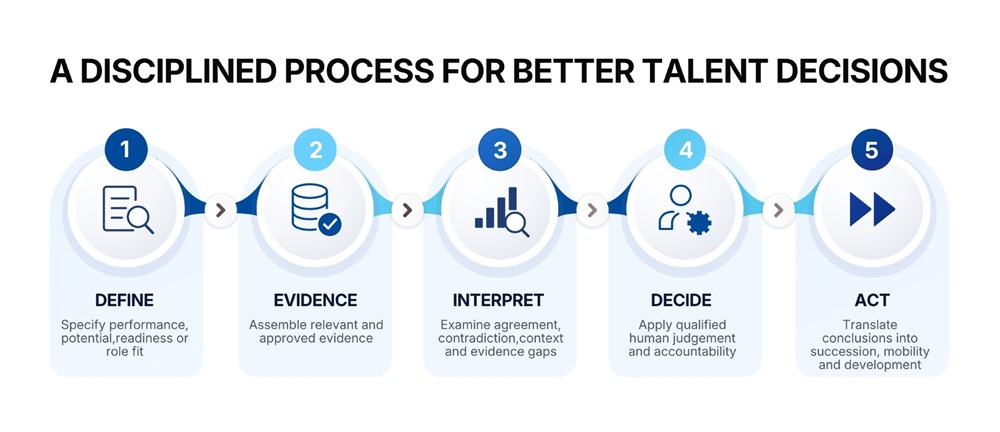
The practical sequence is straightforward: define the decision; assemble evidence relevant to that decision; interpret agreement, contradiction and gaps; apply accountable human judgement; and act. Technology may organize the evidence, but people must own the conclusion.
Knowing better is not enough. Organizations must build the discipline to decide better.
Dr. Sharif Bajo is a talent management practitioner, researcher, and executive coach. He holds a PhD in Talent Management, a master’s degree in Assessment and Evaluation from the University of Melbourne, and the ICF Professional Certified Coach (PCC) credential. His work focuses on how organizations distinguish performance, potential, readiness and role fit and translate evidence into accountable decisions about succession, mobility and development. He is Founder and Managing Director of TIPCONS. Professional profile: www.tipcons.com

Uncover the trends redefining workforce strategy, the skills shaping next-generation CHROs, and strategies to drive lasting impact. Explore insights and assess your readiness to lead the future of talent.
Download the Guide

CredBadge™ is a proprietary, secure, digital badging platform that provides for seamless authentication and verification of credentials across digital media worldwide.
CredBadge™ powered credentials ensure that professionals can showcase and verify their qualifications and credentials across all digital platforms, and at any time, across the planet.

Please enter the License Number/Unique Credential Code of the certificant. Results will be displayed if the person holds an active credential from TMI.