We can't wait to hear from you
Connect
Discover how TMI credentials are designed to accelerate your career growth. Explore how TMI incorporates Talent Management into the practice and systems of Human Capital Management. Learn how you can steer your future confidently through TMI's research driven Talent Management standards. Fellow programs equip global HR professionals with the latest in Talent Management in the transformational way.
Explore how the TMP™, STMP™, and GTML™ credentials can take your HR career places, or add to the capabilities of your promising HR staff and leaders.
View CertificationsStrengthen your enterprise HR system by implementing the TMI-ETMS™ international standards.
Learn About TMI-ETMS™If you are interested in consulting, training or education, partner with TMI to join the global league of TMI aligned institutions, companies and industries.
Become a TMI PartnerLearn the latest about how Talent Management is transforming HR into a future oriented business hyperfunction.
Explore the TMI ApproachLearn the steps to earn your TMI certification, from application to successful completion and maintaining your credential.
TMI credentials include globally recognized digital badges, offering a portable and verifiable representation of your achievements.

Kickstart your Talent Management journey with TMI’s globally recognized certifications and resources to excel in your career.
Create myTMI Account TodayTMI Global and Associate Fellow programs turn HR professionals into global Talent Leaders who can drive growth with their superlative strategic ability, business perspective and readiness for change. Since 2024, more than 150 senior HR professionals and HR leaders from 46 global organizations across industries have completed these programs that establish new standards for the practice of talent management as a driver of organizational success and business competitiveness.
You can contact us here for more information.

TMI–ETMS10™ and TMI–ETMS14™ certified organizations are effective for restructuring Talent Management in an organization. With TMI, organizations are better, more agile and better prepared for challenges that are to come.
The TMI-Enterprise Talent Management Standards power enterprise HR with the latest in Talent Management.
To choose a TMI–ETMS™ version most appropriate for your organization!
Write to us via the contact form.

Partnering with TMI means building a powerful structure of Talent Management thought and practice resulting in business profits through standards, certifications and networks.
Get your HR staffers and managers TMI certified on Talent Management by adding TMI into your training regimen. One step toward embedding TMI credentials in your institutions curricula is to become a TMI-ETMS™ consulting partner. Join us to be a part of the groundbreaking work of Talent Management.

If you hold an elite international qualification in HR or a related discipline, possess a recognized HR credential, or studied HRM at a TMI-recognized institution, you may be eligible for an accelerated pathway to a TMI credential through QualiFly™ leading to TMP™, STMP™ or GTML™.
 Institutions
Explore Certification Bodies, Universities, B-Schools & Other Institutions recognized by TMI under the Q1, Q2, and Q3 Lists.
Check if your institution is recognized
TMI’s blogs cover the latest trends, insights, and best practices in HR and talent management.
Comprehensive guides covering talent development, HR metrics, key facts, and more.
Explore TMI's latest updates, announcements, news and press releases in our newsroom.
Strategic insights driving the future of talent, leadership, and global workforce excellence.
Dive into the inspiring journeys of TMI certification holders and learn how the certification has transformed their careers.
An Interview series featuring key advice from global talent leaders for future HR professionals.
TMI’s editorial team is comprised of researchers, writers, editors, proofreaders, and contributors with extensive experience in the HR and Talent Management space. The team scrupulously researches, analyzes and deliberates on each submission before concluding its suitability for our publications.

Across industries, the gap between needed skills and those held by the workforce is widening faster than traditional hiring and training models can address. According to iMocha.io, 63% of employers believe the skills gap will be a significant barrier to transformation during the 2025 to 2030 period, and the pressure is already showing. Job descriptions go unfilled for months, newly hired employees underperform in roles misaligned with their actual capabilities, and training programs miss the mark because they are designed around static job titles rather than real skill needs.
This is precisely the problem that a skills-based organization is built to solve, and it is where AI is enabling HR to bridge talent gaps with unprecedented precision.
A skills-based organization moves away from organizing work around fixed job titles and hierarchies, and instead structures roles, projects, and career paths around what employees can genuinely do. The result is a workforce that can be deployed more flexibly, developed more precisely, and retained more effectively because people are placed where their capabilities actually fit.
The case for making this shift is backed by more than theory. According to Ressa.ai, 75% of employers face difficulty discovering the right talent with the required skills, and an employee mismatch can cost up to 200% of their salary. These financial losses accumulate with every flawed hire and misaligned role. Traditional job architecture simply cannot match the pace at which digital skills requirements are changing, and the gap between what a job description says and what a role actually demands keeps growing wider.
The shift to a skills-based model addresses this by making capability the primary unit of measurement, but executing that shift at scale is where many organizations have historically struggled.
Creating a meaningful skills-based organization requires building a detailed map of every task, every role, and every capability across the organization, then maintaining and updating that map as the business evolves. Organizations that recognized the value of the approach often stalled during implementation because the time and resource investment required simply exceeded the perceived benefit.
AI workforce planning tools have reshaped how organizations approach skills mapping and talent management. Platforms like Cornerstone Galaxy and iMocha’s skills intelligence cloud automate the most labor-intensive parts of the process: converting job architectures into skills repositories, analyzing resumes and performance data to map current employee capabilities, and continuously updating the entire taxonomy as market conditions shift. What previously might have taken years through manual effort, can now yield initial results in weeks or months.
This compression of implementation time is significant because it means the return on investment arrives sooner, and the barrier to entry for organizations that were previously reluctant to commit is substantially lower.
Understanding how AI enables skills-based organizations means looking at specific capabilities rather than treating AI as a single monolithic tool. Four areas stand out as particularly consequential.
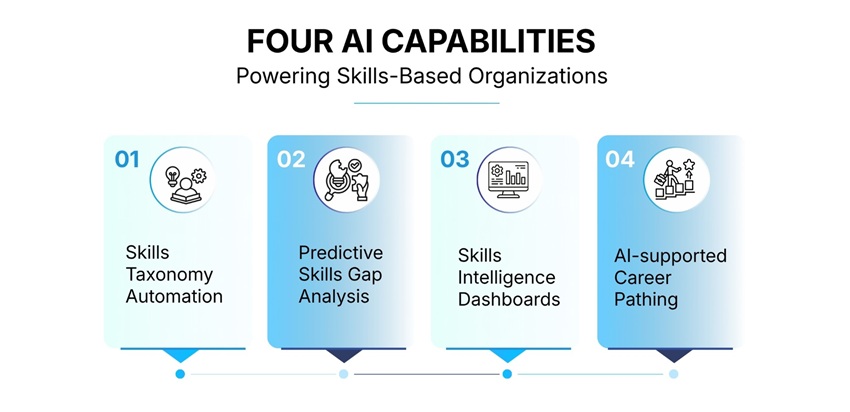
The first is skills taxonomy automation. AI evaluates millions of job descriptions, resumes, and performance records to build dynamic skills frameworks that define and categorize capabilities across functions and industries. These frameworks update automatically as new skills emerge, which means they reflect actual market demand rather than last year’s assumptions.
The second is predictive skills gap analysis. AI-powered tools compare current employee capabilities against what the organization will need for future goals, surfacing gaps at the individual, team, and organizational level. If a specific department needs cloud migration expertise in two months, AI identifies the shortage now and recommends targeted actions rather than waiting for the problem to become acute.
The third is skills intelligence dashboards, which give leaders real-time visibility into workforce capabilities across the organization. These dashboards aggregate data from assessments, learning systems, performance reviews, and project work to show where strengths and gaps exist, enabling more informed decisions around training investment, succession planning, and internal mobility.
The fourth is AI-supported career pathing. By mapping transferable and adjacent skills, AI helps employees see clear pathways for growth and helps organizations fill internal roles without defaulting to external hiring. A data analyst with strong SQL and Excel skills, for instance, can be identified as a strong candidate for upskilling into data engineering through targeted Python and cloud training, a transition that benefits the employee and saves the organization the cost of an external hire.
These capabilities are now being put into practice by companies with measurable outcomes.
See where you stand and identify the right certification path for your career.
Take the Assessment
The value of AI-driven hiring and development becomes clearest when examined through specific examples. Amazon Web Services launched its AWS re/Start program in 2018 to train underemployed job seekers for cloud careers, and at the center of the initiative was an AI-powered personalized learning platform. The system analyzed learning patterns across thousands of students, identified where each person struggled, and generated customized study paths that concentrated practice in weaker areas. The outcome was a graduation rate increase of over 50% compared to traditional programs, with particularly strong results for underrepresented groups.
General Assembly took a different but complementary approach by partnering with Anthropic to use AI tools that continuously monitor changing skills requirements across millions of job postings. This analysis revealed rapid growth in roles involving machine learning, cybersecurity, full-stack development, and data visualization, leading the General Assembly to develop immersive training programs in those disciplines before demand peaked.
When one financial services client needed to build an internal innovation lab, General Assembly used AI-generated skills maps to design a curriculum that blended technical bootcamp content with business strategy instruction, producing graduates equipped for roles that had not previously existed inside that organization.
These examples illustrate something worth noting about predictive workforce analytics: the benefit is not simply knowing what skills are missing today, but anticipating what will be needed before the gap becomes a hiring emergency.
Skills-based approaches are often discussed from an organizational perspective. However, the employee experience matters too because it affects retention and influences whether the model works in practice.
When employees are placed in roles that align with their actual capabilities, engagement tends to improve because the work feels achievable and meaningful rather than perpetually frustrating. AI-supported career pathing gives employees visibility into what growth looks like from their current position, which matters because people are more likely to stay with an organization when they can see a clear path forward.
Platforms like Cornerstone’s Talent Marketplace take this further by using AI to actively match employees with internal projects, mentorships, and learning opportunities that align with both their strengths and their career goals, creating a cycle where engagement feeds retention and retention feeds organizational capability.
The financial implications are significant. Organizations that reduce attrition through better skills alignment and internal mobility lower their recruiting costs while simultaneously building a more capable workforce. AI offers a 10 to 20% improvement in salaries with niche AI roles seeing 35 to 55% increases, reflecting both how valuable these capabilities are and how much organizations stand to gain by developing them internally rather than competing for them externally.
The organizations that are moving most decisively toward skills-based models share a common recognition: the old way of organizing talent around job titles was never designed for the pace at which technology now changes what work actually requires. AI for employee development and AI-driven hiring are not replacing human judgment in these decisions; they are giving that judgment better data, faster turnaround, and a more accurate picture of both current capability and future need.
For organizations that have been hesitant to commit to this shift, the situation has evolved. The tools are more accessible, implementation timelines are shorter, and the cost of staying with a rigid, title-based model is becoming more visible with each year that the skills gap widens. The evidence on that is reasonably clear. The question is whether organizations are willing to make the investment in AI workforce planning infrastructure that makes the approach viable at scale, and whether they treat that investment as a cost to be minimized or a capability to be built.

Uncover the trends redefining workforce strategy, the skills shaping next-generation CHROs, and strategies to drive lasting impact. Explore insights and assess your readiness to lead the future of talent.
Download the Guide

CredBadge™ is a proprietary, secure, digital badging platform that provides for seamless authentication and verification of credentials across digital media worldwide.
CredBadge™ powered credentials ensure that professionals can showcase and verify their qualifications and credentials across all digital platforms, and at any time, across the planet.

Please enter the License Number/Unique Credential Code of the certificant. Results will be displayed if the person holds an active credential from TMI.