We can't wait to hear from you
Connect
Discover how TMI credentials are designed to accelerate your career growth. Explore how TMI incorporates Talent Management into the practice and systems of Human Capital Management. Learn how you can steer your future confidently through TMI's research driven Talent Management standards. Fellow programs equip global HR professionals with the latest in Talent Management in the transformational way.
Explore how the TMP™, STMP™, and GTML™ credentials can take your HR career places, or add to the capabilities of your promising HR staff and leaders.
View CertificationsStrengthen your enterprise HR system by implementing the TMI-ETMS™ international standards.
Learn About TMI-ETMS™If you are interested in consulting, training or education, partner with TMI to join the global league of TMI aligned institutions, companies and industries.
Become a TMI PartnerLearn the latest about how Talent Management is transforming HR into a future oriented business hyperfunction.
Explore the TMI ApproachLearn the steps to earn your TMI certification, from application to successful completion and maintaining your credential.
TMI credentials include globally recognized digital badges, offering a portable and verifiable representation of your achievements.

Start your Talent Management career with TMI’s globally recognized certifications and resources to excel in your career.
Create myTMI Account TodayTMI Global and Associate Fellow programs turn HR professionals into global Talent Leaders who can drive growth with their superlative strategic ability, business perspective and readiness for change. Senior HR professionals and HR leaders from global organizations across industries have completed these programs, which establish new standards for the practice of talent management as a driver of organizational success and business competitiveness.
You can contact us here for more information.

TMI-ETMS10™ and TMI-ETMS14™ certified organizations are effective for restructuring Talent Management in an organization. With TMI, organizations are better, more agile and better prepared for challenges that are to come.
The TMI-Enterprise Talent Management Standards power enterprise HR with the latest in Talent Management.
To choose a TMI-ETMS™ version most appropriate for your organization!
Write to us via the contact form.

Partnering with TMI means building a powerful structure of Talent Management thought and practice resulting in business profits through standards, certifications and networks.
Get your HR staffers and managers TMI certified on Talent Management by adding TMI into your training regimen. One step toward embedding TMI credentials in your institutions curricula is to become a TMI-ETMS™ consulting partner. Join us to be a part of the groundbreaking work of Talent Management.

If you hold an elite international qualification in HR or a related discipline, possess a recognized HR credential, or studied HRM at a TMI-recognized institution, you may be eligible for an accelerated pathway to a TMI credential through QualiFly™ leading to TMP™, STMP™ or GTML™.
 Institutions
Explore Certification Bodies, Universities, B-Schools & Other Institutions recognized by TMI under the Q1, Q2, and Q3 Lists.
Check if your institution is recognized
TMI’s blogs cover the latest trends, insights, and best practices in HR and talent management.
Comprehensive guides covering talent development, HR metrics, key facts, and more.
Explore TMI's latest updates, announcements, news and press releases in our newsroom.
Strategic insights driving the future of talent, leadership, and global workforce excellence.
Dive into the inspiring journeys of TMI certification holders and learn how the certification has transformed their careers.
An Interview series featuring key advice from global talent leaders for future HR professionals.
Olivia Coughtrie is Co-Founder and Director of Oriel Partners, a London-based recruitment consultancy specializing in personal assistant, executive assistant, and business support roles. Her expertise includes senior administrative recruitment and understanding the evolving skills requirements of business support professionals.

Only 7% of leaders say they’re making great progress on accelerating the orchestration of people, skills, and resources, even though 88% rate it extremely or very important, according to Deloitte’s 2026 Global Human Capital Trends survey of more than 9,000 leaders in 89 countries. Part of that gap sits in the planning unit itself. Most strategic workforce planning still counts job titles and headcount, while the work inside those titles keeps changing.
Skills-based workforce planning closes the gap by planning around the capabilities the business needs, the skills it already has, and the gaps it must fill. Job titles still anchor pay, grading, contracts, and reporting lines, so the practical answer is to run the two side by side.
This article sets out a two-ledger model for doing that, works it through with the business support role family, and covers who owns the data, what managers do, and how to measure progress.
Skills-based workforce planning means identifying the capabilities an organization needs to meet its objectives, mapping the skills its people already have, and deciding how to close the gaps through development, redeployment, or hiring. Skills become the main unit of supply and demand, and job titles stay in place for pay, grading, and structure.
The approach is most useful where work changes quickly, responsibilities overlap between roles, or a capability is needed before the business is ready to create a permanent position. It keeps the plan responsive to the work while keeping the structure people are managed by.
Job titles are a useful shorthand for structure and pay, and a loose guide to capability. Two people with the same title can bring very different strengths, and people in unrelated roles often share skills a new priority could use.
Deloitte’s 2023 Human Capital Trends research found that only 24% of workers do the same work as others in their organization with the same job title and level, and 71% do some work outside their job descriptions.
When a plan counts titles, a vacancy tends to become a request for the same title again. The search goes outside before anyone checks whether a colleague already has the transferable skills, which adds cost and slows internal progression.
Titles also age as the work changes. CEOs surveyed for IBM’s 2026 CEO Study expect 53% of employees to need upskilling for their current roles, and 29% to need reskilling for different roles, by 2028. Skills-based planning separates the work from the title that holds it, so the plan reflects what people can do today.
One practical approach is to maintain two complementary planning records: a job-based ledger for formal workforce structures and a capability-based ledger for skills availability, development, and deployment.
Many organizations are already moving this way. Deloitte’s 2026 Global Human Capital Trends research found that 61% of organizations now align and deploy workers based on tasks, skills, and outcomes, compared with 33% that use job or position-based models.
SD Worx’s 2026 survey of almost 6,000 HR decision-makers in 16 European countries found that 55% of employers now look increasingly at skills as well as job titles.
| Job-Based Ledger | Capability-Based Ledger |
|---|---|
| Headcount budgets and workforce costs | Skills availability and capability gaps |
| Organizational structure and reporting lines | Transferable skills across teams and functions |
| Contractual responsibilities and formal roles | Work requirements and task-level capabilities |
| Job descriptions, grades, and position control | Skills development, proficiency, and future potential |
| Vacancy management and approved positions | Internal mobility, redeployment, and emerging talent needs |
The job-based ledger supports consistent compensation, grading, contractual responsibilities, and organizational reporting, while the capability-based ledger informs workforce development and deployment decisions.
The capability-based ledger gives you flexibility. It shows what your people can do, where capabilities cluster, and how skills could move as priorities change. Used together, the two ledgers turn capability-based planning into everyday decisions about where to hire, what to develop, and how to deploy the people you already have.
Business support is a clear test case, because one title can cover very different work. You will often find that the difference between support roles lies in the depth and type of support:
Personal assistants (PAs) and executive assistants (EAs) often have overlapping responsibilities, but the scope of their work can differ considerably depending on organizational needs, seniority, and the level of executive support required.
Two people with the same title can sit at very different points on that line. Hybrid roles such as office manager and EA, or EA and chief of staff, are common, and the title rarely tells you which mix you have.
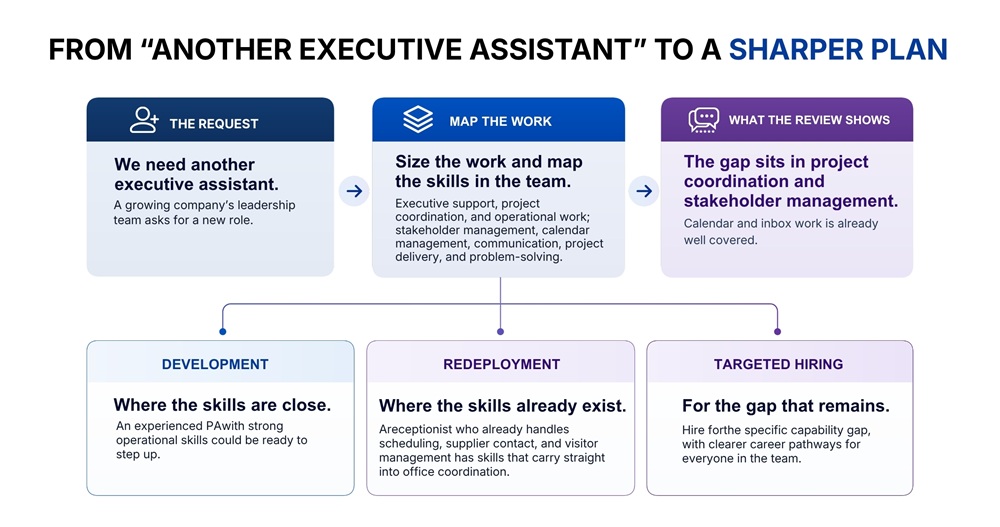
Picture a growing company whose leadership team asks for another executive assistant. Before anyone writes a job description, it maps the work and the skills already in the team.
| Planning Area | Traditional Approach | Skills-Based Approach |
|---|---|---|
| Workforce demand | Forecast the number of executive assistants required | Size the executive support, project coordination, and operational work required |
| Skills assessment | Review existing job titles and experience | Map capabilities such as stakeholder management, calendar management, communication, project delivery, and problem-solving |
| Filling the gap | Hire against a standard job description | Close specific capability gaps through development, redeployment, or targeted hiring |
| Development and deployment | Progression follows established role levels | Build cross-functional skills, broader responsibilities, and internal moves |
The review might show that the gap sits in project coordination and stakeholder management, and that calendar and inbox work is already well covered. An experienced PA with strong operational skills could be ready to step up. A receptionist who already handles scheduling, supplier contact, and visitor management has skills that carry straight into office coordination.
The result is a sharper plan: Development where the skills are close, redeployment where they already exist, and targeted hiring for the gap that remains, with clearer career pathways for everyone in the team.
Skills-based planning depends on reliable skills data, and many organizations are starting from a thin base. In the same SD Worx survey, 39% of employers said they don’t yet have a clear picture of the skills their organization will need, and the CIPD’s Resourcing and Talent Planning Report 2026 found that 36% of UK organizations collect no workforce planning data at all.
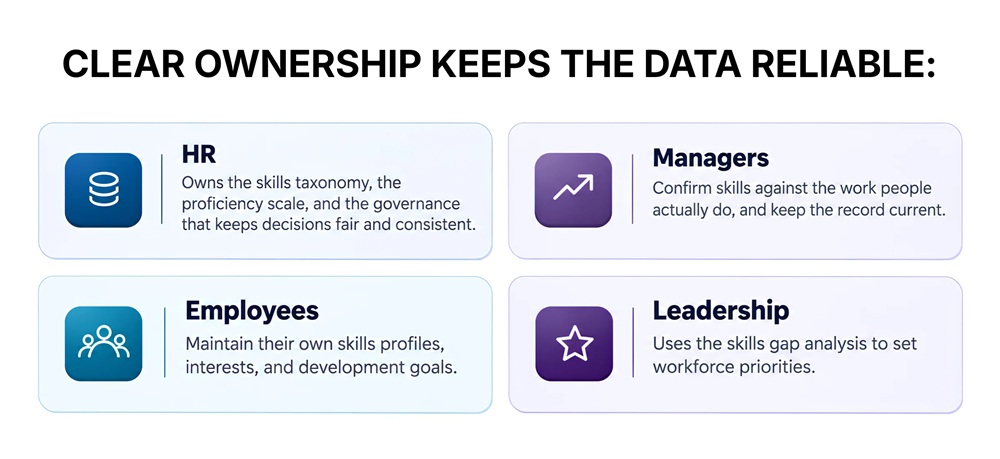
Gartner’s October 2026 advice to CHROs is to focus on fewer skills that differentiate the organization’s value, and a short, well-kept list is easier to maintain than an exhaustive one. TMI’s guide to translating workforce data into strategic decisions covers the next step.
Managers turn the model into routine. Start by listing the capabilities your team needs to meet its objectives, compare them with the skills on the team, and agree development goals with each person. Then look at whether work could be shared out differently before asking for a new role.
Regular conversations keep this current, because people build skills through projects, exposure, and new responsibilities. They also make internal mobility visible, and career pathing becomes a conversation about skills as well as grades, a change TMI explores in how career portfolios are replacing career ladders.
When a gap remains, describe the work and the missing capability, and let the title follow.
Professional development pathways, including TMI’s Senior Talent Management Practitioner (STMP™) certification, can support the development of strategic talent management and workforce planning competencies.
Measure progress by whether skills data leads to better workforce decisions. Set a baseline before you start, so you can see the change in visibility, deployment, and speed over time.
Useful indicators include:
Read these alongside headcount, vacancy rates, and retention, and keep the reporting light. To look further ahead, TMI’s guide to predictive workforce planning with AI analytics shows how the same data supports forecasting.
Q. How Does Skills-Based Workforce Planning Compare With Headcount Planning?
A. Skills-based workforce planning and headcount planning answer different questions. Headcount planning sets how many people you need, in which roles, and at what cost. Skills-based workforce planning sets which capabilities you need and how to build, move, or buy them. They work best together, with headcount covering budget and structure and skills covering deployment and development.
Q. What Are the 5 R’s of Workforce Planning, and Where Do Skills Fit?
A. The 5 R’s of workforce planning, in the version AIHR sets out, are right size, right shape, right skills, right site, and right spend. Versions differ between publishers. Skills sit at the center of all five, because the skills you need shape how big the team is, how it’s structured, where people work, and what it costs.
Q. What Are the Key Elements of Workforce Planning, and Where Do Skills Fit?
A. The key elements of workforce planning, in the CIPD’s version, are understanding the organization, analyzing the workforce, setting future needs, finding the skills and knowledge gaps, building an action plan, and monitoring it. Skills data feeds every stage, and it does most of its work in the gap analysis that the action plan is built on.
Q. How Should Organizations Get Started With Skills-Based Workforce Planning?
A. Skills-based workforce planning works best when introduced one role family at a time. Choose one where work is changing; skills overlap, or demand is high. Business support is a natural first choice, because PA, EA, office manager, and chief of staff roles cover such a wide spread of capability.
Map the priorities the role family supports, the skills those priorities need, and the skills already in place. Then use the result for one practical decision, such as a development plan, a redeployment, or a change in how work is shared. Once that works, extend the model to the next function, and your workforce plan starts to reflect the work your business actually needs done.
Olivia Coughtrie is Co-Founder and Director of Oriel Partners, a London-based recruitment consultancy specializing in personal assistant, executive assistant, and business support roles. Her expertise includes senior administrative recruitment and understanding the evolving skills requirements of business support professionals.

Prepare your organization for the next era of talent management with a practical framework for building a skills-first, AI-enabled workforce.
Inside the guide:

CredBadge™ is a proprietary, secure, digital badging platform that provides for seamless authentication and verification of credentials across digital media worldwide.
CredBadge™ powered credentials ensure that professionals can showcase and verify their qualifications and credentials across all digital platforms, and at any time, across the planet.

Please enter the License Number/Unique Credential Code of the certificant. Results will be displayed if the person holds an active credential from TMI.