We can't wait to hear from you
Connect
Discover how TMI credentials are designed to accelerate your career growth. Explore how TMI incorporates Talent Management into the practice and systems of Human Capital Management. Learn how you can steer your future confidently through TMI's research driven Talent Management standards. Fellow programs equip global HR professionals with the latest in Talent Management in the transformational way.
Explore how the TMP™, STMP™, and GTML™ credentials can take your HR career places, or add to the capabilities of your promising HR staff and leaders.
View CertificationsStrengthen your enterprise HR system by implementing the TMI-ETMS™ international standards.
Learn About TMI-ETMS™If you are interested in consulting, training or education, partner with TMI to join the global league of TMI aligned institutions, companies and industries.
Become a TMI PartnerLearn the latest about how Talent Management is transforming HR into a future oriented business hyperfunction.
Explore the TMI ApproachLearn the steps to earn your TMI certification, from application to successful completion and maintaining your credential.
TMI credentials include globally recognized digital badges, offering a portable and verifiable representation of your achievements.

Kickstart your Talent Management journey with TMI’s globally recognized certifications and resources to excel in your career.
Create myTMI Account TodayTMI Global and Associate Fellow programs turn HR professionals into global Talent Leaders who can drive growth with their superlative strategic ability, business perspective and readiness for change. Since 2024, more than 150 senior HR professionals and HR leaders from 46 global organizations across industries have completed these programs that establish new standards for the practice of talent management as a driver of organizational success and business competitiveness.
You can contact us here for more information.

TMI–ETMS10™ and TMI–ETMS14™ certified organizations are effective for restructuring Talent Management in an organization. With TMI, organizations are better, more agile and better prepared for challenges that are to come.
The TMI-Enterprise Talent Management Standards power enterprise HR with the latest in Talent Management.
To choose a TMI–ETMS™ version most appropriate for your organization!
Write to us via the contact form.

Partnering with TMI means building a powerful structure of Talent Management thought and practice resulting in business profits through standards, certifications and networks.
Get your HR staffers and managers TMI certified on Talent Management by adding TMI into your training regimen. One step toward embedding TMI credentials in your institutions curricula is to become a TMI-ETMS™ consulting partner. Join us to be a part of the groundbreaking work of Talent Management.

If you hold an elite international qualification in HR or a related discipline, possess a recognized HR credential, or studied HRM at a TMI-recognized institution, you may be eligible for an accelerated pathway to a TMI credential through QualiFly™ leading to TMP™, STMP™ or GTML™.
 Institutions
Explore Certification Bodies, Universities, B-Schools & Other Institutions recognized by TMI under the Q1, Q2, and Q3 Lists.
Check if your institution is recognized
TMI’s blogs cover the latest trends, insights, and best practices in HR and talent management.
Comprehensive guides covering talent development, HR metrics, key facts, and more.
Explore TMI's latest updates, announcements, news and press releases in our newsroom.
Strategic insights driving the future of talent, leadership, and global workforce excellence.
Dive into the inspiring journeys of TMI certification holders and learn how the certification has transformed their careers.
An Interview series featuring key advice from global talent leaders for future HR professionals.
TMI’s editorial team is comprised of researchers, writers, editors, proofreaders, and contributors with extensive experience in the HR and Talent Management space. The team scrupulously researches, analyzes and deliberates on each submission before concluding its suitability for our publications.

Workforce decisions made with outdated information create expensive problems. When companies rely on year-old labor statistics or incomplete spreadsheets, they miss critical shifts in talent availability. Skills that seemed abundant six months ago have become scarce overnight. Meanwhile, internal capabilities go unrecognized because no system tracks them properly.
This disconnect between what organizations need and what they know about their workforce drives poor hiring choices, unexpected turnover, and missed opportunities for internal mobility. Research shows that companies using talent intelligence see 25% better workforce planning outcomes and double the retention rates for high performers compared to those relying on traditional methods.
The solution lies in talent intelligence planning powered by AI workforce analytics. Rather than reacting to gaps after they appear, organizations can anticipate needs, spot emerging trends, and make proactive decisions about who to develop, where to hire, and which skills matter most for future success.
AI workforce analytics uses machine learning to analyze internal and external talent data, enabling predictive workforce planning instead of reactive hiring.
Talent intelligence combines workforce data with external market insights to create a complete picture of organizational capability. This goes beyond knowing who works for you today. It means understanding what skills exist across teams, how capabilities compare to market benchmarks, which roles face the highest attrition risk, and where future demands will emerge.
Three core elements drive effective talent intelligence:
These components work together to answer practical questions. Which departments will face the biggest capability gaps next year? Can we fill senior positions through internal promotion, or must we recruit externally? Where should training budgets focus to maximize business impact? Talent intelligence provides evidence-based answers rather than educated guesses.
Most organizations struggle with fundamental data problems that compromise their talent strategies. These issues manifest differently across companies but create similar consequences: missed hiring windows, ineffective development programs, and unexpected attrition.
Government labor statistics arrive months or years after collection. By the time agencies publish employment figures, entire industries have shifted. The United Kingdom experienced this impact when a two-year delay in labor market data hampered both central bank decisions and government policy. Economic realities had moved on while decision makers operated with stale information.
AI is accelerating change, not the problem. Roles transform within months, not years. A job posting from six months ago may describe responsibilities that no longer exist or omit skills that recently became essential. Organizations need current intelligence to stay aligned with talent market reality.
Survey-based labor statistics often lack the granularity needed for precise planning. A report might indicate growth in technology jobs without specifying whether demand centers on cloud architecture, machine learning engineering, or cybersecurity analysis. Each requires different recruitment strategies and compensation packages.
Consider the green transition creating millions of jobs. Renewable energy sectors expect over 10 million positions by 2030, yet organizations struggle to identify exactly where opportunities concentrate and which specific capabilities matter most. Broad categories provide insufficient guidance for targeted workforce development.
Skills data lives in learning management systems. Performance metrics sit in annual review databases. Succession plans exist in spreadsheets maintained by individual managers. Career progression information gets captured in disparate recruiting tools. Each system holds valuable insights, but none connect to form a complete employee picture.
This fragmentation means HR teams cannot easily answer fundamental questions. Who possesses the right capabilities for an emerging role? Which high performers might leave due to limited advancement paths? Where do skills gaps pose the greatest business risk? Answering requires manual data compilation across multiple platforms, by which time circumstances have changed.
Predictive analysis applies machine learning to workforce data, identifying patterns that signal future developments. Rather than simply reporting what happened last quarter, these systems forecast what comes next and recommend specific actions to prepare.
Modern AI in talent management automatically builds comprehensive skills inventories by analyzing multiple data sources. Natural language processing extracts capabilities from resumes, project histories, and training records. The system continuously updates as employees complete certifications, take courses, or work on new assignments.
This dynamic mapping surfaces unexpected talent. An engineer who took machine learning courses three years ago might possess exactly the skills needed for a new AI initiative, even though their current role does not emphasize those capabilities. Without automated discovery, such matches go unnoticed until external recruiting begins.
Intelligent gap analysis compares current workforce capabilities against both present needs and projected future requirements. Algorithms evaluate not just whether skills exist but their depth, distribution, and development trajectory.
A healthcare network using predictive workforce planning reduced nursing shortages by 35% by forecasting demand spikes months ahead. The system analyzed historical patient volume patterns, upcoming service expansions, and retirement timelines to predict exactly when and where shortages would occur. This allowed targeted recruitment and internal transfers before gaps affected patient care.
Advanced platforms forecast talent requirements by analyzing business strategy, market trends, and competitive activity. They identify which roles will grow or shrink, what new positions will emerge, and how skill requirements will evolve within existing functions.
Deutsche Telekom implemented structured skills taxonomy development that standardized role descriptions and enabled targeted upskilling. The taxonomy provided clear pathways showing how employees could develop from current positions into future-focused roles. This improved internal mobility and reduced dependency on external hiring for emerging skill needs.
Implementing talent intelligence requires methodical attention to data quality, integration architecture, and analytical capabilities. Organizations that rush implementation without proper foundations struggle with accuracy problems and user adoption resistance.
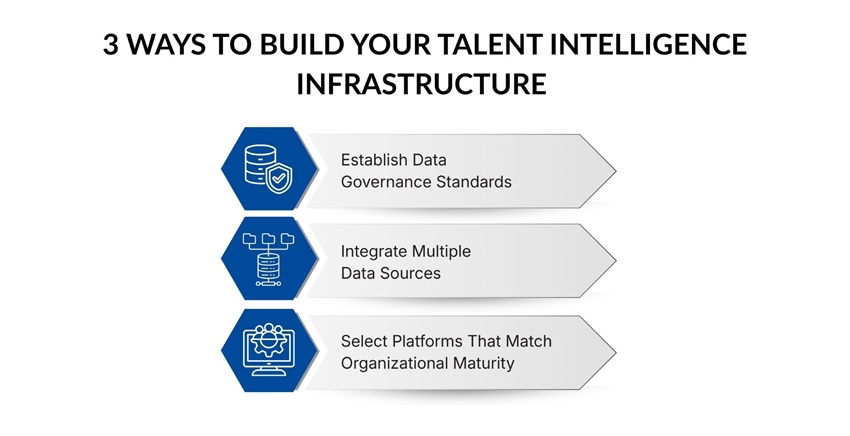
Predictive accuracy depends entirely on input quality. Organizations need clear protocols for how skills of information gets captured, who maintains responsibility for updates, and what verification processes ensure reliability. Without governance, databases quickly fill with inconsistent terminology, outdated information, and duplicate entries.
Start by defining standard skill categories aligned with business objectives. Finance teams need different capability frameworks than engineering departments. Both require consistent application within their domains. Regular audits catch drift before bad data corrupts analytical outputs.
Comprehensive talent intelligence pulls from diverse systems. Core HRIS platforms provide employee demographics and organizational structure. Performance management tools contribute to assessment data. Learning management systems track development activity. External market intelligence adds a competitive context.
Integration means more than connecting APIs. Data must flow bidirectionally with appropriate governance. Updates in one system should trigger relevant changes elsewhere. When an employee completes a certification, that information should automatically update their skills profile, inform career development discussions, and factor into succession planning algorithms.
Technology selection depends on current analytical sophistication and available resources. Organizations just beginning talent intelligence journeys need different tools than those with established data science teams.
Entry-level platforms emphasize ease of use with pre-built models and guided workflows. They deliver value quickly but offer limited customization. Enterprise solutions provide powerful analytical flexibility but require dedicated technical expertise. The wrong match creates either capability gaps or adoption failures.
Certain platforms cater to mid-sized organizations requiring advanced analytics without extensive internal data science resources. The platform connects job requirements with current workforce capabilities, highlighting urgent gaps and recommending targeted development paths. JM Family Enterprises used TalentNeuron analytics to identify emerging skills gaps and implement proactive upskilling, increasing workforce readiness for technological change.
Talent intelligence drives improvements across the entire employee lifecycle, from initial recruitment through development and retention decisions.
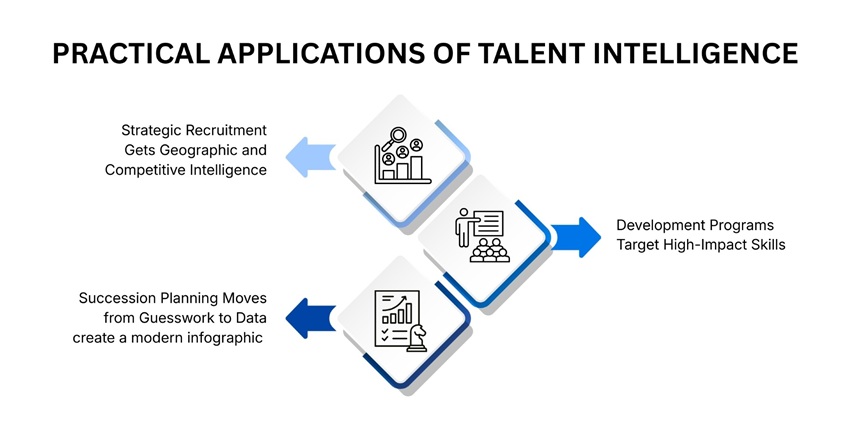
Location decisions significantly impact hiring success and costs. Predictive analytics reveal where specific talent concentrates, what compensation ranges prevail, and how much competition exists for particular roles.
Southwest Airlines leveraged automation-ready talent insights to optimize recruitment strategies by region. The analysis identified markets with higher candidate availability and lower compensation expectations, enabling more efficient hiring without sacrificing quality. Understanding competitor activity also helped prioritize urgent positions.
Organizations spend an average of 4,700 USD per hire, with some positions costing four times the annual salary. Better location and candidate assessment decisions dramatically reduce these expenses while improving retention outcomes.
Learning budgets demand strategic allocation. Training investments should focus on capabilities that advance business objectives while addressing genuine workforce gaps. Talent intelligence reveals exactly which skills deliver maximum return.
Qualcomm used predictive analytics to prioritize digital transformation skills, ensuring development programs aligned with future business needs rather than current comfort zones. The approach prevented talent shortages before they became critical by building capabilities ahead of demand.
Effective platforms also identify which employees possess aptitude for emerging skills based on related capabilities and learning patterns. This enables targeted development offers that maximize success probability while respecting individual career interests.
Leadership pipeline strength determines long-term organizational resilience. Traditional succession planning relies heavily on manager opinion and visible performance. Predictive analytics add objective assessment of capability fit, development trajectory, and retention risk.
A multinational bank achieved 60% improvement in succession planning effectiveness by leveraging predictive HR analytics to identify future leadership gaps. The system flagged critical positions lacking ready successors, highlighted development needs for potential candidates, and predicted which high-potential employees might leave without intervention.
Even well-designed implementations face predictable challenges. Understanding these obstacles helps organizations prepare appropriate responses.
Managers accustomed to intuition-based decisions to resist data-driven approaches. They question algorithm recommendations that contradict their assessments. Some fear of transparency reduces their discretion.
Successful rollouts emphasize augmentation rather than replacement. Systems provide insight and recommendations, but humans make final decisions. Training programs help managers interpret analytics and understand limitations. Demonstrating quick wins builds confidence in system value.
Initial data cleanup efforts often reveal deeper problems. Job titles mean different things across departments. Skills assessments use inconsistent frameworks. Performance ratings suffer from rater bias. Each issue compromises predictive accuracy.
Organizations need sustained data quality programs, not one-time fixes. Regular audits catch emerging problems. Automated validation flags anomalies for review. Clear ownership ensures accountability for maintaining standards.
Large organizations often run dozens of HR-related systems. Each integration multiplies technical complexity and maintenance burden. APIs change, requiring updates. Data formats evolve, breaking existing connections.
Platform selection should consider integration ease. Solutions with pre-built connectors for common HRIS systems reduce implementation time. Middleware layers can simplify complex integration landscapes by creating standardized data exchange protocols.
Success requires commitment beyond purchasing software. Organizations must invest in data quality, change management, and analytical literacy. They need patience as systems mature and teams adapt to new workflows. Half of workers worldwide will require significant reskilling by 2030 due to technological advancement. Organizations that wait risk falling permanently behind in critical capability areas.
The path forward starts with honest assessment. What talent data exists today? How reliable is that information? Which gaps create the biggest planning challenges? Answers guide initial implementation priorities and set realistic timelines.
Talent intelligence planning powered by AI workforce analytics represents a significant enhancement to workforce strategy in how organizations understand and develop their people. Companies making this transition move from constantly reacting to workforce surprises toward confidently shaping their talent future.
Q. What is talent intelligence in workforce planning?
A. Talent intelligence combines internal workforce data with external labor market insights to understand current skills, predict talent needs, and support better hiring and development decisions.
Q. How does AI improve workforce planning?
A. AI analyzes workforce and market data to predict skill gaps, future hiring needs, and attrition risks, helping organizations make proactive talent decisions.
Q. What data is used in AI-driven talent intelligence?
A. It uses internal data such as employee skills, performance, and learning records along with external data like labor market trends, salary benchmarks, and hiring patterns.
Q. Can mid-sized companies use predictive workforce planning?
A. Yes. Many AI workforce analytics platforms are designed for mid-sized organizations and help them forecast talent needs and identify skill gaps without needing large data teams.

Uncover the trends redefining workforce strategy, the skills shaping next-generation CHROs, and strategies to drive lasting impact. Explore insights and assess your readiness to lead the future of talent.
Download the Guide

CredBadge™ is a proprietary, secure, digital badging platform that provides for seamless authentication and verification of credentials across digital media worldwide.
CredBadge™ powered credentials ensure that professionals can showcase and verify their qualifications and credentials across all digital platforms, and at any time, across the planet.

Please enter the License Number/Unique Credential Code of the certificant. Results will be displayed if the person holds an active credential from TMI.