We can't wait to hear from you
Connect
Discover how TMI credentials are designed to accelerate your career growth. Explore how TMI incorporates Talent Management into the practice and systems of Human Capital Management. Learn how you can steer your future confidently through TMI's research driven Talent Management standards. Fellow programs equip global HR professionals with the latest in Talent Management in the transformational way.
Explore how the TMP™, STMP™, and GTML™ credentials can take your HR career places, or add to the capabilities of your promising HR staff and leaders.
View CertificationsStrengthen your enterprise HR system by implementing the TMI-ETMS™ international standards.
Learn About TMI-ETMS™If you are interested in consulting, training or education, partner with TMI to join the global league of TMI aligned institutions, companies and industries.
Become a TMI PartnerLearn the latest about how Talent Management is transforming HR into a future oriented business hyperfunction.
Explore the TMI ApproachLearn the steps to earn your TMI certification, from application to successful completion and maintaining your credential.
TMI credentials include globally recognized digital badges, offering a portable and verifiable representation of your achievements.

Start your Talent Management career with TMI’s globally recognized certifications and resources to excel in your career.
Create myTMI Account TodayTMI Global and Associate Fellow programs turn HR professionals into global Talent Leaders who can drive growth with their superlative strategic ability, business perspective and readiness for change. Senior HR professionals and HR leaders from global organizations across industries have completed these programs, which establish new standards for the practice of talent management as a driver of organizational success and business competitiveness.
You can contact us here for more information.

TMI-ETMS10™ and TMI-ETMS14™ certified organizations are effective for restructuring Talent Management in an organization. With TMI, organizations are better, more agile and better prepared for challenges that are to come.
The TMI-Enterprise Talent Management Standards power enterprise HR with the latest in Talent Management.
To choose a TMI-ETMS™ version most appropriate for your organization!
Write to us via the contact form.

Partnering with TMI means building a powerful structure of Talent Management thought and practice resulting in business profits through standards, certifications and networks.
Get your HR staffers and managers TMI certified on Talent Management by adding TMI into your training regimen. One step toward embedding TMI credentials in your institutions curricula is to become a TMI-ETMS™ consulting partner. Join us to be a part of the groundbreaking work of Talent Management.

If you hold an elite international qualification in HR or a related discipline, possess a recognized HR credential, or studied HRM at a TMI-recognized institution, you may be eligible for an accelerated pathway to a TMI credential through QualiFly™ leading to TMP™, STMP™ or GTML™.
 Institutions
Explore Certification Bodies, Universities, B-Schools & Other Institutions recognized by TMI under the Q1, Q2, and Q3 Lists.
Check if your institution is recognized
TMI’s blogs cover the latest trends, insights, and best practices in HR and talent management.
Comprehensive guides covering talent development, HR metrics, key facts, and more.
Explore TMI's latest updates, announcements, news and press releases in our newsroom.
Strategic insights driving the future of talent, leadership, and global workforce excellence.
Dive into the inspiring journeys of TMI certification holders and learn how the certification has transformed their careers.
An Interview series featuring key advice from global talent leaders for future HR professionals.
TMI’s editorial team is comprised of researchers, writers, editors, proofreaders, and contributors with extensive experience in the HR and Talent Management space. The team scrupulously researches, analyzes and deliberates on each submission before concluding its suitability for our publications.

California now counts the absence of bias testing as evidence in a discrimination case. New York City requires employers to publish the results of a bias audit before an automated tool screens a single candidate. Federal law has prohibited the underlying conduct since 1964.
Your HR team uses systems that influence critical employment decisions, and regulators want to know who controls them. AI governance serves as your documented framework clarifying responsibility. The alternative is a program that depends on vendor assurances and processes no one has recorded.
This article explains what AI governance means in an HR setting and where the risks concentrate across the employee lifecycle. It then describes the steps to build a framework and the obligations that already apply to you.
AI governance in HR is the structure that assigns accountability for every AI system influencing an employment decision, along with the controls and records that prove the structure works.
Three terms get used interchangeably in this field, and separating them clarifies what you are building:
HR raises the stakes on that machinery for a specific reason. A recommendation engine that suggests the wrong product costs a sale. A screening system that ranks the wrong candidates affects someone’s livelihood, and the decision sits inside a body of employment law built to protect them.
You do not have to write your principles yourself. The NIST AI Risk Management Framework names seven characteristics of a trustworthy AI system, and each one becomes a question you can ask about an HR tool.
The seventh characteristic is a measurement commitment, and outcome data is the only thing that satisfies it. The wider ethical questions around these tools, including candidate consent and the limits of automated judgment, appear in this discussion of ethical AI in HR.
Risk concentrates at the points where a tool narrows a group of people. The table below maps those points.
| Lifecycle Stage | What the AI Does | The Risk It Creates |
|---|---|---|
| Sourcing | Targets job advertisements at selected audiences | Qualified groups never see the opening |
| Screening | Ranks or filters applications against the role | Proxy features exclude candidates on protected characteristics |
| Assessment | Scores interviews, tests, or recorded responses | Scoring penalizes accent, disability, or speech pattern |
| Task Allocation | Assigns work based on inferred traits | Assignment patterns limit who gains promotable experience |
| Performance Monitoring | Measures activity and behavior continuously | Metrics reward visible activity over actual contribution |
| Promotion and Exit | Flags candidates for advancement or separation | Historical patterns in the training data repeat themselves |
Federal law reaches every row through one provision. Title VII makes a practice unlawful where it "causes a disparate impact on the basis of race, color, religion, sex, or national origin." The employer can defend that practice by showing it is "job related for the position in question and consistent with business necessity." A scoring tool is a practice, so the test applies to it.
One definition in California’s rules closes a gap that HR teams assume protects them. The state defines an automated-decision system as "a computational process that makes a decision or facilitates human decision making regarding an employment benefit." A tool that only recommends still facilitates the decision, so keeping a reviewer in the loop does not place that tool outside the rules.
US obligations sit in three layers, and each asks you for something different.
Federal law supplies the standard. Title VII sets the disparate impact test described above. The Uniform Guidelines on Employee Selection Procedures supply the measurement, treating a selection rate below four-fifths of the highest group’s rate as evidence of adverse impact. Both sit in statute and regulation, which is why they outlast shifts in agency guidance.
California converts governance into evidence. California’s employment regulations effective October 1, 2025, made three changes that bear on how you run an AI program.
That first provision reverses the usual incentive, because the testing you skip becomes part of a claimant’s case. The state’s announcement describes the full scope.
Local Law 144 adds disclosure duties. New York City’s rule bars an automated employment decision tool unless a bias audit has been conducted "within one year of the use of the tool." A summary of the results has to be public, and candidates must receive notice at least 10 business days before use. The Department of Consumer and Worker Protection has enforced it since July 2023.
State activity continues to expand, so your tracking has to cover every state where you hire.
One international note. If you employ people in the European Union, the EU AI Act treats recruitment and workforce management as high-risk uses with documentation and oversight duties. Regulation (EU) 2026/1744 moved those duties to 2 December 2027. With no EU workforce, this sits outside your perimeter.
The sequence below moves from visibility to control. Each step depends on the one before it.
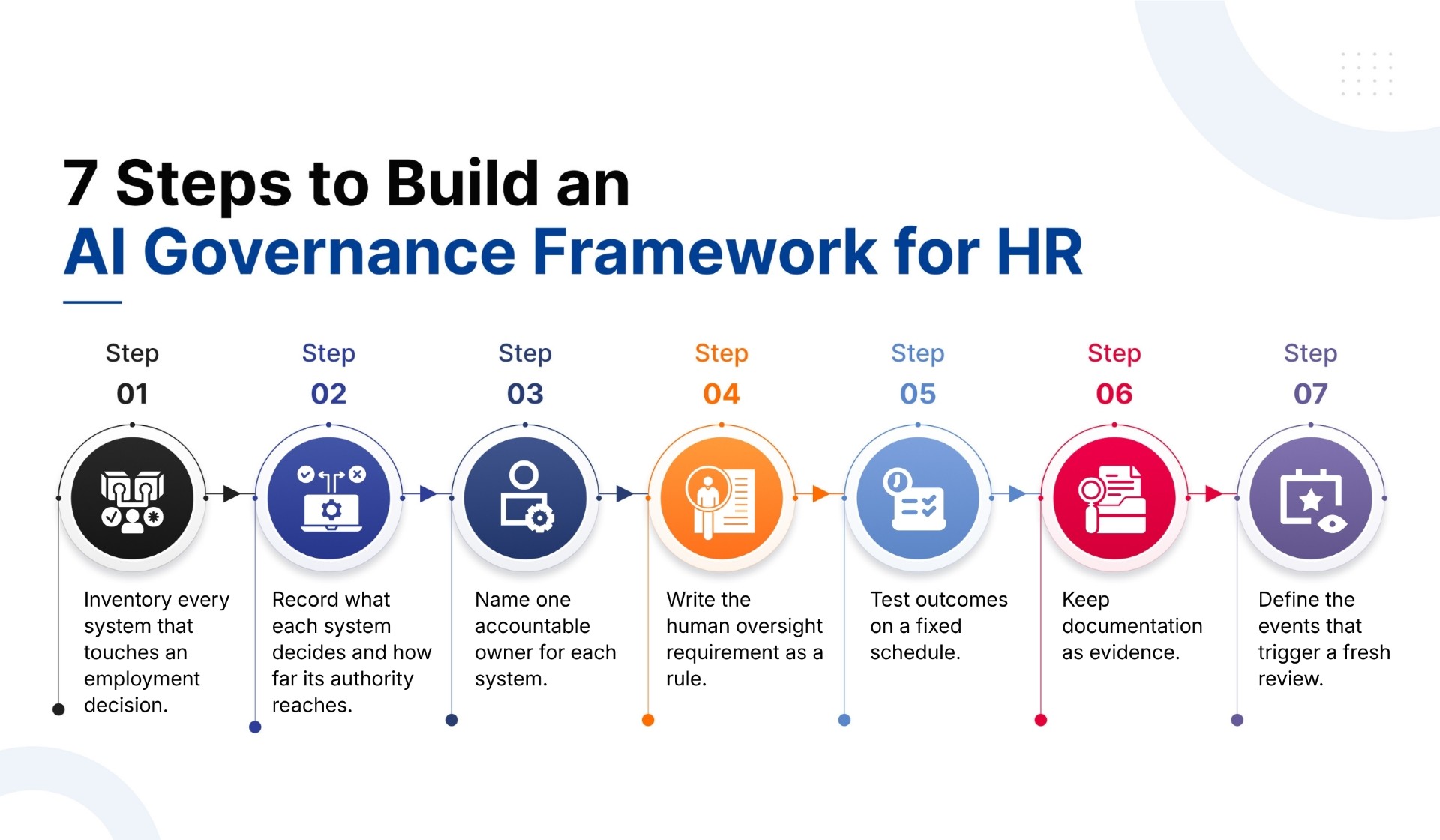
Step 1: Inventory every system that touches an employment decision. List the tools inside your applicant tracking system and your HR information system. Add your assessment vendors and any standalone tool a team adopted directly. This guide to building an HR tech stack covers the layers where these systems sit.
Step 2: Record what each system decides and how far its authority reaches. For every entry, write down the decision it influences and whether a person reviews its output before anything happens.
| Decision Authority | Control You Apply | Record You Keep |
|---|---|---|
| Recommends to a person | Reviewer training and a documented override path | Override rate and the reasons given |
| Decides within set limits | Written limits and an escalation threshold | Every decision at the limit boundary |
| Acts without review | Continuous monitoring and a tested rollback | A full action log with inputs |
Step 3: Name one accountable owner for each system. The owner holds the outcome metrics as a target and carries the authority to switch it off. A committee can review those metrics, and no member of it answers for them.
Step 4: Write the human oversight requirement as a rule. State what a reviewer must examine and how much time the review requires. Name the decisions a person cannot delegate to the tool, because an oversight claim that no procedure supports fails under examination.
Step 5: Test outcomes on a fixed schedule. Measure selection rates by group at each stage and compare them. Record the sample size behind every figure, and put the test on a calendar so it runs whether anyone has raised a concern.
Step 6: Keep documentation as evidence. Retain the vendor’s technical description alongside your own test results. Keep the review procedure and a dated record of every change you made, because regulators and claimants both ask what you knew and when.
Step 7: Define the events that trigger a fresh review. A model update or a change to the role criteria invalidates your last assessment. So does a new vendor release or a shift in your applicant pool.
These steps give effect to the functions NIST describes. GOVERN is "a cross-cutting function that is infused throughout AI risk management," which Steps 3 and 4 establish. Your inventory serves the MAP function, and your testing schedule serves MEASURE and MANAGE.
Agentic tools change the control problem. A model recommends and waits, so a reviewer stands between the output and the consequence. An agent pursues a goal through each step it requires and completes the work itself, which removes that reviewer from the path.
Four controls hold an HR agent inside a boundary you can defend.
Deployment patterns and the tasks these systems handle today appear in this overview of AI agents in HR.
Four patterns account for the gaps that surface during an incident or a claim.
Vendor assurance treated as your evidence. The report a vendor gives you describes the vendor’s testing on the vendor’s data. Your obligation attaches to outcomes in your applicant pool, which only your own measurement produces.
One policy applied to every tool. Drafting interview questions and ranking finalists carry different consequences. Uniform controls either over-restrict the first or under-govern the second.
The audit performed once at launch. Models get retrained and applicant pools shift, so a result from eighteen months ago describes a tool that has since changed. New York City’s one-year audit window reflects that reality.
Tools adopted inside team workflows. A recruiter using a general-purpose assistant to summarize applications has introduced an AI system into a hiring decision, and your inventory misses it.
Governance answers one question in a form you can show someone. For every system that shapes an employment decision, you need a named owner and written limits, plus evidence that the system works as described.
The regulatory direction is settled even where the dates have moved. The AI Act has classified your HR tools as high-risk, and New York City already requires published audits and candidate notice. Other jurisdictions are legislating on the same model.
Begin with the inventory, because a system you have not listed is a system you cannot govern. Name an owner for each entry this quarter, then write the oversight rule for the systems holding the most authority. That sequence gives you a framework you can extend as the obligations arrive.

Prepare your organization for the next era of talent management with a practical framework for building a skills-first, AI-enabled workforce.
Inside the guide:

CredBadge™ is a proprietary, secure, digital badging platform that provides for seamless authentication and verification of credentials across digital media worldwide.
CredBadge™ powered credentials ensure that professionals can showcase and verify their qualifications and credentials across all digital platforms, and at any time, across the planet.

Please enter the License Number/Unique Credential Code of the certificant. Results will be displayed if the person holds an active credential from TMI.