We can't wait to hear from you
Connect
Discover how TMI credentials are designed to accelerate your career growth. Explore how TMI incorporates Talent Management into the practice and systems of Human Capital Management. Learn how you can steer your future confidently through TMI's research driven Talent Management standards. Fellow programs equip global HR professionals with the latest in Talent Management in the transformational way.
Explore how the TMP™, STMP™, and GTML™ credentials can take your HR career places, or add to the capabilities of your promising HR staff and leaders.
View CertificationsStrengthen your enterprise HR system by implementing the TMI-ETMS™ international standards.
Learn About TMI-ETMS™If you are interested in consulting, training or education, partner with TMI to join the global league of TMI aligned institutions, companies and industries.
Become a TMI PartnerLearn the latest about how Talent Management is transforming HR into a future oriented business hyperfunction.
Explore the TMI ApproachLearn the steps to earn your TMI certification, from application to successful completion and maintaining your credential.
TMI credentials include globally recognized digital badges, offering a portable and verifiable representation of your achievements.

Kickstart your Talent Management journey with TMI’s globally recognized certifications and resources to excel in your career.
Create myTMI Account TodayTMI Global and Associate Fellow programs turn HR professionals into global Talent Leaders who can drive growth with their superlative strategic ability, business perspective and readiness for change. Since 2024, more than 150 senior HR professionals and HR leaders from 46 global organizations across industries have completed these programs that establish new standards for the practice of talent management as a driver of organizational success and business competitiveness.
You can contact us here for more information.

TMI–ETMS10™ and TMI–ETMS14™ certified organizations are effective for restructuring Talent Management in an organization. With TMI, organizations are better, more agile and better prepared for challenges that are to come.
The TMI-Enterprise Talent Management Standards power enterprise HR with the latest in Talent Management.
To choose a TMI–ETMS™ version most appropriate for your organization!
Write to us via the contact form.

Partnering with TMI means building a powerful structure of Talent Management thought and practice resulting in business profits through standards, certifications and networks.
Get your HR staffers and managers TMI certified on Talent Management by adding TMI into your training regimen. One step toward embedding TMI credentials in your institutions curricula is to become a TMI-ETMS™ consulting partner. Join us to be a part of the groundbreaking work of Talent Management.

If you hold an elite international qualification in HR or a related discipline, possess a recognized HR credential, or studied HRM at a TMI-recognized institution, you may be eligible for an accelerated pathway to a TMI credential through QualiFly™ leading to TMP™, STMP™ or GTML™.
 Institutions
Explore Certification Bodies, Universities, B-Schools & Other Institutions recognized by TMI under the Q1, Q2, and Q3 Lists.
Check if your institution is recognized
TMI’s blogs cover the latest trends, insights, and best practices in HR and talent management.
Comprehensive guides covering talent development, HR metrics, key facts, and more.
Explore TMI's latest updates, announcements, news and press releases in our newsroom.
Strategic insights driving the future of talent, leadership, and global workforce excellence.
Dive into the inspiring journeys of TMI certification holders and learn how the certification has transformed their careers.
An Interview series featuring key advice from global talent leaders for future HR professionals.
TMI’s editorial team is comprised of researchers, writers, editors, proofreaders, and contributors with extensive experience in the HR and Talent Management space. The team scrupulously researches, analyzes and deliberates on each submission before concluding its suitability for our publications.

Consider a company marks World Mental Health Day by launching a meditation app and hosting a lunchtime webinar on resilience. On the same floor, a customer support team has run short-staffed for two quarters, and its manager has never been trained to discuss mental health with the people who report to her.
The initiative is well meant, and it leaves the team’s working conditions unchanged. The app may help some employees manage stress, while the understaffing and lack of manager training continue to expose the team to workplace risks. The World Health Organization (WHO) begins its guidance for employers with conditions like these.
For HR and talent management leaders, WHO’s guidance lays a concrete foundation to build effective workplace wellness initiatives.
This article covers the scale of the problem in WHO’s own figures and the areas of action WHO recommends. It then explains how to build a program around that framework, along with the design choices that reduce a program’s effect.
An estimated USD 12 billion working days are lost globally each year to depression and anxiety, at a cost of USD 1 trillion in lost productivity, according to WHO’s fact sheet on mental health at work. The same source estimates that 16 percent of working-age adults were living with a mental disorder in 2023.
Part of that cost falls on employers, and WHO is specific about where the risk originates. Poor working environments pose a risk to mental health, and the risks WHO lists include excessive workloads and low control over job design, along with job insecurity and discrimination.
WHO treats work as protective as well. Decent work supports good emotional health by providing a livelihood and a sense of purpose, which gives employers a direct way to improve it.
Within your own organization, the cost of poor mental well-being takes more familiar forms. Absence and turnover each carry their own expense, recorded in separate budget lines such as sick pay and recruitment, which makes the combined figure easy to overlook.
WHO’s recommendations for employers reflect both sides of that relationship. They fall into four areas, opening with prevention through organizational interventions that assess workplace risks and then reduce or remove them. Individual interventions, such as stress-management skills, belong to the second area, alongside training managers and workers.
Workplace health programs have traditionally leaned toward physical wellness, as discussed in this analysis of HR’s role in employee health equity. The table below maps all four of WHO’s areas to what each covers and the limit it carries when used alone:
| Area of Action | What It Covers | Examples From WHO | Limit When Used Alone |
|---|---|---|---|
| Prevent | Working conditions and psychosocial risks | Flexible working arrangements; frameworks for handling harassment | Offers little to employees already struggling |
| Protect and promote | Recognizing distress and building coping skills | Leadership training; stress-management skills | Leaves workload and staffing untouched |
| Support | Participation for employees with existing conditions | Reasonable accommodations; return-to-work programs | Does nothing to prevent new cases |
| Create an enabling environment | The conditions that sustain progress | Dedicated budgets; worker participation in decisions | Achieves little without action in the other areas |
Each area reaches a different part of the problem. A resilience workshop addresses how an employee responds to pressure, which leaves the source of that pressure to other areas of action.
A program that starts with individual interventions provides the employees most exposed to workplace risk with tools for coping with conditions that continue producing strain. Beginning with prevention changes those conditions first, so the individual support that follows works on a smaller problem.
Applied to the support team from the opening, a prevention-first program would begin by examining its staffing and the pace of work it absorbs, treating two quarters of shortfall as a risk to resolve. Leadership training would then equip its supervisor to notice distress and open a conversation about it. The meditation app continues to provide value, supporting employees as working conditions improve.
WHO further recommends that action involve workers and their representatives, along with persons with lived experience of emotional health conditions. That principle applies at every stage, and it gives you a practical safeguard, since the people closest to the work can identify risks that aggregate data may not show.
Prevention affects measures that talent management owns. WHO notes that safe and healthy working environments are more likely to reduce tension and conflict at work and to improve staff retention alongside work performance. Retention and performance sit beside engagement and development in the metrics HR reports to the business, which places mental health among the function’s core concerns.
You influence several of the factors that determine working conditions, including role design and manager development. With both the business case and a means to act on it, HR can reasonably lead a mental health strategy and keep it tied to how work is organized.
You can turn WHO’s guidance into a working program through six steps, in the order below.
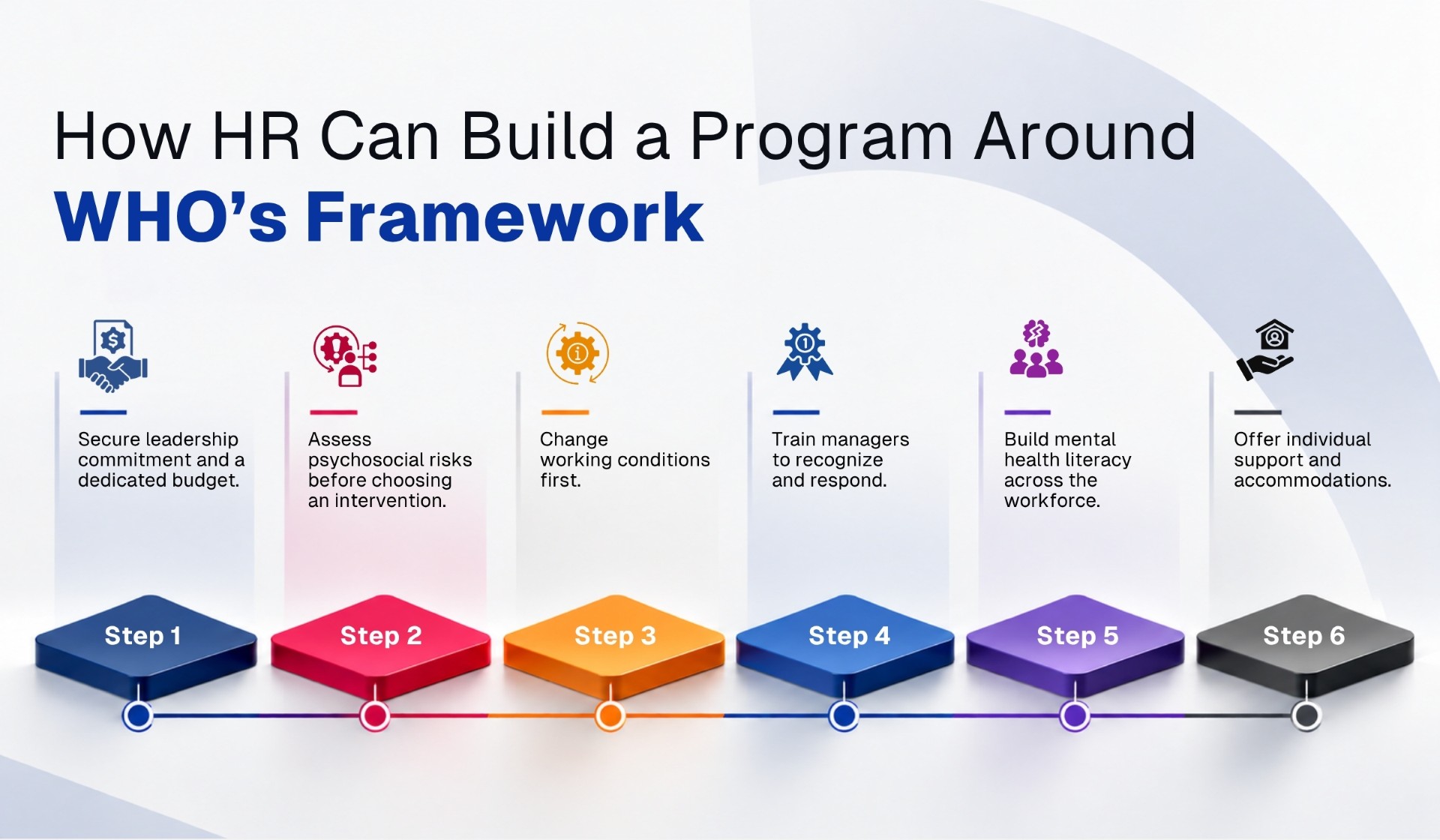
Step 1: Secure leadership commitment and a dedicated budget. WHO lists leadership and investment among the conditions that enable change, including dedicated budgets for action on mental health at work. Without a named owner and reliable funding, a program risks becoming a series of occasional events. Confirm both before you design its content.
Step 2: Assess psychosocial risks before choosing an intervention. Map these risks across the organization, starting with workload and staffing, then job control and role clarity. Sick-leave patterns and exit interviews show where risk concentrates, and conversations with employees explain what the numbers cannot. Compare indicators across groups where you can, since strain concentrated in one department points to a local cause that a company-wide program may overlook.
Step 3: Change working conditions first. Respond to the risks the assessment surfaces with organizational interventions. In practice these include clarifying roles where responsibilities overlap and rebalancing workloads that have grown uneven across a group. Resourcing an understaffed team belongs in this step, as headcount is itself a working condition.
Step 4: Train managers to recognize and respond. WHO recommends manager training that helps supervisors recognize and respond to employees experiencing emotional distress, and that builds skills in open communication and active listening. Managers shape the daily experience of work for their teams, a point developed further in this article on leadership in talent management. Plan the training as a recurring commitment, with refreshers timed to shifts in reporting structure or workload.
Step 5: Build mental health literacy across the workforce. Worker training in mental health literacy and awareness, another of WHO’s recommendations, aims to improve knowledge and reduce stigma. Stigma can keep employees from using support that already exists, a barrier explored in this piece on the future of employee well-being. Literacy training can also help colleagues notice when a peer may need support, extending the program’s reach beyond its formal channels.
Step 6: Offer individual support and accommodations. Provide stress-management training and similar personal support, and make reasonable accommodations available to employees with a mental health condition. WHO’s examples include extra time to complete tasks and time off for health appointments, and a structured return-to-work route supports employees coming back after an absence.
A program built this way needs measures that track working conditions and outcomes, since those are what it sets out to change. Participation figures remain useful, and they are most informative alongside measures closer to the underlying risk. Indicators you can track include:
Record these measures before the program launches as well as after, so the comparison reflects what the program itself changed.
Even with the right starting point, your program can lose its effect through a few avoidable design choices:
Prioritizing mental health in workplace wellness hinges on addressing the direct impact of working conditions and WHO’s framework is an evidence-based place for you to begin. Prevention addresses the cause of workplace risk, and training and individual support extend its effect.
The theme for World Mental Health Day 2026, set by the World Federation for Mental Health, is “Lived Experiences Heard: Real Voices, Real Change”. In practice, the theme suggests where to begin. Before selecting any new benefit this October, run a psychosocial risk assessment with the employees who do the work each day, and let what they report decide where the program begins.
If you or a colleague are struggling, an employee assistance program or a qualified mental health professional is a good first point of contact.

Uncover the trends redefining workforce strategy, the skills shaping next-generation CHROs, and strategies to drive lasting impact. Explore insights and assess your readiness to lead the future of talent.
Download the Guide

CredBadge™ is a proprietary, secure, digital badging platform that provides for seamless authentication and verification of credentials across digital media worldwide.
CredBadge™ powered credentials ensure that professionals can showcase and verify their qualifications and credentials across all digital platforms, and at any time, across the planet.

Please enter the License Number/Unique Credential Code of the certificant. Results will be displayed if the person holds an active credential from TMI.