We can't wait to hear from you
Connect
Discover how TMI credentials are designed to accelerate your career growth. Explore how TMI incorporates Talent Management into the practice and systems of Human Capital Management. Learn how you can steer your future confidently through TMI's research driven Talent Management standards. Fellow programs equip global HR professionals with the latest in Talent Management in the transformational way.
Explore how the TMP™, STMP™, and GTML™ credentials can take your HR career places, or add to the capabilities of your promising HR staff and leaders.
View CertificationsStrengthen your enterprise HR system by implementing the TMI-ETMS™ international standards.
Learn About TMI-ETMS™If you are interested in consulting, training or education, partner with TMI to join the global league of TMI aligned institutions, companies and industries.
Become a TMI PartnerLearn the latest about how Talent Management is transforming HR into a future oriented business hyperfunction.
Explore the TMI ApproachLearn the steps to earn your TMI certification, from application to successful completion and maintaining your credential.
TMI credentials include globally recognized digital badges, offering a portable and verifiable representation of your achievements.

Kickstart your Talent Management journey with TMI’s globally recognized certifications and resources to excel in your career.
Create myTMI Account TodayTMI Global and Associate Fellow programs turn HR professionals into global Talent Leaders who can drive growth with their superlative strategic ability, business perspective and readiness for change. Since 2024, more than 150 senior HR professionals and HR leaders from 46 global organizations across industries have completed these programs that establish new standards for the practice of talent management as a driver of organizational success and business competitiveness.
You can contact us here for more information.

TMI–ETMS10™ and TMI–ETMS14™ certified organizations are effective for restructuring Talent Management in an organization. With TMI, organizations are better, more agile and better prepared for challenges that are to come.
The TMI-Enterprise Talent Management Standards power enterprise HR with the latest in Talent Management.
To choose a TMI–ETMS™ version most appropriate for your organization!
Write to us via the contact form.

Partnering with TMI means building a powerful structure of Talent Management thought and practice resulting in business profits through standards, certifications and networks.
Get your HR staffers and managers TMI certified on Talent Management by adding TMI into your training regimen. One step toward embedding TMI credentials in your institutions curricula is to become a TMI-ETMS™ consulting partner. Join us to be a part of the groundbreaking work of Talent Management.

If you hold an elite international qualification in HR or a related discipline, possess a recognized HR credential, or studied HRM at a TMI-recognized institution, you may be eligible for an accelerated pathway to a TMI credential through QualiFly™ leading to TMP™, STMP™ or GTML™.
 Institutions
Explore Certification Bodies, Universities, B-Schools & Other Institutions recognized by TMI under the Q1, Q2, and Q3 Lists.
Check if your institution is recognized
TMI’s blogs cover the latest trends, insights, and best practices in HR and talent management.
Comprehensive guides covering talent development, HR metrics, key facts, and more.
Explore TMI's latest updates, announcements, news and press releases in our newsroom.
Strategic insights driving the future of talent, leadership, and global workforce excellence.
Dive into the inspiring journeys of TMI certification holders and learn how the certification has transformed their careers.
An Interview series featuring key advice from global talent leaders for future HR professionals.

TMI’s editorial team is comprised of researchers, writers, editors, proofreaders, and contributors with extensive experience in the HR and Talent Management space. The team scrupulously researches, analyzes and deliberates on each submission before concluding its suitability for our publications.

Organizations face persistent paradoxes. Despite massive investments in learning programs, sophisticated recruitment processes, and comprehensive benefits packages, employee engagement remains stubbornly low. Training initiatives often fail to create lasting change. High-potential talent quietly disengages and departs. Performance management systems trigger defensiveness rather than development.
The problem is not inadequate effort or insufficient resources. The fundamental issue is that traditional talent management approaches were designed without understanding how the human brain actually functions. Companies have been fighting against human neurobiology rather than working with it.
Behavioral science and neuroscience offer a transformative alternative. By grounding talent strategy in evidence about how people learn, make decisions, form habits, and respond to their environment, organizations can create systems that align with rather than contradict human nature. This alignment produces better outcomes across the entire employee lifecycle, from talent acquisition through development and retention.
This article explores how applying behavioral science across recruitment, onboarding, development, performance management, and culture solves the most critical talent challenges organizations face today.
The human brain is not a blank slate waiting to be programmed through policies and procedures. It is a sophisticated organ shaped by millions of years of evolution, operating according to predictable patterns and principles. Effective talent strategy must acknowledge and accommodate these biological realities.
Three neural systems are particularly relevant for talent management.
The prefrontal cortex handles executive functions like planning, decision-making, and self-regulation. However, this region has limited capacity and depletes throughout the day, much like a smartphone battery draining as it runs multiple applications simultaneously. This explains why cramming eight hours of training into a single day, produces minimal retention.
The limbic system processes emotions and social information. The amygdala within this system acts as a threat detector, constantly scanning for danger. When it perceives threat, whether from a charging predator or critical feedback from a manager, it triggers defensive responses that shut down rational thinking. This neurological reality explains why traditional performance reviews often backfire despite good intentions.
The reward system, centered on the neurotransmitter dopamine, drives motivation and goal-directed behavior. Dopamine surges not when rewards are received but when progress toward goals is anticipated. This anticipation, rather than achievement itself, fuels sustained motivation. Organizations that understand this principle can design career pathways that maintain engagement even during routine work phases.
These neural systems interact constantly, creating the complex patterns we observe as workplace behavior. When talent strategy ignores these interactions, it creates policies that sound logical but fail in practice. When strategy accommodates these systems, it produces interventions that feel effortless to employees while delivering powerful results.
Most companies invest substantial resources in training programs that employees forget within weeks. This failure stems from designing learning experiences for machines rather than human brains.
The prefrontal cortex can maintain focus for limited periods before requiring rest. Attempting to absorb large volumes of information in marathon sessions overwhelms this capacity, resulting in minimal actual learning despite maximal time investment. Neuroscience reveals why this approach fails and points toward more effective alternatives.
Neuroplasticity, the brain's ability to form new neural connections, requires repetition and spacing. Think of learning a new skill like creating a walking path through a forest. The first attempt involves pushing through thick undergrowth with considerable effort. Each subsequent traversal clears the trail slightly more until eventually a clear pathway emerges. This process cannot be rushed. The neural highways that support lasting behavioral change require repeated practice distributed over time.
Organizations solving the retention problem replace marathon training sessions with microlearning, bite-sized lessons spread across weeks. Shifting from week-long technical bootcamps to daily 15-minute skill-building sessions can dramatically improve knowledge retention. This approach aligns with how neuroplasticity actually functions, allowing neural connections to strengthen between sessions.
Bite-sized learning modules enhance brain connectivity and foster knowledge growth through focused, engaging micro-lessons. The spacing effect, well-documented in cognitive psychology, demonstrates that information reviewed multiple times over extended periods is retained far better than the same information crammed into a single intensive session.
Effective microlearning also incorporates retrieval practice. Asking learners to recall information rather than simply reviewing it strengthens memory more effectively. Organizations can build this into training by incorporating brief quizzes, scenario-based applications, and peer teaching opportunities that require active recall rather than passive consumption.
The recruitment process represents the first opportunity to apply behavioral science to talent strategy. Understanding how candidates' brains process employer signals enables more effective talent acquisition.
Unilever implemented a digital hiring system using gamified assessments and video interviews to evaluate candidates based on potential rather than credentials. This data-driven approach delivered impressive results:
The gamified assessments measured cognitive ability, risk tolerance, and behavioral traits through engaging scenarios rather than traditional tests. Video interviews allowed candidates to respond to standardized questions on their schedule, removing geographic and timing barriers. AI analysis reduced interviewer bias while maintaining human oversight of final decisions.
This approach demonstrates that neuroscience-informed recruitment can simultaneously improve efficiency, reduce costs, increase diversity, and enhance retention by better matching candidates to roles based on actual capability and cultural fit.
The onboarding period represents a critical window when new employees' brains are highly receptive to learning organizational culture, building relationships, and forming habits that will persist throughout their tenure.
Airbnb redesigned its onboarding using principles from its core business of hospitality. New employees were welcomed like valued guests, with thoughtful touches that created immediate belonging.
The host-style approach included personalized welcome packages, assigned "hosts" who served as guides through the first months, structured milestone celebrations, and deliberate community-building activities. These elements addressed belonging needs, created dopamine trails through visible progress, and managed cognitive load through clear guidance.
The success demonstrates that onboarding design matters enormously. Investing in the first 90 days produces returns throughout the employee lifecycle by establishing neural patterns of engagement, competence, and connection from the start.
Most corporate training fails to produce lasting behavioral change because it ignores how the brain actually learns. Understanding neuroplasticity and memory formation enables dramatically more effective learning experiences.
Several organizations have adopted gaming and spaced repetition principles from language learning platforms like Duolingo for corporate training.
The Duolingo model delivers brief daily lessons, uses spaced repetition algorithms to determine optimal review timing, incorporates retrieval practice through exercises and quizzes, provides immediate feedback, and creates visible progress through streaks and levels. Each of these elements aligns with learning neuroscience.
When applied to corporate contexts, whether technical skills, leadership development, or compliance training, these principles produce dramatically superior outcomes compared to traditional intensive workshops. The investment in platform development pays returns through actual behavioral change rather than checking training completion boxes.
Traditional performance reviews represent one of the most neurologically problematic HR practices. Understanding threat responses enables complete redesign that fosters genuine development.
Adobe eliminated annual performance reviews and ratings in favor of frequent check-in conversations focused on growth and development. Two years after implementation, Adobe reported:
The check-in model emphasized regular manager-employee conversations about expectations, feedback, and career development. Without ratings, conversations became less threatening and more collaborative. Managers provided coaching rather than judgment. Employees could discuss challenges without fear of permanent record consequences.
The Adobe example demonstrates that eliminating neurologically problematic practices while replacing them with brain-friendly alternatives produces better outcomes for both employees and organizations. The shift requires cultural change and manager training but delivers substantial returns through improved performance and retention.
Understanding how the dopamine system functions enables dramatically more effective approaches to motivation and recognition. Several counterintuitive principles emerge from neuroscience research.
Cisco implemented a real-time recognition platform that enabled immediate peer-to-peer appreciation, visible achievement tracking, and social celebration of contributions. The platform lifted employee Net Promoter Score by 18 points while increasing voluntary participation in discretionary initiatives.
The system allowed any employee to recognize any other employee immediately when they observed valuable contributions. Recognition appeared on public dashboards, creating social acknowledgment. The immediacy ensured that dopamine responses occurred close to the recognized behavior, strengthening the neural connection between action and reward.
The platform also tracked individuals' recognition history, creating visible progress trails that sustained motivation. Employees could see their contributions adding up over time, triggering ongoing dopamine responses rather than just single-event rewards. This design incorporated multiple neuroscience principles simultaneously, producing measurably superior results.
Effective leadership creates psychological safety, which is not an abstract cultural concept but a biological state characterized by specific neural patterns. Understanding the neuroscience of trust enables leaders to build cultures that support performance and wellbeing.
Google's Project Aristotle famously identified psychological safety as the most important factor in team effectiveness. Recent neuroscience research has deepened understanding of why safety matters and how leaders create it.
The updated findings emphasize that psychological safety is not personality-dependent but rather emerges from specific, learnable leadership behaviors. Teams with high psychological safety show different neural patterns during collaboration, with greater prefrontal activation and lower amygdala reactivity.
The research identified the importance of predictable team rhythms, structured turn-taking in discussions, and explicit acknowledgment of contributions as concrete practices that build neural trust. These findings translate psychological safety from abstract concepts to actionable behaviors that any leader can implement.
Chronic workplace stress produces measurable neurological damage that impairs performance and wellbeing. Understanding stress neuroscience enables organizations to design genuinely protective interventions rather than superficial wellness programs.
Several organizations have achieved substantial burnout reduction through neuroscience-informed interventions. Etsy implemented structured recovery periods, mandatory vacation policies, and meeting-free afternoons, reducing reported burnout while maintaining productivity.
Asana designed its work culture around sustainable pace principles, including meeting-free Wednesdays, encouraged time blocking for focus work, and cultural norms against after-hours communication. These interventions reduced burnout indicators while improving both retention and performance metrics.
The key insight is that burnout prevention requires structural interventions rather than individual wellness programs. When organizations design work to respect neural recovery needs, provide autonomy over schedules, and maintain reasonable workloads, burnout decreases naturally. Superficial wellness programs cannot compensate for work structures that chronically overtax the stress response system.
As organizations apply neuroscience and behavioral science to talent management, ethical considerations become paramount. Several principles should guide implementation to ensure practices remain beneficial rather than manipulative.
Employees should understand what behavioral principles are being applied and why. Transparency about using neuroscience insights to design training, feedback systems, or recognition programs builds trust rather than undermining it. Covert manipulation, even with benevolent intent, violates the trust necessary for psychological safety.
Consent becomes particularly important for interventions involving biometric monitoring, neurofeedback, or extensive behavioral tracking. While organizations can require participation in training or performance management, more invasive interventions require genuine voluntary participation without career consequences for declining.
The line between influence and manipulation lies in respect for autonomy. Influence that helps people achieve their own goals while preserving choice is ethical. Manipulation that covertly drives behavior toward organizational objectives without regard for individual wellbeing crosses ethical boundaries.
Dark patterns are design choices that trick users into behaviors not in their interest. Consumer technology frequently uses dark patterns to maximize engagement or spending. Similar techniques applied to workplace behavioral science would be unethical.
Examples of dark patterns to avoid include hiding information about how behavioral systems work, using shame or excessive social pressure to drive compliance, designing systems that make opting out difficult, or leveraging neurological insights to extract more work without compensating fairly.
Ethical behavioral science should be transparent about its mechanisms, voluntary wherever possible, designed to benefit employees alongside organizational objectives, and subject to regular review to ensure it maintains these standards. Organizations should establish oversight mechanisms that prevent behavioral science from becoming manipulative.
The brain-based talent strategy represents a fundamental shift from guessing about what motivates and develops people to applying evidence about how human neurobiology actually functions. Organizations that make this shift gain measurable advantages in talent acquisition, development, engagement, and retention.
Neuroscience reveals why traditional approaches often fail despite good intentions. Marathon training sessions overwhelm limited prefrontal cortex capacity. Annual performance reviews trigger an amygdala hijack that prevents learning. Opaque career paths starve the dopamine system of motivational fuel. Each of these failures stems from policies designed without understanding the neural systems they must influence.
Behavioral science provides practical alternatives aligned with brain function. Microlearning accommodates neuroplasticity requirements. Continuous feedback prevents threat responses while enabling habit formation. Visible career pathways sustain dopamine-driven motivation. Leadership practices that build neural trust reduce stress and increase engagement.
The future of talent management lies not in more technology or better policies but in better neuroscience. When organizations design for how the brain actually works, training sticks, feedback fosters growth, motivation sustains, and talent thrives.

Uncover the trends redefining workforce strategy, the skills shaping next-generation CHROs, and strategies to drive lasting impact. Explore insights and assess your readiness to lead the future of talent.
Download the Guide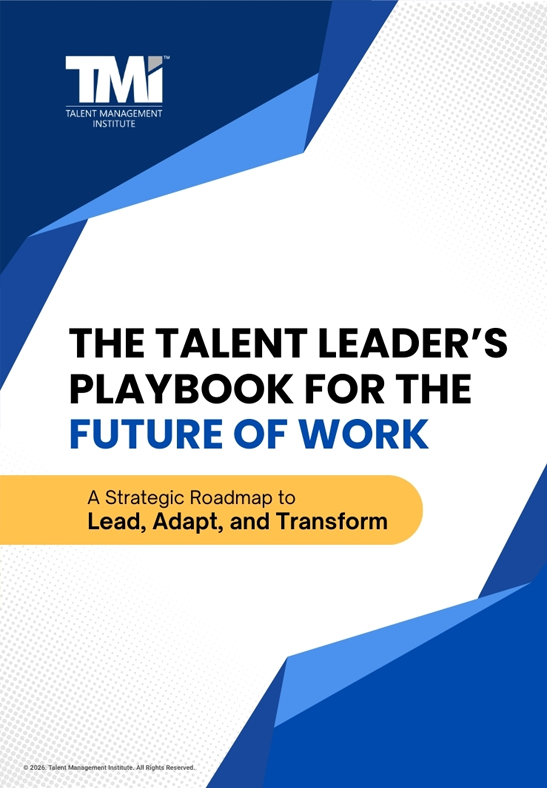

CredBadge™ is a proprietary, secure, digital badging platform that provides for seamless authentication and verification of credentials across digital media worldwide.
CredBadge™ powered credentials ensure that professionals can showcase and verify their qualifications and credentials across all digital platforms, and at any time, across the planet.

Please enter the License Number/Unique Credential Code of the certificant. Results will be displayed if the person holds an active credential from TMI.