We can't wait to hear from you
Connect
Discover how TMI credentials are designed to accelerate your career growth. Explore how TMI incorporates Talent Management into the practice and systems of Human Capital Management. Learn how you can steer your future confidently through TMI's research driven Talent Management standards. Fellow programs equip global HR professionals with the latest in Talent Management in the transformational way.
Explore how the TMP™, STMP™, and GTML™ credentials can take your HR career places, or add to the capabilities of your promising HR staff and leaders.
View CertificationsStrengthen your enterprise HR system by implementing the TMI-ETMS™ international standards.
Learn About TMI-ETMS™If you are interested in consulting, training or education, partner with TMI to join the global league of TMI aligned institutions, companies and industries.
Become a TMI PartnerLearn the latest about how Talent Management is transforming HR into a future oriented business hyperfunction.
Explore the TMI ApproachLearn the steps to earn your TMI certification, from application to successful completion and maintaining your credential.
TMI credentials include globally recognized digital badges, offering a portable and verifiable representation of your achievements.

Kickstart your Talent Management journey with TMI’s globally recognized certifications and resources to excel in your career.
Create myTMI Account TodayTMI Global and Associate Fellow programs turn HR professionals into global Talent Leaders who can drive growth with their superlative strategic ability, business perspective and readiness for change. Since 2024, more than 150 senior HR professionals and HR leaders from 46 global organizations across industries have completed these programs that establish new standards for the practice of talent management as a driver of organizational success and business competitiveness.
You can contact us here for more information.

TMI–ETMS10™ and TMI–ETMS14™ certified organizations are effective for restructuring Talent Management in an organization. With TMI, organizations are better, more agile and better prepared for challenges that are to come.
The TMI-Enterprise Talent Management Standards power enterprise HR with the latest in Talent Management.
To choose a TMI–ETMS™ version most appropriate for your organization!
Write to us via the contact form.

Partnering with TMI means building a powerful structure of Talent Management thought and practice resulting in business profits through standards, certifications and networks.
Get your HR staffers and managers TMI certified on Talent Management by adding TMI into your training regimen. One step toward embedding TMI credentials in your institutions curricula is to become a TMI-ETMS™ consulting partner. Join us to be a part of the groundbreaking work of Talent Management.

If you hold an elite international qualification in HR or a related discipline, possess a recognized HR credential, or studied HRM at a TMI-recognized institution, you may be eligible for an accelerated pathway to a TMI credential through QualiFly™ leading to TMP™, STMP™ or GTML™.
 Institutions
Explore Certification Bodies, Universities, B-Schools & Other Institutions recognized by TMI under the Q1, Q2, and Q3 Lists.
Check if your institution is recognized
TMI’s blogs cover the latest trends, insights, and best practices in HR and talent management.
Comprehensive guides covering talent development, HR metrics, key facts, and more.
Explore TMI's latest updates, announcements, news and press releases in our newsroom.
Strategic insights driving the future of talent, leadership, and global workforce excellence.
Dive into the inspiring journeys of TMI certification holders and learn how the certification has transformed their careers.
An Interview series featuring key advice from global talent leaders for future HR professionals.
TMI’s editorial team is comprised of researchers, writers, editors, proofreaders, and contributors with extensive experience in the HR and Talent Management space. The team scrupulously researches, analyzes and deliberates on each submission before concluding its suitability for our publications.

Employee Appreciation Day offers an opportunity to recognize the people whose work sustains the organization every day. While recognition matters, its real value lies in acknowledging how employees contribute ideas, share feedback, and their commitment to the assigned roles. HR plays a vital role here. They define how decisions are made, how feedback travels, and whether employees have meaningful influence over the systems they work within.
A report from the University of Phoenix reinforces a clear conclusion. Employees flourish when they experience both autonomy and organizational support. In fact, 91 percent of workers who feel they have meaningful autonomy, reported adapting easily to new situations.
In this analysis, flourishing is not best explained by personality or demographics. It is a function of work design.
A study conducted by the Center for Professional Responsibility in Business and Society at the University of Illinois’ Gies College of Business surveyed 2,000 U.S. workers. It found that 68 percent of employees flourish in environments characterized by both high autonomy and high support. In contrast, only 10 percent thrive in environments lacking both conditions.
Within this analysis, flourishing at work was not concentrated in any demographic group. Outcomes did not systematically differ by age, gender, income, education, race, or region. Instead, the defining factor was the quality of work conditions.
In this context, autonomy refers to meaningful discretion over how work is performed. Support refers to consistent backing from supervisors, peers, and the organization when exercising that discretion. One without the other produces imbalance. Together, they create sustainable performance conditions. But structural conditions do not maintain themselves. Employee voice is one of the mechanisms through which those conditions are either sustained or undermined.
Autonomy is sustained or constrained through leadership behavior and the broader voice environment. These are the norms and channels that determine whether employee input is invited, safe, and consequential.
An employee’s voice is often sustained or constrained through leadership behavior. Leaders directly influence workplace norms regarding employee say. They can either encourage it or suppress it through their responses and expectations.
Chris Mullen, Executive Director of The Workforce Institute, has warned of what he describes as ‘troubling inequality in the feedback loop’. He further said: “Employee engagement is an important part of the overall employee experience, and if employees don’t feel heard, then their engagement and sense of belonging at work suffers.”
Jeff Fox, Principal at Aon, has highlighted the limits of traditional employee listening surveys, noting that what employees say may not fully reflect how they actually feel. He points out that conventional surveys often depend on direct self-reporting, which can capture only surface-level sentiment.
More advanced listening approaches, including neuroscience-informed methodologies and indirect response techniques, aim to go deeper. Rather than relying solely on direct questions, these models assess reactions to structured prompts or affirmations to better understand underlying employee sentiment.
Listening alone is not sufficient. Fox stresses the importance of visible action in response to feedback. Clear communication outlining what was heard and what changed addresses the common perception that feedback disappears into a void.
Many organizations equate employee voice with the existence of surveys, town halls, or suggestion platforms. These mechanisms create opportunities for expression. They do not automatically create influence.
Influence requires that employee input shapes decisions, policies, or processes in observable ways. Without that connection, the voice becomes symbolic. Employees may continue to respond, but their participation becomes procedural rather than meaningful.
This distinction explains why some organizations report strong survey participation yet struggle with disengagement and turnover. Expression without impact does not sustain commitment.
Research consistently links employee voice to retention. The number of avenues employees have to express input correlates with lower turnover. The following summarizes commonly reported organizational outcomes when employees have meaningful influence or say at work:
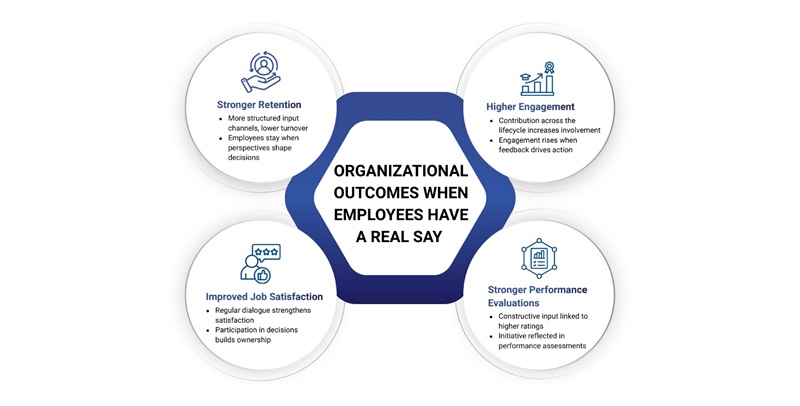
Employee voices have a direct relationship with retention. The more structured avenues employees have to express concerns, share ideas, and influence decisions, the lower the likelihood of voluntary turnover. When individuals believe their perspectives matter and can shape outcomes, they are more inclined to stay. Organizations have expanded formal feedback channels in recognition of this connection.
Engagement increases when employees are invited to contribute input at multiple stages of the employee lifecycle. Seeking feedback during onboarding, performance discussions, and organizational change initiatives strengthens involvement. Engagement improves most when employees see that their input informs policies and practices rather than being collected without visible impact.
Job satisfaction rises when employees maintain regular dialogue with supervisors and participate in decision-making processes. Involvement signals professional respect and reinforces a sense of competence. Employees who have a say in how work is structured report stronger satisfaction than those operating within rigid, top-down systems.
It also influences performance perceptions. Managers tend to rate employees more favorably when they demonstrate constructive voice behaviors such as raising risks, offering solutions, and contributing ideas. Lower levels of participation are often associated with lower performance assessments. In practice, voice functions as an indicator of initiative and commitment.
When employees do not feel heard, consequences accumulate gradually.
Trust declines as employees question whether leadership intends to incorporate their perspectives. Engagement diminishes because contribution appears inconsequential. Creativity narrows, as proposing new ideas carries risk without clear benefit. Retention weakens as employees look for environments where their input influences outcomes.
Control-based cultures rarely identify themselves as such. They often rely on established processes and centralized decision-making. Over time, limited participation reduces adaptability. Change initiatives encounter resistance because employees were not involved in shaping them.
The erosion is often subtle. It does not require overt toxicity. Indifference to input is sufficient.
Recognition remains important, but it has evolved. Standardized rewards and generic praise no longer meet employee expectations. Insights from the State of Recognition and Rewards report indicate that high-impact programs are two to three times more likely to offer diverse reward types, including symbolic mementos, flexible gift cards, experiential rewards, learning opportunities, and leadership interactions.
Variety signals attentiveness to individual preferences. However, recognition alone does not substitute for structural participation. Appreciation programs reinforce belonging. Decision rights reinforce ownership.
For HR leaders, the question during HR Appreciation Week is not only how employees are recognized, but how work systems incorporate employee judgment.
The evidence is consistent. Flourishing depends on autonomy combined with support. Voice depends on leadership norms and credible response mechanisms. Retention, engagement, satisfaction, and performance are influenced by whether employees can shape how work functions.
For HR Leaders, this elevates employee voice from a cultural initiative to a governance priority, influencing decision rights, escalation processes, and formal consultation mechanisms across the organization. It requires clarity on which decisions are centralized, which are consultative, and which are delegated. It requires listening tools that capture sentiment accurately and communication processes that demonstrate follow-through.
Employees have something to say. The organizational question is whether the system allows that input to influence outcomes. Work conditions determine whether people flourish or languish. Designing those conditions remains one of HR’s most consequential responsibilities.

Uncover the trends redefining workforce strategy, the skills shaping next-generation CHROs, and strategies to drive lasting impact. Explore insights and assess your readiness to lead the future of talent.
Download the Guide

CredBadge™ is a proprietary, secure, digital badging platform that provides for seamless authentication and verification of credentials across digital media worldwide.
CredBadge™ powered credentials ensure that professionals can showcase and verify their qualifications and credentials across all digital platforms, and at any time, across the planet.

Please enter the License Number/Unique Credential Code of the certificant. Results will be displayed if the person holds an active credential from TMI.