We can't wait to hear from you
Connect
Discover how TMI credentials are designed to accelerate your career growth. Explore how TMI incorporates Talent Management into the practice and systems of Human Capital Management. Learn how you can steer your future confidently through TMI's research driven Talent Management standards. Fellow programs equip global HR professionals with the latest in Talent Management in the transformational way.
Explore how the TMP™, STMP™, and GTML™ credentials can take your HR career places, or add to the capabilities of your promising HR staff and leaders.
View CertificationsStrengthen your enterprise HR system by implementing the TMI-ETMS™ international standards.
Learn About TMI-ETMS™If you are interested in consulting, training or education, partner with TMI to join the global league of TMI aligned institutions, companies and industries.
Become a TMI PartnerLearn the latest about how Talent Management is transforming HR into a future oriented business hyperfunction.
Explore the TMI ApproachLearn the steps to earn your TMI certification, from application to successful completion and maintaining your credential.
TMI credentials include globally recognized digital badges, offering a portable and verifiable representation of your achievements.

Kickstart your Talent Management journey with TMI’s globally recognized certifications and resources to excel in your career.
Create myTMI Account TodayTMI Global and Associate Fellow programs turn HR professionals into global Talent Leaders who can drive growth with their superlative strategic ability, business perspective and readiness for change. Since 2024, more than 150 senior HR professionals and HR leaders from 46 global organizations across industries have completed these programs that establish new standards for the practice of talent management as a driver of organizational success and business competitiveness.
You can contact us here for more information.

TMI–ETMS10™ and TMI–ETMS14™ certified organizations are effective for restructuring Talent Management in an organization. With TMI, organizations are better, more agile and better prepared for challenges that are to come.
The TMI-Enterprise Talent Management Standards power enterprise HR with the latest in Talent Management.
To choose a TMI–ETMS™ version most appropriate for your organization!
Write to us via the contact form.

Partnering with TMI means building a powerful structure of Talent Management thought and practice resulting in business profits through standards, certifications and networks.
Get your HR staffers and managers TMI certified on Talent Management by adding TMI into your training regimen. One step toward embedding TMI credentials in your institutions curricula is to become a TMI-ETMS™ consulting partner. Join us to be a part of the groundbreaking work of Talent Management.

If you hold an elite international qualification in HR or a related discipline, possess a recognized HR credential, or studied HRM at a TMI-recognized institution, you may be eligible for an accelerated pathway to a TMI credential through QualiFly™ leading to TMP™, STMP™ or GTML™.
 Institutions
Explore Certification Bodies, Universities, B-Schools & Other Institutions recognized by TMI under the Q1, Q2, and Q3 Lists.
Check if your institution is recognized
TMI’s blogs cover the latest trends, insights, and best practices in HR and talent management.
Comprehensive guides covering talent development, HR metrics, key facts, and more.
Explore TMI's latest updates, announcements, news and press releases in our newsroom.
Strategic insights driving the future of talent, leadership, and global workforce excellence.
Dive into the inspiring journeys of TMI certification holders and learn how the certification has transformed their careers.
An Interview series featuring key advice from global talent leaders for future HR professionals.
TMI’s editorial team is comprised of researchers, writers, editors, proofreaders, and contributors with extensive experience in the HR and Talent Management space. The team scrupulously researches, analyzes and deliberates on each submission before concluding its suitability for our publications.

Human resources teams handle an enormous volume of text every week, from resumes and policies to survey comments and manager notes. That volume has made Claude AI useful for HR departments. According to McKinsey’s The State of AI in 2025 report, 88% of respondents said their organizations regularly use AI in at least one business function, an increase from the previous year. HR is frequently one of the first areas where that adoption shows up.
Claude can be particularly useful for HR tasks that involve organizing, summarizing, comparing, or rewriting information that already exists. It becomes more challenging when a prompt asks it to make a decision about a person's career, infer sensitive information, or supply facts that are not supported by the source material.
This article looks at what practical Claude prompts for HR actually look like, where the tool genuinely saves time and where human oversight has to stay firmly in place.
Claude works well for HR tasks that involve turning existing material into a structured draft, summary, comparison, or analysis rather than tasks that require it to invent facts or make a call about a person's career. It becomes riskier when a prompt asks it to rank, decide, or infer sensitive information. That distinction shapes almost every recommendation in this article.
Anthropic has released a Claude for HR plugin, built for use inside Claude Cowork. The plugin covers recruiting, onboarding, performance reviews, compensation analysis, and policy guidance. HR still reviews and validates every output before it’s finalized.
HR work is text-heavy and pattern-heavy at the same time. Job descriptions, onboarding plans, exit interview notes, and performance reviews all follow recognizable structures, which makes them well suited to a model that can organize information quickly once it has the right input. The key factor is that AI prompts only produce useful output when the person writing them supplies enough context. A vague request such as "write a job ad" tends to return generic copy that could apply to any company, while a request that names the role, department, seniority, and required sections produces something closer to a usable first draft.
This is where prompt engineering proves its value in HR specifically. A well-built prompt tells Claude who is asking, what the finished output should contain, what tone and reading level fit the audience, and what topics are off limits. Frameworks such as AIHR's BRIEF approach are one way to structure that discipline. Teams that build this habit tend to need far fewer rounds of editing before an output is ready to use, though prompt quality alone is not the whole picture.
The Talent Management Institute frames the wider governance question as four pillars: fairness in the underlying data, privacy and compliance in how employee data is handled, transparency in how outputs can be explained, and human oversight that keeps a person accountable for anything consequential. A well phrased prompt matters far less if those four conditions are not already in place.
A handful of HR use cases show consistently across teams already working with Claude and each one follows the same pattern of feeding the model's source material rather than asking it to guess.
You are an L&D partner supporting internal mobility. I will paste the employee's current role profile and the job description for [target role]. Compare the two and output a table with columns: current strength, target requirement, gap (none, partial, full), and recommended development action. Do not make a promotion readiness decision. Flag any gap that training or mentoring alone cannot close.
You are an HR analyst reviewing anonymized engagement survey comments from [team], covering [date range]. I will paste the comments below. Identify the top themes, note how many comments mention each one, and separate "Evidence" (paraphrased from the comments) from "Interpretation" (your reading of the pattern). If a theme appears only once, label it anecdotal rather than a pattern. Do not include any identifying details.
You are an HRBP onboarding a new [role title] in [department], reporting to [manager], expected to be productive within [timeframe]. Build a 30-60-90 day plan as a single table with columns: phase, goal, learning priorities, key meetings, and early deliverables. Use an eighth grade reading level and a supportive, professional tone.
You are coaching a manager ahead of a performance review. I will paste rough notes on an employee's performance. Rewrite each point into behavior based feedback covering what happened, why it matters, what good looks like, and what the employee should do next. Avoid labels like "lazy" or "not a team player." Provide a direct version and a softer version for each point.
You are helping a manager prepare for a difficult but necessary conversation with an employee in [role]. I will paste documented examples of the issue and any prior feedback given. Create a 30-minute conversation plan with an opening line, key points tied to specific examples, questions to ask, likely employee responses, and next steps. Keep the language factual and calm. Do not include accusatory framing or speculation about intent.
Each of these prompts asks Claude to reorganize something that already exists rather than to supply missing judgment. That is the pattern worth copying whenever a new use case comes up.
Writing a strong HR prompt starts with naming the exact artifact needed, not just the general topic. Instead of asking for help with a policy, a stronger prompt asks Claude to draft a hybrid work policy where every clause is labeled as copied from the source, adapted, or flagged for legal review. That labeling habit does more than improve accuracy. It gives the person reviewing the output a fast way to see which parts are safe to use as written and which parts need a second look before anyone relies on them.
A few habits consistently separate prompts that work from prompts that create extra editing work later.
That last point matters more than it might first appear. A model that fills a gap with a plausible-sounding number is far more dangerous in HR than one that simply flags the gap and asks a person to fill it in.
Some HR tasks should never be handed to a model, regardless of how well the prompt is written. Ranking candidates and rejecting the bottom portion, deciding who gets promoted or placed on a performance plan, confirming legal compliance across jurisdictions, setting a final salary figure from memory, and reading private messages to guess who might be disengaged all fall into this category. Better prompting does not remove the need for human judgment in these situations.
US regulators have already drawn this line in practice. The EEOC (Equal Employment Opportunity Commission) has made clear that Title VII applies when employers use AI, algorithms or other automated systems in employment selection, meaning employers cannot avoid their anti-discrimination obligations simply because a third-party vendor supplies the technology. New York City’s Local Law 144 goes further by requiring covered employers and employment agencies using automated employment decision tools to ensure an independent bias audit within one year of use, publicly post a summary of the audit, and provide required notice at least 10 business days before using the tool. Violations can carry civil penalties of up to USD 1,500 for subsequent violations, with each day of unlawful use potentially treated as a separate violation. Illinois has also adopted employment-specific AI protections, while New Jersey has issued guidance confirming that employers can remain responsible for discriminatory outcomes produced by automated decision-making tools they did not develop.
The practical rule that follows from this is simple to apply. Claude can organize the evidence a person needs to make a decision, but it should not be the one making that decision. A performance review draft built from a manager's notes and project outcomes is fair use. A prompt asking Claude to decide the final rating is not.
Prompting works well for one-off drafts and repeatable templates, but it starts to show its limits once a task depends on employee data that needs to persist and stay connected across systems and review cycles. BCG’s 2026 research found that nearly 70% of respondents report using generative AI in some capacity, yet only 38% consider it highly or strongly relevant to their organization today. In addition, 51% cite data privacy and compliance concerns as the greatest barrier to introducing generative AI. That gap points to the real boundary of prompt-based HR AI tools. A prompt can produce a strong first draft of a review or a skills gap analysis, but it cannot maintain a record that follows an employee’s goals, skills, and development actions across multiple cycles, or manage the recurring workflow of reminders, calibration, and approval that a formal HR system is designed to handle.
Recognizing that boundary early saves teams from overextending a tool that was never meant to replace a system of record. The sensible approach is to use Claude for the drafting and analysis work it does well, then route anything that touches persistent employee history, compliance obligations, or a final employment decision through the appropriate HR platform and the humans responsible for it.
Claude prompts for HR deliver the most value when they are treated as a way to speed up drafting and analysis rather than a shortcut around judgment. Give the model real source material, name the exact deliverable, separate evidence from interpretation, and set clear limits on tone, length, and sensitive content. Review every output before it reaches an employee or a candidate, and keep any decision that affects someone's job, pay, or standing firmly with the people accountable for it.
Used this way, prompt engineering becomes a practical discipline for HR teams. The goal is to make routine work more efficient while keeping decisions that affect employees with the people responsible for making them.

Uncover the trends redefining workforce strategy, the skills shaping next-generation CHROs, and strategies to drive lasting impact. Explore insights and assess your readiness to lead the future of talent.
Download the Guide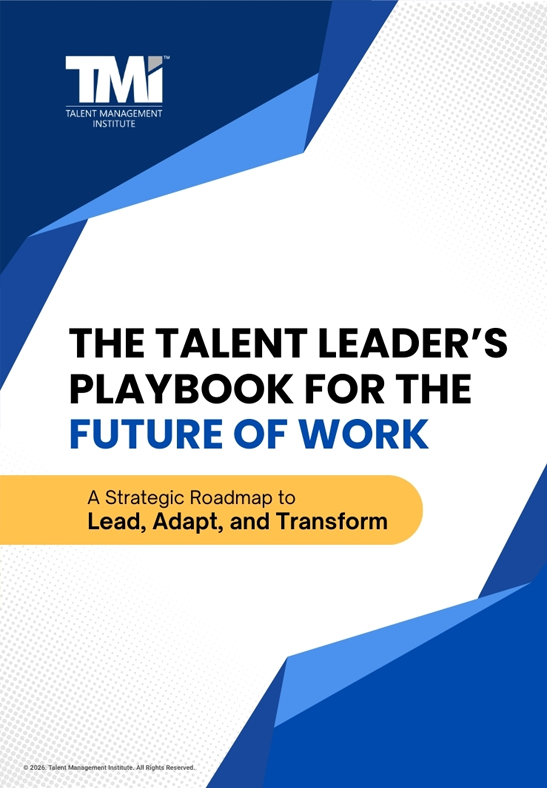

CredBadge™ is a proprietary, secure, digital badging platform that provides for seamless authentication and verification of credentials across digital media worldwide.
CredBadge™ powered credentials ensure that professionals can showcase and verify their qualifications and credentials across all digital platforms, and at any time, across the planet.

Please enter the License Number/Unique Credential Code of the certificant. Results will be displayed if the person holds an active credential from TMI.