We can't wait to hear from you
Connect
Discover how TMI credentials are designed to accelerate your career growth. Explore how TMI incorporates Talent Management into the practice and systems of Human Capital Management. Learn how you can steer your future confidently through TMI's research driven Talent Management standards. Fellow programs equip global HR professionals with the latest in Talent Management in the transformational way.
Explore how the TMP™, STMP™, and GTML™ credentials can take your HR career places, or add to the capabilities of your promising HR staff and leaders.
View CertificationsStrengthen your enterprise HR system by implementing the TMI-ETMS™ international standards.
Learn About TMI-ETMS™If you are interested in consulting, training or education, partner with TMI to join the global league of TMI aligned institutions, companies and industries.
Become a TMI PartnerLearn the latest about how Talent Management is transforming HR into a future oriented business hyperfunction.
Explore the TMI ApproachLearn the steps to earn your TMI certification, from application to successful completion and maintaining your credential.
TMI credentials include globally recognized digital badges, offering a portable and verifiable representation of your achievements.

Kickstart your Talent Management journey with TMI’s globally recognized certifications and resources to excel in your career.
Create myTMI Account TodayTMI Global and Associate Fellow programs turn HR professionals into global Talent Leaders who can drive growth with their superlative strategic ability, business perspective and readiness for change. Since 2024, more than 150 senior HR professionals and HR leaders from 46 global organizations across industries have completed these programs that establish new standards for the practice of talent management as a driver of organizational success and business competitiveness.
You can contact us here for more information.

TMI–ETMS10™ and TMI–ETMS14™ certified organizations are effective for restructuring Talent Management in an organization. With TMI, organizations are better, more agile and better prepared for challenges that are to come.
The TMI-Enterprise Talent Management Standards power enterprise HR with the latest in Talent Management.
To choose a TMI–ETMS™ version most appropriate for your organization!
Write to us via the contact form.

Partnering with TMI means building a powerful structure of Talent Management thought and practice resulting in business profits through standards, certifications and networks.
Get your HR staffers and managers TMI certified on Talent Management by adding TMI into your training regimen. One step toward embedding TMI credentials in your institutions curricula is to become a TMI-ETMS™ consulting partner. Join us to be a part of the groundbreaking work of Talent Management.

If you hold an elite international qualification in HR or a related discipline, possess a recognized HR credential, or studied HRM at a TMI-recognized institution, you may be eligible for an accelerated pathway to a TMI credential through QualiFly™ leading to TMP™, STMP™ or GTML™.
 Institutions
Explore Certification Bodies, Universities, B-Schools & Other Institutions recognized by TMI under the Q1, Q2, and Q3 Lists.
Check if your institution is recognized
TMI’s blogs cover the latest trends, insights, and best practices in HR and talent management.
Comprehensive guides covering talent development, HR metrics, key facts, and more.
Explore TMI's latest updates, announcements, news and press releases in our newsroom.
Strategic insights driving the future of talent, leadership, and global workforce excellence.
Dive into the inspiring journeys of TMI certification holders and learn how the certification has transformed their careers.
An Interview series featuring key advice from global talent leaders for future HR professionals.
TMI’s editorial team is comprised of researchers, writers, editors, proofreaders, and contributors with extensive experience in the HR and Talent Management space. The team scrupulously researches, analyzes and deliberates on each submission before concluding its suitability for our publications.

Onboarding one new hire at a growing company can mean entering the same details over and over: once in the payroll system, again in a benefits portal, then in a shared spreadsheet, and once more in an email to IT asking for a laptop. Each system holds its own copy of the employee’s data, and none of them connect to the others. When someone changes their address or leaves the company, you update the record in one place and forget the other three.
This patchwork works when you have ten employees. It breaks when you have a hundred. Data ends up scattered across disconnected tools; compliance reporting turns into a manual chore, and your HR team spends its days on data entry when it could be doing the people’s work it was hired for. Instead of saving time, these tools can increase the administrative burden.
An HR tech stack solves this problem. It is a connected set of software that runs your people operations, designed so the pieces share data across the whole system.
This article walks through what a tech stack is and decodes the core acronyms of HRIS, ATS, and HCM, then covers the layers of a complete stack, what growing organizations should adopt first, and how to choose software that fits.
An HR tech stack is the collection of software tools an organization uses to manage its people processes, from hiring and onboarding through payroll and performance to development. The word stack matters, because the value comes from how the tools connect with one another.
A well-built stack provides one trusted place for every employee record. When a new hire’s information enters the system once and flows automatically to payroll and to the org chart, you remove the duplicate entry and the errors that come with it. That connection is the difference between a set of tools and an actual stack. You can see how this shapes the wider function in this look at technology-driven talent management.
The stack expands HR’s measurement capabilities. When your data sits in one connected system, you can answer questions about turnover and time-to-hire, or the true cost of your workforce, that scattered spreadsheets could never support. A tech stack enables HR to base decisions on unified data.
The HR software market is full of acronyms, and three matter most when you are building a stack. Understanding what each one does, and where they overlap, saves you from buying the same capability twice.
The relationship among the three is a matter of scope. An HCM is the wider platform that usually contains an HRIS, while an ATS is a specialized hiring tool, sometimes sold on its own and sometimes bundled inside an HCM. The table below sets out where each one fits:
| Dimension | HRIS | ATS | HCM |
|---|---|---|---|
| Primary Purpose | Store and manage core employee data | Manage recruiting and hiring | Run the full employee lifecycle |
| Main Users | HR admins and employees | Recruiters and hiring managers | Managers and leadership |
| Typical Scope | Records with payroll and benefits | Job posts and candidate pipeline | HRIS with talent and analytics |
| Where It Fits | Foundation of the stack | Front end of hiring | Broad platform across functions |
From the table, you can see why the categories blur in the market. Many vendors sell an HCM that already contains HRIS and ATS capabilities, while others sell each piece separately, which is why the first step in evaluating software is understanding what a given product covers.
A full HR tech stack maps to the employee lifecycle. The acronyms above covered the central layers, the record-keeping and hiring systems that the rest of the stack builds around. Past those, a complete stack adds onboarding software to turn a signed offer into a productive employee and performance tools to connect individual goals to business outcomes. It also adds a learning management system (LMS) to deliver training and track development. HR analytics sits across all of them, turning the data each one produces into insight on hiring and retention.
You rarely need every layer at once, and the priority shifts with your situation. A company hiring at speed feels the absence of an ATS first, while one wrestling with turnover may need performance and engagement tools before anything else. The point is to match the layer to the problem in front of you, which is where the next section starts.
The instinct to buy a complete stack in one purchase is a common and expensive mistake. A better approach starts with the foundation and adds layers as specific needs appear, so each tool proves its value before the next one arrives.
Start with an HRIS as the base. It is the hub everything else connects to, and putting it in place first gives you clean, centralized employee data that later tools can build on. Without that base in place, every system you add creates another disconnected pocket of information.
From there, let your most acute pain point guide the next purchase. If you are hiring quickly and experiencing candidate drop-off to a slow, disorganized process, an ATS delivers the fastest return. If payroll errors and compliance worries are your pressing concern, prioritize a dependable payroll and benefits system. The right sequence depends on where the strain is greatest, and matching your next investment to that need keeps your spending tied to measurable results.
At some point, the case for consolidating into an HCM platform grows stronger, since managing many separate tools eventually costs more time and integration effort than a unified suite. There is no employee count that marks this moment, and it varies with how complex your operations are and how many systems you run. The signal to watch is practical. Once the effort of connecting and maintaining your tools starts to rival the work they save, a broader platform is worth evaluating.
Selecting HR software comes down to a handful of criteria that predict whether a tool will deliver value or go unused after purchase. Weigh each candidate against the same standards, so your comparison stays honest.

Integration is what separates a real stack from a collection of disconnected tools, and it is where the return on the whole approach concentrates. When your systems share data automatically, information entered once appears everywhere it is needed, which removes manual re-entry and keeps each record consistent. A candidate who accepts an offer in the ATS becomes an employee in the HRIS without anyone retyping the details.
That connection enables effective HR analytics. Analytics needs unified data to work, since the numbers stay unreliable when they live in separate tools that never reconcile.
Once the data is connected, a few measures tell you the most. On hiring, track time-to-hire and cost-per-hire, along with which sourcing channels produce the people who stay. On retention, watch your turnover rate and separate the departures you regret from the ones you expected, because the first group is the one that costs you. On cost and development, follow total labor spend against headcount and check whether training actually moves the performance it was meant to improve.
Each of these draws on data from more than one system, which is why they only come into view once the stack is connected. That shared view is what lets HR move from administration to strategy.
Building and running a connected, data-driven HR function is a defining skill for modern HR professionals. The Talent Management Practitioner (TMP™) certification covers HR technology and talent analytics directly, developing the ability to evaluate tools and turn workforce data into decisions. You can read more on this shift in this piece on embracing talent management technology.
A few recurring errors turn a promising stack into an expensive burden:
Avoiding these mistakes matters as much as choosing the right tools, because a stack undermined by poor integration or low adoption fails no matter how strong its individual parts are.
An HR tech stack is the connected software foundation that lets your people team run hiring and payroll, as well as performance and development, from one reliable source of data. The categories behind the acronyms are simpler than they first appear. An HRIS holds the core employee data and an ATS runs hiring, while an HCM ties the full lifecycle together.
The path to a strong stack is to build deliberately. Start with the system of record, add each layer as a real need appears, and hold every tool to the standard of whether it integrates and scales, plus whether it gets used. Build it that way, and your tech stack becomes the engine that lets HR spend less time on administration and more on the people it exists to serve.

Uncover the trends redefining workforce strategy, the skills shaping next-generation CHROs, and strategies to drive lasting impact. Explore insights and assess your readiness to lead the future of talent.
Download the Guide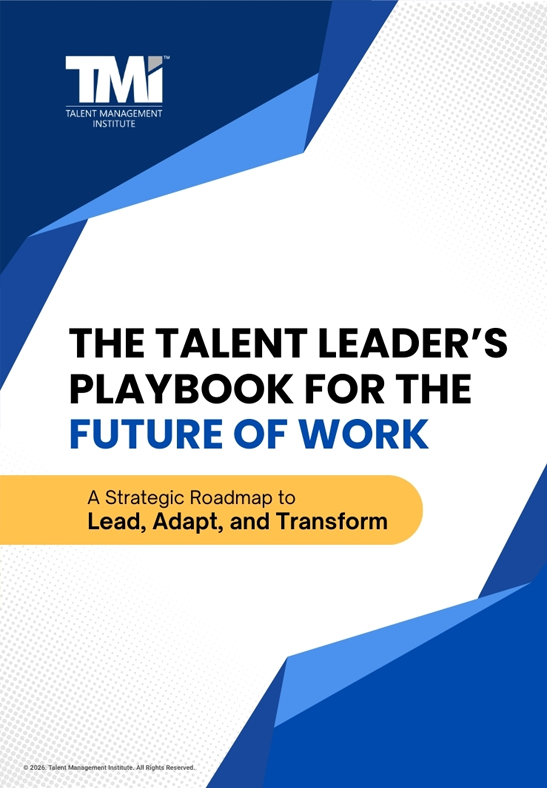

CredBadge™ is a proprietary, secure, digital badging platform that provides for seamless authentication and verification of credentials across digital media worldwide.
CredBadge™ powered credentials ensure that professionals can showcase and verify their qualifications and credentials across all digital platforms, and at any time, across the planet.

Please enter the License Number/Unique Credential Code of the certificant. Results will be displayed if the person holds an active credential from TMI.