We can't wait to hear from you
Connect
Discover how TMI credentials are designed to accelerate your career growth. Explore how TMI incorporates Talent Management into the practice and systems of Human Capital Management. Learn how you can steer your future confidently through TMI's research driven Talent Management standards. Fellow programs equip global HR professionals with the latest in Talent Management in the transformational way.
Explore how the TMP™, STMP™, and GTML™ credentials can take your HR career places, or add to the capabilities of your promising HR staff and leaders.
View CertificationsStrengthen your enterprise HR system by implementing the TMI-ETMS™ international standards.
Learn About TMI-ETMS™If you are interested in consulting, training or education, partner with TMI to join the global league of TMI aligned institutions, companies and industries.
Become a TMI PartnerLearn the latest about how Talent Management is transforming HR into a future oriented business hyperfunction.
Explore the TMI ApproachLearn the steps to earn your TMI certification, from application to successful completion and maintaining your credential.
TMI credentials include globally recognized digital badges, offering a portable and verifiable representation of your achievements.

Kickstart your Talent Management journey with TMI’s globally recognized certifications and resources to excel in your career.
Create myTMI Account TodayTMI Global and Associate Fellow programs turn HR professionals into global Talent Leaders who can drive growth with their superlative strategic ability, business perspective and readiness for change. Since 2024, more than 150 senior HR professionals and HR leaders from 46 global organizations across industries have completed these programs that establish new standards for the practice of talent management as a driver of organizational success and business competitiveness.
You can contact us here for more information.

TMI–ETMS10™ and TMI–ETMS14™ certified organizations are effective for restructuring Talent Management in an organization. With TMI, organizations are better, more agile and better prepared for challenges that are to come.
The TMI-Enterprise Talent Management Standards power enterprise HR with the latest in Talent Management.
To choose a TMI–ETMS™ version most appropriate for your organization!
Write to us via the contact form.

Partnering with TMI means building a powerful structure of Talent Management thought and practice resulting in business profits through standards, certifications and networks.
Get your HR staffers and managers TMI certified on Talent Management by adding TMI into your training regimen. One step toward embedding TMI credentials in your institutions curricula is to become a TMI-ETMS™ consulting partner. Join us to be a part of the groundbreaking work of Talent Management.

If you hold an elite international qualification in HR or a related discipline, possess a recognized HR credential, or studied HRM at a TMI-recognized institution, you may be eligible for an accelerated pathway to a TMI credential through QualiFly™ leading to TMP™, STMP™ or GTML™.
 Institutions
Explore Certification Bodies, Universities, B-Schools & Other Institutions recognized by TMI under the Q1, Q2, and Q3 Lists.
Check if your institution is recognized
TMI’s blogs cover the latest trends, insights, and best practices in HR and talent management.
Comprehensive guides covering talent development, HR metrics, key facts, and more.
Explore TMI's latest updates, announcements, news and press releases in our newsroom.
Strategic insights driving the future of talent, leadership, and global workforce excellence.
Dive into the inspiring journeys of TMI certification holders and learn how the certification has transformed their careers.
An Interview series featuring key advice from global talent leaders for future HR professionals.
TMI’s editorial team is comprised of researchers, writers, editors, proofreaders, and contributors with extensive experience in the HR and Talent Management space. The team scrupulously researches, analyzes and deliberates on each submission before concluding its suitability for our publications.

Human Resources is entering one of its most transformative periods yet. As we move through 2026, HR professionals face unprecedented challenges and opportunities. AI is reshaping decision-making; skills gaps are widening, and the pressure for speed and adaptability has never been greater. The most effective HR leadership will come from those who act as architects of change, building trust and innovation into the very fabric of their organizations.
Based on Gartner insights from 426 CHROs across 23 industries and 4 global regions, the critical HR trends and priorities shaping success in 2026 have been identified.
Before diving into specific trends, let's examine the four top priorities driving HR innovation this year:
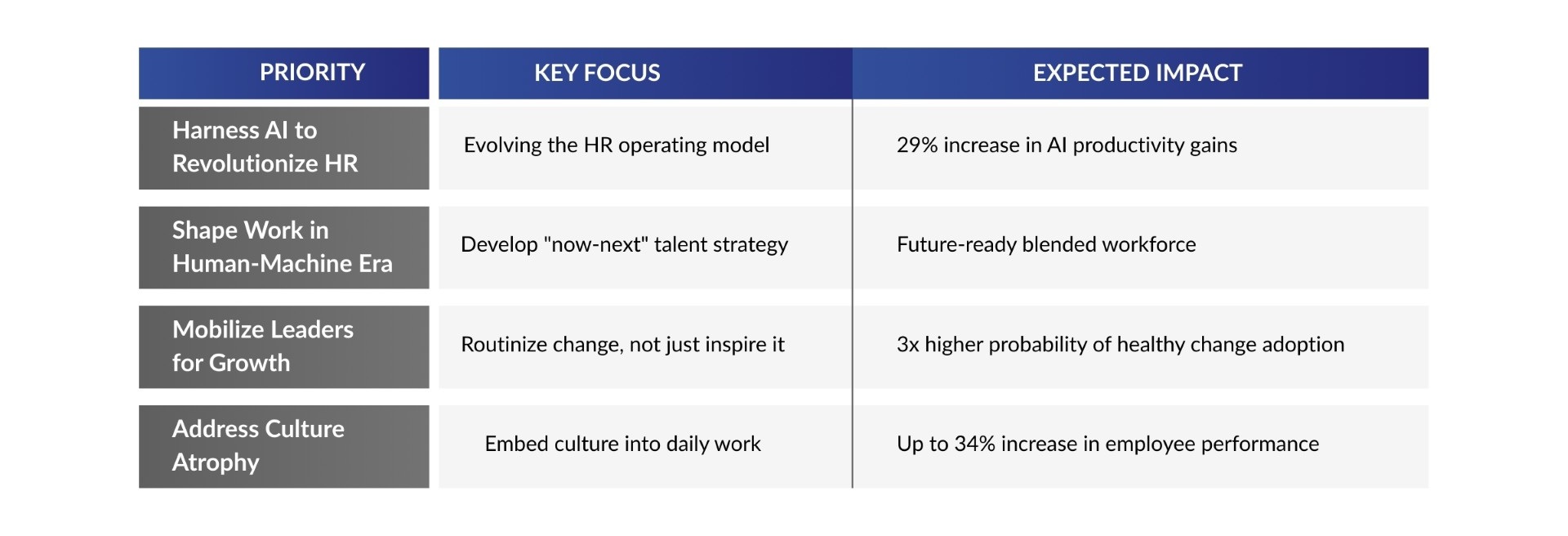
These priorities reflect fundamental shifts in how work is being organized and delivered.
Now let's explore the specific HR trends shaping 2026.
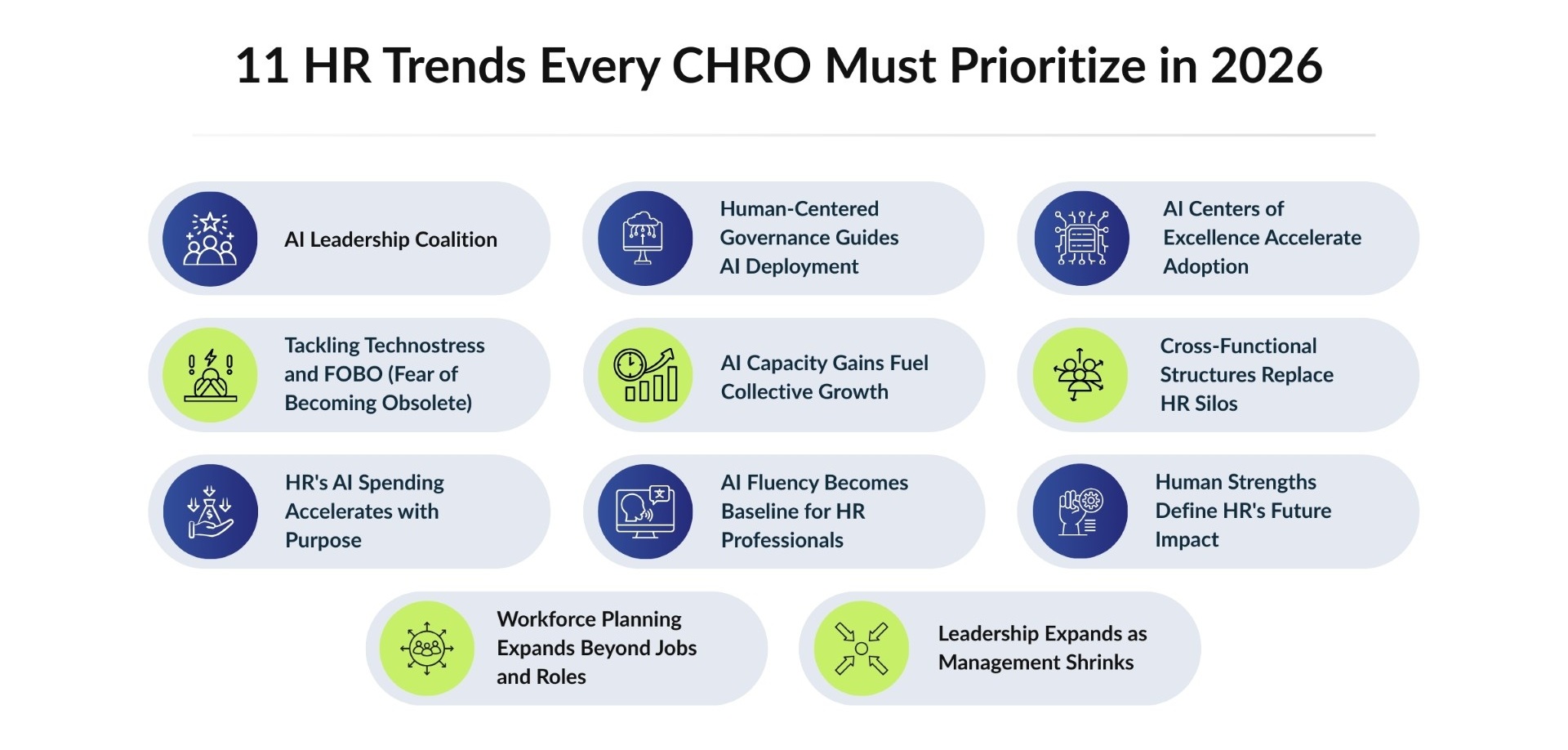
The era of HR "supporting" technology initiatives is over. AI has moved from the IT department straight into the boardroom, and CHROs must be active participants in this transformation.
The Current State:
The Challenge:
However, only 21% are closely involved in AI strategy decisions. This gap shows that many HR functions still lack the influence, mandate, or capabilities to claim a genuine seat at the strategic table.
Why It Matters:
The impact of AI transformation is deeply human. Organizations that bring HR into AI strategy from the outset are more likely to balance speed with sustainability, translating tech-driven change into measurable outcomes without compromising culture.
Action Steps for HR Professionals:
As 78% of organizations deploy AI in at least one function, new risks are emerging not just from the technology itself, but from how people use it.
Employee Concerns Are Real:
According to research, more than half of U.S. workers cite cybersecurity, inaccuracy, or personal privacy as top concerns about generative AI. A third of employees worry about explainability, equity, and fairness.
HR's Distinct Role:
While IT and Legal provide technical and regulatory safeguards, HR professionals must translate those safeguards into everyday practices that employees understand and trust. This includes:
What CHROs Should Prioritize:
Even though 98% of organizations are accelerating AI integration, very few feel ready to scale it effectively. This is where AI Centers of Excellence (CoEs) are making a difference.
The Data Speaks:
Companies ahead in AI adoption are 2.5 times more likely to involve HR in helping employees identify tasks suited for automation, which accelerates adoption and reduces resistance.
What Makes CoEs Effective:
These cross-functional teams bring together technology, talent, and trust. They coordinate efforts across departments, define success metrics, manage risks, and create sustainable governance structures.
HR's Critical Contribution:
Leading organizations increasingly bring HR professionals into these CoEs to:
While AI creates opportunities, it also fuels anxiety. 52% of workers are worried about AI's future impact in the workplace, and one in three believes it will reduce job opportunities for them.
The Reality Check:
The World Economic Forum reports that 41% of employers plan to reduce headcounts in the next five years due to AI. Yet 75% of employees don't feel confident using AI in their day-to-day work.
The Impact on People Strategy:
This combination of fear and lack of confidence creates:
How HR Leadership Can Help:
AI is transforming work by changing what people spend their time on. Research shows AI can free up more than 120 hours per employee per year.
The Strategic Choice:
Leading companies are reinvesting these savings. More than 80% of their AI investments have gone toward redesigning core functions and launching new offerings, not just cutting costs.
A Cautionary Tale:
Not all approaches work. Fintech company Klarna laid off around 700 customer service employees expecting AI agents to fully replace them. However, leadership later acknowledged that relying on AI alone "was not the right fit," and the company ended up rehiring human staff.
The Better Path:
With 39% of current skills expected to be disrupted in five years, CHROs must:
Traditional HR structures are becoming outdated. 89% of HR functions have already been restructured or plan to do so in the next two years.
Why the Shift Matters:
AI platforms like Workday, SAP Joule, and Microsoft Copilot are connecting data and workflows across the entire employee lifecycle, naturally blurring functional boundaries.
The New Model:
Leading organizations are forming agile, cross-functional teams where HR professionals from different specialties work on shared business challenges like:
The Current Gap:
While 42% of marketing teams already use AI, only 13% of HR teams do. This needs to change for HR to remain relevant.
Actions for HR Professionals:
HR tech budgets are rising fast. 55% of companies are increasing their HR technology spend, and by 2030, the AI HR technology market size is expected to triple.
The Adoption Reality:
While 49% of HR teams use AI in recruitment, fewer than 15% apply it to other areas like performance management, development, or onboarding.
The ROI Gap:
Returns vary widely—top performers report an ROI of 55% or more, while others lag with returns as low as 5%.
What CHROs Should Prioritize:
AI literacy is no longer optional. While only 2% of HR job postings currently list AI skills as a requirement, demand is growing at 66% year over year, faster than any other sector.
The Confidence Gap:
Today, only 35% of HR professionals say they feel equipped to use AI technologies.
The Learning Path:
Self-exploration is leading the way: 38% of HR practitioners are building AI skills by experimenting with tools, trialing features, testing prompts, and learning by doing.
Building HR Innovation:
As AI handles more technical work, human capabilities become the differentiator. Nearly three in five employers say soft skills are more important today than five years ago, and demand for social and emotional skills is expected to grow 26% by 2030.
The New Core Competencies:
Why This Matters for CHRO Leadership:
These skills are especially important in moments of uncertainty, where HR is called on to guide leaders, support employees, and hold space for complex conversations about change.
Action Steps:
Traditional job-based workforce planning is giving way to skills-first approaches. Skill-based organizations are 57% more likely to anticipate and respond effectively to change.
Real-World Success:
Three-quarters of Mastercard's workforce is now registered on its internal talent marketplace, helping unlock 100,000 hours of capacity and $21 million in savings through internal mobility alone.
The People Strategy Shift:
Instead of filling roles, CHROs are asking: What capabilities are needed for specific initiatives? How can they be assembled across employees, gig workers, partners, and AI agents?
Implementation for HR Professionals:
Organizations are streamlining structures in what's called "The Great Flattening." The number of managers globally has dropped by over 6% in the past three years.
The Shift in Focus:
While administrative management shrinks, human-centered leadership becomes more essential. Organizations are moving toward informal, distributed, and situational leadership.
The Evidence:
A study comparing formal and informal leaders across 161 variables found that informal leaders consistently scored higher on shared vision, communication, relationships, and character.
What CHROs Should Do:
The HR trends shaping 2026 point to a future where technology amplifies human capability rather than replacing it. Organizations that adapt quickly, invest in the right skills, and embrace responsible innovation will thrive.
The opportunity for HR leadership is clear: contribute to AI strategy, strengthen human capabilities, and redesign workforce planning for a skills-first era. These changes are already underway, and how CHROs respond will shape both business outcomes and the future of work.
Now is the time to act with confidence, bring others along, and build the kind of HR function that creates lasting value for both the organization and its people.

Uncover the trends redefining workforce strategy, the skills shaping next-generation CHROs, and strategies to drive lasting impact. Explore insights and assess your readiness to lead the future of talent.
Download the Guide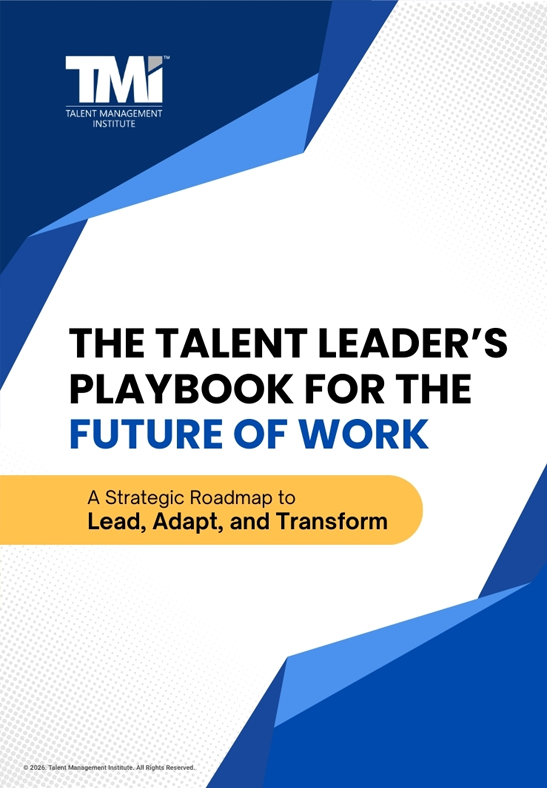

CredBadge™ is a proprietary, secure, digital badging platform that provides for seamless authentication and verification of credentials across digital media worldwide.
CredBadge™ powered credentials ensure that professionals can showcase and verify their qualifications and credentials across all digital platforms, and at any time, across the planet.

Please enter the License Number/Unique Credential Code of the certificant. Results will be displayed if the person holds an active credential from TMI.