We can't wait to hear from you
Connect
Discover how TMI credentials are designed to accelerate your career growth. Explore how TMI incorporates Talent Management into the practice and systems of Human Capital Management. Learn how you can steer your future confidently through TMI's research driven Talent Management standards. Fellow programs equip global HR professionals with the latest in Talent Management in the transformational way.
Explore how the TMP™, STMP™, and GTML™ credentials can take your HR career places, or add to the capabilities of your promising HR staff and leaders.
ExploreRevitalize your enterprise HR system through the TMI-ETMS by implementing the latest in international.
ExploreIf you are interested in consulting, training or education, partner with TMI to join the global league of TMI aligned institutions, companies and industries.
ExploreLearn the latest about how Talent Management is transforming HR into a future oriented business hyperfunction.
Explore
TMP™ is ideal for individuals starting in Talent Management, providing foundational knowledge and skills.
Download Program Brochure
STMP™ is tailored for mid-career HR professionals aiming to accelerate their growth and take on advanced roles.
Download Program Brochure
GTML™ is suited for senior HR professionals ready to lead global talent strategies and drive organizational transformation.
Download Program BrochureLearn the steps to earn your TMI certification, from application to successful completion and maintaining your credential.
TMI credentials include globally recognized digital badges, offering a portable and verifiable representation of your achievements.

Kickstart your Talent Management journey with TMI’s globally recognized certifications and resources to excel in your career.
Create myTMI Account TodayTMI Global and Associate Fellow programs turn HR professionals into global Talent Leaders who can drive growth with their superlative strategic ability, business perspective and readiness for change. In the last three years, more than 150 senior HR professionals and HR leaders from 46 global organizations across industries have completed these programs that establish new standards for the practice of talent management as a driver of organizational success and business competitiveness.
You can contact us here for more information.

TMI–ETMS10™ and TMI–ETMS14™ certified organizations are effective for restructuring Talent Management in an organization. With TMI, organizations are better, more agile and better prepared for challenges that are to come.
The TMI-Enterprise Talent Management Standards power enterprise HR with the latest in Talent Management.
To choose a TMI–ETMS™ version most appropriate for your organization!
Write to us via the contact form.

Partnering with TMI means building a powerful structure of Talent Management thought and practice resulting in business profits through standards, certifications and networks.
Get your HR staffers and managers TMI certified on Talent Management by adding TMI into your training regimen. One step toward embedding TMI credentials in your institutions curricula is to become a TMI-ETMS™ consulting partner. Join us to be a part of the groundbreaking work of Talent Management.

If you hold an elite international qualification in HR or a related discipline, possess a recognized HR credential, or studied HRM at a TMI-recognized institution, you may be eligible for an accelerated pathway to a TMI credential through QualiFly™ leading to TMP™, STMP™ or GTML™.
 Institutions
Explore Certification Bodies, Universities, B-Schools & Other Institutions recognized by TMI under the Q1, Q2, and Q3 Lists.
Check if your institution is recognized
TMI’s blogs cover the latest trends, insights, and best practices in HR and talent management.
Comprehensive guides covering talent development, HR metrics, key facts, and more.
Explore TMI's latest updates, announcements, news and press releases in our newsroom.
Strategic insights driving the future of talent, leadership, and global workforce excellence.
Dive into the inspiring journeys of TMI certification holders and learn how the certification has transformed their careers.
An Interview series featuring key advice from global talent leaders for future HR professionals.
TMI’s editorial team is comprised of researchers, writers, editors, proofreaders, and contributors with extensive experience in the HR and Talent Management space. The team scrupulously researches, analyzes and deliberates on each submission before concluding its suitability for our publications.

Strategic reskilling is becoming central to how organizations adapt and grow. Changes in technology, business models, and labor markets are occurring faster than traditional hiring or organizational restructuring can keep up with, making continuous workforce development a practical necessity.
In the most-cited global employer survey series, World Economic Forum reports that employers estimate 44% of workers’ skills will be disrupted within five years, and that six in ten workers will require training before 2027. Despite this, only half are seen to have access to adequate training today.
The trend is not “just” about automation eliminating work; it is about structural churn and task reallocation. The same survey summarizes a projected 23% “structural labor-market churn” (a combined measure of job creation and destruction effects), alongside widespread planned adoption of digital platforms, education and workforce technologies, AI, cloud, and data, all of which reshape skill requirements even when headcount stays stable.
In the United States, labor-market projections reinforce why “reskill to redeploy” is becoming strategically unavoidable. U.S. Bureau of Labor Statistics projects 5.2 million net new jobs from 2024–2034, while also describing demand pressure from healthcare growth and AI-adjacent professional services. At the same time, BLS projects about 19 million openings per year on average over 2024–2034 dominated by replacement needs (retirements, occupational transfers), which makes internal mobility and accelerated time-to-proficiency a central business lever, not a retention tactic.
Now, there is also an “execution gap” on skills strategy that organizational leaders are noticing. In a survey by Gartner, 41% of HR leaders agreed their workforce lacks required skills, highlighting a structural data problem: only 8% of organizations have reliable skills data. Separately, Deloitte reports that while 73% of respondents say it is important to keep human capabilities in step with technological innovation, only 9% say they are making progress toward that balance—an especially acute issue in the age of generative AI.
Most importantly, “reskilling at scale” is constrained by how most adult learning actually happens. The Organisation for Economic Co-operation and Development (OECD) finds that adult learning participation patterns skew toward short, compliance-oriented training: across OECD countries, 8% of adults participate in formal learning while 37% participate in non-formal job-related learning on average, and 42% of non-formal job-related learning activities last one day or less. That mix is not well-suited to deep role transitions unless organizations design modular pathways that compound into real proficiency.
The indicators above combine survey-based signals from employer and HR-leader research (WEF, Gartner, Deloitte) to illustrate a common pattern: disruption is large, but organizational visibility and readiness are often smaller.
Large-scale reskilling succeeds when it is treated as a business operating system, i.e., a repeatable way to sense skill demand, build capability, and reallocate talent, rather than a catalog of courses. A practical, synthesis framework (grounded in the “skills-based organization” body of work, reskilling program research, and employer survey findings) looks like this: strategy first, then work redesign, followed by skills intelligence, lastly learning-by-doing pathways, all governed and measured as enterprise change.
This model highlights several “non-negotiables” that repeatedly show up in rigorous research and field evidence:
Technology is a force-multiplier for reskilling, but it does not substitute for strategy, governance, or culture. The biggest value comes when technology is used to create a closed loop: infer and validate skills → personalize pathways → link learning to real work opportunities → measure outcomes.
A useful way to describe the tech stack for reskilling is by the problems it solves:
The case evidence below is intentionally cross-industry and multi-level (enterprise and national), because “transform at scale” is rarely about one sector’s constraints. The common lesson across cases is that scalable reskilling is an integrated system of skills intelligence + learning pathways + mobility mechanisms + incentives + measurement, typically supported by digital platforms.
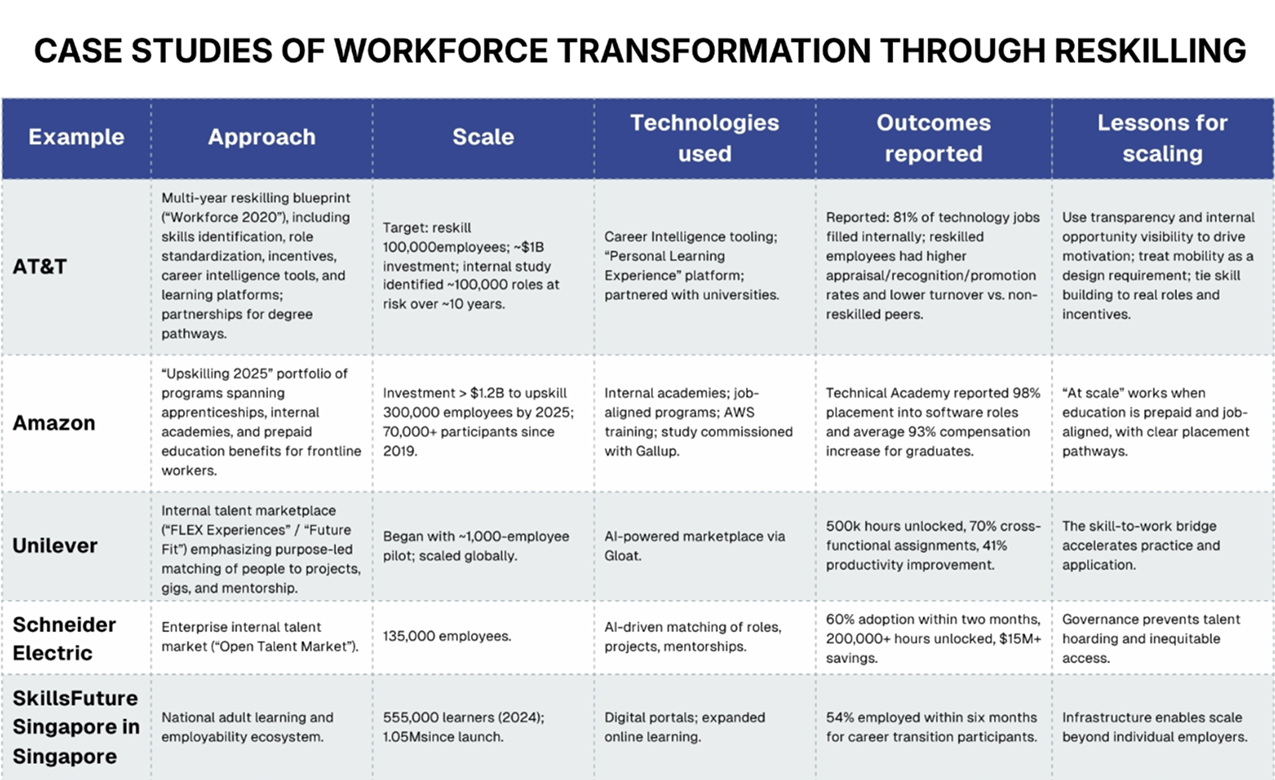
A key interpretive takeaway from these cases is that “scale” is achieved by combining three reinforcing systems: (1) visibility, (2) conversion, and (3) allocation.
Even organizations that invest heavily often struggle to convert training into enterprise transformation because they underestimate barriers that are cultural, measurement-related, and operational.
A practical implication is that reskilling should be treated as a behavior-change and resource-reallocation program, not a content rollout.
Measuring reskilling impact shapes what leaders will scale.
Levels-based evaluation remains common, but best practice starts with business results and designs backward.
In practical terms, the future of reskilling at scale will look less like “training programs” and more like a continuously updated talent-and-work allocation system, powered by credible skills data, AI-enabled matching, structured practice, and ROI-grade measurement designed into the operating model from the start.
If you are ready to move beyond episodic training and build a reskilling system that delivers measurable workforce impact, please express your interest in TMI credentialing to identify the most relevant, standards-aligned certification pathway for your HR team.

Uncover the trends redefining workforce strategy, the skills shaping next-generation CHROs, and strategies to drive lasting impact. Explore insights and assess your readiness to lead the future of talent.
Download the Guide

CredBadge™ is a proprietary, secure, digital badging platform that provides for seamless authentication and verification of credentials across digital media worldwide.
CredBadge™ powered credentials ensure that professionals can showcase and verify their qualifications and credentials across all digital platforms, and at any time, across the planet.

Please enter the License Number/Unique Credential Code of the certificant. Results will be displayed if the person holds an active credential from TMI.