We can't wait to hear from you
Connect
Discover how TMI credentials are designed to accelerate your career growth. Explore how TMI incorporates Talent Management into the practice and systems of Human Capital Management. Learn how you can steer your future confidently through TMI's research driven Talent Management standards. Fellow programs equip global HR professionals with the latest in Talent Management in the transformational way.
Explore how the TMP™, STMP™, and GTML™ credentials can take your HR career places, or add to the capabilities of your promising HR staff and leaders.
View CertificationsStrengthen your enterprise HR system by implementing the TMI-ETMS™ international standards.
Learn About TMI-ETMS™If you are interested in consulting, training or education, partner with TMI to join the global league of TMI aligned institutions, companies and industries.
Become a TMI PartnerLearn the latest about how Talent Management is transforming HR into a future oriented business hyperfunction.
Explore the TMI ApproachLearn the steps to earn your TMI certification, from application to successful completion and maintaining your credential.
TMI credentials include globally recognized digital badges, offering a portable and verifiable representation of your achievements.

Kickstart your Talent Management journey with TMI’s globally recognized certifications and resources to excel in your career.
Create myTMI Account TodayTMI Global and Associate Fellow programs turn HR professionals into global Talent Leaders who can drive growth with their superlative strategic ability, business perspective and readiness for change. Since 2024, more than 150 senior HR professionals and HR leaders from 46 global organizations across industries have completed these programs that establish new standards for the practice of talent management as a driver of organizational success and business competitiveness.
You can contact us here for more information.

TMI–ETMS10™ and TMI–ETMS14™ certified organizations are effective for restructuring Talent Management in an organization. With TMI, organizations are better, more agile and better prepared for challenges that are to come.
The TMI-Enterprise Talent Management Standards power enterprise HR with the latest in Talent Management.
To choose a TMI–ETMS™ version most appropriate for your organization!
Write to us via the contact form.

Partnering with TMI means building a powerful structure of Talent Management thought and practice resulting in business profits through standards, certifications and networks.
Get your HR staffers and managers TMI certified on Talent Management by adding TMI into your training regimen. One step toward embedding TMI credentials in your institutions curricula is to become a TMI-ETMS™ consulting partner. Join us to be a part of the groundbreaking work of Talent Management.

If you hold an elite international qualification in HR or a related discipline, possess a recognized HR credential, or studied HRM at a TMI-recognized institution, you may be eligible for an accelerated pathway to a TMI credential through QualiFly™ leading to TMP™, STMP™ or GTML™.
 Institutions
Explore Certification Bodies, Universities, B-Schools & Other Institutions recognized by TMI under the Q1, Q2, and Q3 Lists.
Check if your institution is recognized
TMI’s blogs cover the latest trends, insights, and best practices in HR and talent management.
Comprehensive guides covering talent development, HR metrics, key facts, and more.
Explore TMI's latest updates, announcements, news and press releases in our newsroom.
Strategic insights driving the future of talent, leadership, and global workforce excellence.
Dive into the inspiring journeys of TMI certification holders and learn how the certification has transformed their careers.
An Interview series featuring key advice from global talent leaders for future HR professionals.
TMI’s editorial team is comprised of researchers, writers, editors, proofreaders, and contributors with extensive experience in the HR and Talent Management space. The team scrupulously researches, analyzes and deliberates on each submission before concluding its suitability for our publications.

Talent has become the factor that decides which organizations win. As automation absorbs routine work and business models are rebuilt around new technology, the ability to attract, develop, and keep capable people now separates the companies that grow from the ones that stall. That change has moved human resources (HR) from a support function to the center of business strategy. As expectations rise, many HR professionals are turning to structured certifications to develop and validate the leadership capabilities these roles require.
The shift raises what is expected of you as an HR professional. Leading talent strategy calls for a different capability than administering HR processes, and the difference is becoming the line between the practitioners who advance and those who plateau.
A joint study by Cognizant and Pearson found that six in ten HR leaders admit their learning programs cannot keep pace with the speed of change, which leaves a real gap between the skills the moment demands and the ones typical development builds.
A talent management certification is one clear way to close that gap.
This article explains what talent management involves and why it matters now, then covers the value of certification, the skills it develops, how it supports your career, and prepares you for the workforce ahead.
This is where talent management separates from general HR. A broad HR function covers the operational core of the workplace, including compliance and compensation alongside employee relations, and that work keeps the organization running. Talent management concentrates on the strategic layer above it, where workforce planning and leadership development connect directly to business results.
The distinction matters for your career because the two draw on different capabilities. Administering HR processes rewards accuracy and consistency. Leading talent strategy rewards judgment about where the business is headed and what people it will need to get there. Professionals who develop that judgment are the ones organizations look for leadership.
| General HR | Talent Management |
|---|---|
| Focuses on HR operations | Focuses on workforce strategy |
| Supports day-to-day business needs | Builds long-term organizational capability |
| Includes compliance, payroll, and employee relations | Includes workforce planning, succession planning, leadership development, and employee growth |
Talent management has become central because the workforce is under pressure from several directions at once. Automation is reshaping which skills hold value, and role definitions are shifting as the supply of experienced talent tightens. The Cognizant and Pearson research found that 94% of HR leaders anticipate AI will create entirely new entry-level roles within five years, and someone inside each organization has to design those roles.
That work sits squarely inside talent management, and its payoff is measurable. A McKinsey Global Survey of 1,820 executives found that 99% of respondents with very effective talent management reported outperforming their competitors, against 56% of everyone else.
The same shift increases the value of HR professionals who can lead this work. When talent decisions shape whether a business can execute its strategy, whoever leads them gains influence over its direction. That is the opportunity in front of you, and meeting it depends on developing expertise that a senior role will recognize.
A talent management certification validates your higher-level skill against an independent standard, and that validation is what sets advancing professionals apart. It earns its place for three reasons:
That portability is what makes the credential compound. It stays an asset across your whole career, useful well beyond the role you held when you earned it.
A rigorous certification develops the competencies that separate strategic HR work from administrative work, the ones employers weigh most when they fill senior roles:
These capabilities are most valuable because they work together. Effective workforce planning relies on data to identify future talent needs, succession planning depends on strong leadership development practices, and organizational change requires leaders who can align people initiatives with business priorities. Developing these competencies as part of a structured certification reflects how talent management functions in practice rather than as a collection of isolated skills.
You can explore the wider set in this overview of the key skills every HR professional needs.
Certification compounds across a career. Earning it opens a role, and that role builds the experience that qualifies you for a broader mandate and the next tier of credential to match it. Each step sets up the one after it.
A tiered credential path matches that progression, because HR careers move through distinct stages and each stage calls for different proof. Knowing which level fits you now depends on understanding who each one serves:
Reading the requirements of the next level up tells you what a senior role will expect before you reach it, which turns your development into work against a concrete target. The progression also shortens the time others need to trust your judgment. A verified credential gives a promotion committee immediate evidence of your readiness, which is often what moves a strong candidate ahead of an equally experienced one without it. You can see how this fits a longer arc in this guide to HR career paths and advancement.
Preparing for what comes next starts with an honest read of where you stand today. The workforce is being reshaped by automation and shifting role definitions, and the HR professionals who thrive will be the ones who built strategic depth before the pressure arrived.
Step 1: Assess your current position. Identify where you sit on the path from practitioner to leader, and be specific about the strategic skills you have yet to develop.
Step 2: Close the strategic gap. Pursue structured development that builds the higher-level competencies your current role does not exercise. Waiting for day-to-day experience to supply them leaves the timing to chance.
Step 3: Validate against a standard. Earn a credential that measures your capability independently, so an employer can see your readiness confirmed by a third party.
Step 4: Keep it current. Maintain ongoing development, as the practices that define strong talent management continue to evolve.
The urgency here is grounded in what HR leaders themselves expect. The Cognizant and Pearson study found that 94% anticipate AI will create entirely new entry-level roles within five years, and someone inside each organization has to design those roles and the paths that support them. That work belongs to HR professionals equipped to do it.
A talent management certification answers the gap this article opened with. Where scattered training leaves your strategic capability unproven, an independent credential confirms it and gives your career a defined structure to advance through.
HR leaders emerging in the next decade will be the ones who invested early in strategic capability and had it independently confirmed. Assess where you stand, choose the credential that matches your stage, and build the record that moves you from managing HR tasks to leading talent strategy.
Q. What is a talent management certification?
A. It is a professional credential that measures your ability to attract, develop, and retain talent against an independent standard. It gives an employer verified proof of strategic capability that a self-reported resume cannot provide.
Q. Which HR professionals should pursue talent management certification?
A. Anyone moving from operational HR toward strategy benefits, from early-career professionals building a foundation to senior leaders setting talent direction across an organization. The right level depends on your experience, since the credentials are tiered to match each career stage.
Q. How is talent management certification different from HR certification?
A. A general HR certification confirms your command of day-to-day operations such as payroll and benefits alongside labor compliance. A talent management certification validates the higher-level work of shaping strategy and planning the workforce, then developing the people who will lead it.

Uncover the trends redefining workforce strategy, the skills shaping next-generation CHROs, and strategies to drive lasting impact. Explore insights and assess your readiness to lead the future of talent.
Download the Guide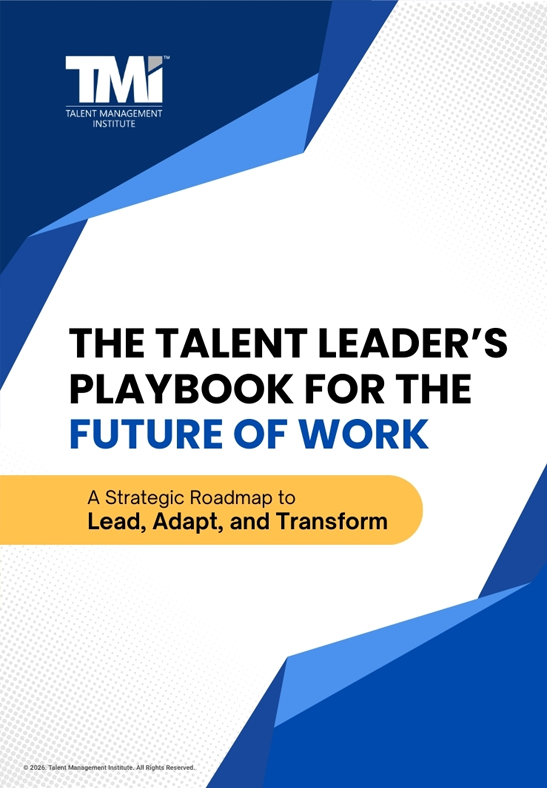

CredBadge™ is a proprietary, secure, digital badging platform that provides for seamless authentication and verification of credentials across digital media worldwide.
CredBadge™ powered credentials ensure that professionals can showcase and verify their qualifications and credentials across all digital platforms, and at any time, across the planet.

Please enter the License Number/Unique Credential Code of the certificant. Results will be displayed if the person holds an active credential from TMI.